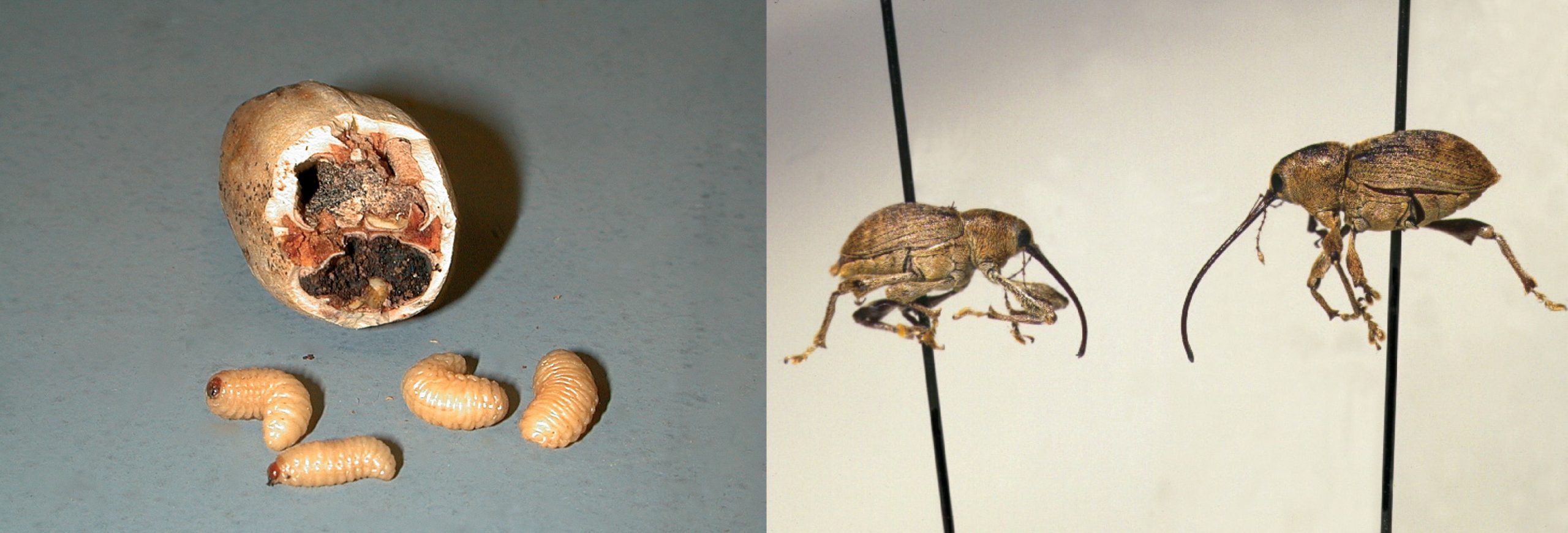
The pecan weevil is a native species that feeds on trees in the Carya genus, including pecan, hickory, and walnut in the genus Juglans. Adult pecan weevils typically emerge from the soil between August and November, with peak populations observed between August and September. This emergence is usually timed with the initiation of kernel development. However, emergence can be influenced by rainfall and soil moisture, with studies showing that drought conditions in clay soil can delay peak emergence until late September or October. Upon emergence, adult weevils can damage pecan nuts via direct feeding and oviposition (egg-laying). This can cause small track and puncture marks on the shell and shuck. Roughly 5 days after emergence, female pecan weevils will deposit 2-4 eggs onto a kernel. Upon hatching, the larvae will feed on the kernel for 4-5 weeks, eventually destroying the market value of the nut. Mature larvae chew a small exit hole and drop to the ground, and then burrow anywhere from 3-12 inches into the soil and build an earthen cell. 90% of the pecan weevils entering the soil will spend 2 years underground prior to emergence, while the remaining 10% will spend an additional year (3 years total) underground.
Pecan weevils are found throughout the native range of pecans, including most of Texas and Oklahoma. They have been introduced and have been established throughout most of the eastern states where pecans are grown commercially, including Georgia. Pecan weevils are absent from most of the Western pecan growing states, including Arizona, California, and most of New Mexico and far West Texas. Small, localized populations have been identified in a few counties in New Mexico and West Texas. Naturally, pecan weevils rarely move far from where they were born. While able fliers, adult populations appear to stay put at their origin site so long as there are nuts available to infest. As a result, pecan weevils often exist in pockets or ‘hot spots’ within an area/orchard while being sparse or absent elsewhere.
So how is it that pecan weevils can reach new areas outside their native range? The answer is straightforward; humans are the primary cause of pecan weevil movement throughout the pecan belt. In fact, human movement of pecan weevil is such an issue that several states have quarantines that restrict the movement of pecan weevil host parts (including pecan, hickory, and walnut) from quarantined areas to non-quarantined areas, unless those parts have undergone treatment based on the state quarantine guidelines.
Regardless, pecan weevil still occasionally gets into areas where it is not currently established. This can happen due to multiple factors, such as movement of product without following quarantine protocols and moving uncleaned equipment and vehicles that have been used in weevil infested orchards to non-infested areas. Even something as simple as a person picking up a single infested nut and carelessly moving it to another area can move weevils. Therefore, it is always important to learn to recognize the evidence of potential weevil presence in your area. Spotting an infestation early is critical to establishing a monitoring, containment, and eradication program as soon as possible. Past eradication programs in New Mexico have usually been effective due to several aspects of the weevil’s biology: 1) they spread slowly throughout an infested area, 2) their long life cycle of 2-3 years and low number of offspring means their populations increase slowly, 3) their reproductive period is short (~8 weeks) making it easy to plan and time treatments. Thus, targeting populations before they establish and grow is the best way to implement a successful eradication program.
Identifying Evidence of Weevil Presence in Your Area
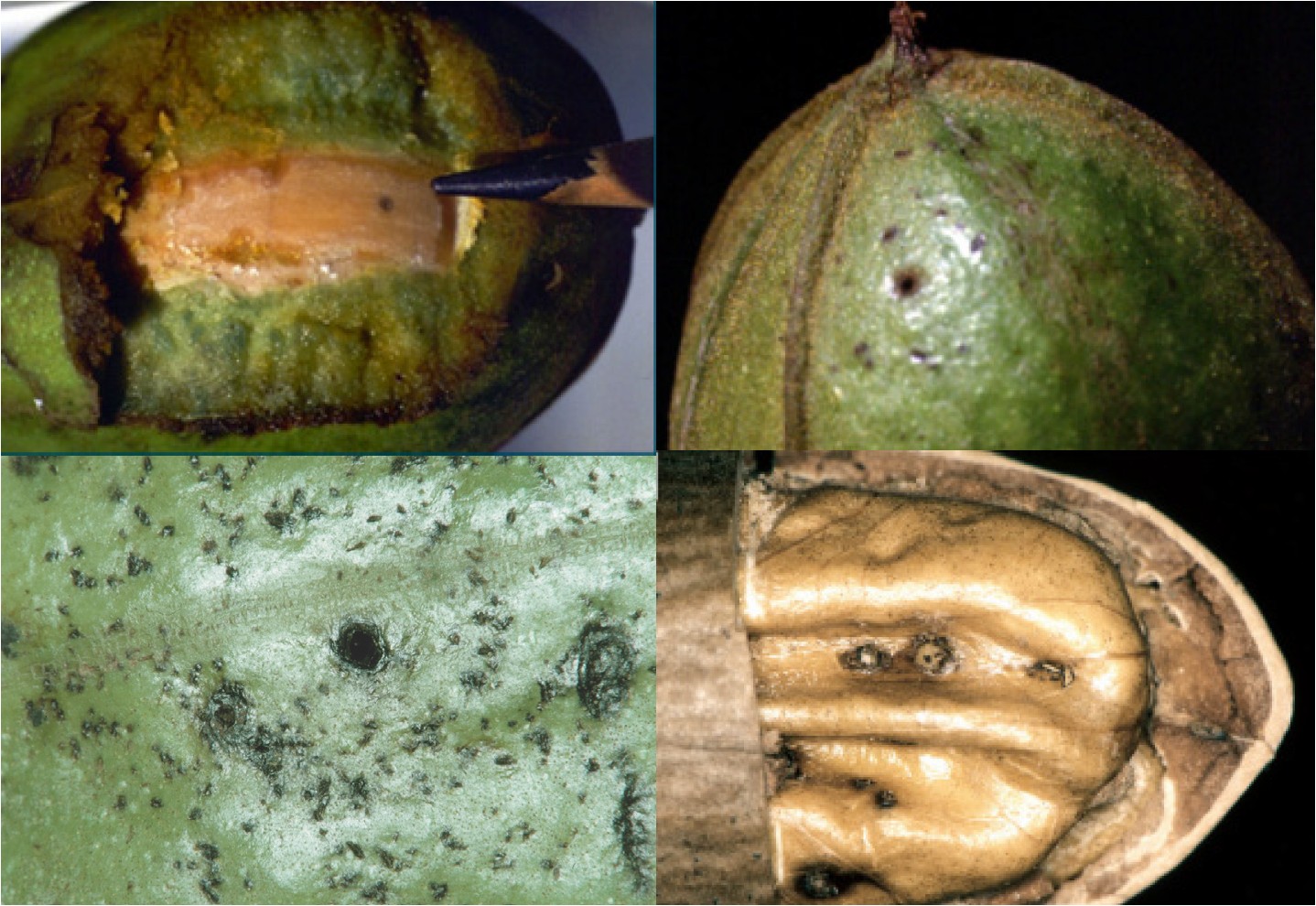
The best way to survey for pecan weevil infestations is through inspection of nuts as they go through cleaning plants. Inspections should begin as soon as the cleaning plant begins the cleaning process. Inspectors should perform inspections 1-2 times per week as long as cleaning and processing is ongoing. For growers who are running a cleaning plant, this should be a continuous process while they are harvesting, as they or their staff are present all the time. It is important to educate all cleaning plant staff on inspection protocols and signs of infestation, since more eyes mean a higher likelihood of spotting an infested nut. Focus should be placed on number 2 and lower quality nuts along with discarded shucks, shells, and “pops”, though number 1’s should also be inspected if time and labor allow. Inspecting nuts and debris as they are running through the plant is the easiest way to accomplish this task, as nuts can be easily examined as they run along the belt. In addition, any trash that is produced and discarded during the cleaning process should be inspected. This is especially critical if the cleaning plant is running daily, as this will allow inspectors to examine material that was missed since the last inspection day. When performing inspections of the above material, the inspectors and cleaning plant personnel should look for signs of pecan weevil presence, including larvae, circular exit holes in the nuts, and track marks and punctures on shucks and nuts. In addition, nuts examined from trash piles can also be cracked to look for weevil larvae that have not yet emerged.
Puncture and tracking damage caused by adult female pecan weevil chewing and ovipositor scaring on the pecan shuck, shell, and kernel. (Photo credit: Allen Knutson (top row), Jerry A. Payne, USDA Agricultural Research Service, Bugwood.org (bottom row))
Identification is a very important skill to successfully differentiate pecan weevil larvae and damage from other issues. Mature pecan weevil larvae are creamy white to yellow in color, legless, and 3/5” long with a reddish-brown head capsule. The body is short and bulky. As a result, they are easily distinguishable from moth caterpillars such as pecan nut casebearer, hickory shuckworm, and navel orangeworm that may occasionally be found in pecan shucks and damaged pecan shells. Moth caterpillars are often more elongated and thinner than pecan weevil larvae and possess a set of pronounced legs near the front of the body. In addition, the presence of a hole in the pecan shell does not always guarantee the presence of a pecan weevil, as many other pests may cause damage to the shell. Pecan weevil larvae make a characteristic circular hole with beveled edges that corresponds with a larva pushing its head capsule through the hole as it exits the nut. Damage caused by other animals, such as birds and rodents, can be commonly observed in cleaning plants as well, but this damage is usually more irregular or larger than a circular weevil hole.

Photo Credit: Bill Ree (All)
Cleaning plant personnel should always keep good records of the origin of all pecans and harvesting equipment that moves through the cleaning plant area. For farms with multiple orchard blocks, plant personnel should keep a record of which blocks individual groups of pecans are transported from. In the event that evidence of pecan weevil is identified, it is much easier for farm, extension, and Department of Agriculture personnel to develop a monitoring and management program for an individual block, as opposed to trying to monitor and manage the entire farm.
Mitigation of Spread and Eradication
In non-quarantined areas, if evidence of weevil is found, the owner/farm manager or other responsible personnel should contact their county agent as soon as possible. The county agent and farm manager should work with their state pecan extension specialist and their Department of Agriculture to develop a plan to monitor, manage, and potentially eradicate weevil from the orchard. These steps should be followed regardless of whether a weevil is physically found or if there is only potential evidence of pecan weevil (e.g., holes in nuts).
Monitoring should consist of both field and cleaning plant monitoring. Cleaning plant inspections should always be the primary means of monitoring for pecan weevil. The procedure for inspecting for pecan weevils after weevils are found is the same as mentioned above. This should be done at the cleaning plant that is cleaning nuts from the infested orchard, as well as all nearby cleaning plants, in order to identify potential new hotspots.
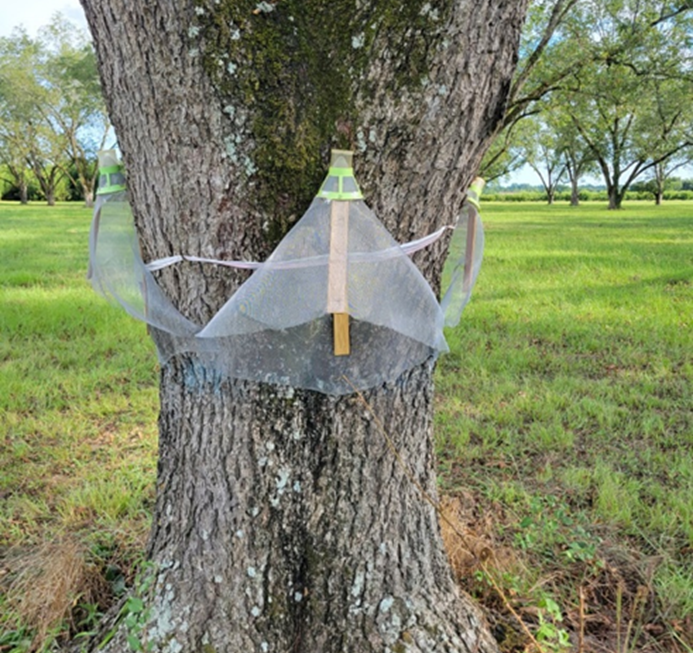
Field traps should be deployed no later than the last week of July. Several traps are available for pecan weevil monitoring, including wire cone traps, pyramid traps, and circle traps. Circle traps are often preferred as they are attached directly to the trees, where they don’t interfere with standard orchard operations such as mowing, livestock grazing, or flood irrigation. Circle traps can be built from scratch (visit
https://extension.okstate.edu/fact-sheets/monitoring-adult-weevil-populations-in-pecan-and-fruit-trees-in-oklahoma.html for detailed information on how to construct circle traps) or purchased online. There is no current standard on how many circle traps to deploy in an orchard. Due to the lack of a pheromone or any other attractant, circle traps are passive traps that will only catch weevils that climb up the tree that the trap is attached to. Therefore, they are not a reliable means of determining the presence of pecan weevil within an orchard. Rather, they are better suited for determining the timing of insecticide applications within an orchard where a population is known to occur by deploying them on trees with a history of weevil infestation. However, if evidence of weevil is found in a cleaning plant and the block the nut came from is known, it can be beneficial to deploy as many traps as cost, labor, and time permit in order to identify where potential hotspots may be.

Circle traps are an effective method for monitoring for pecan weevil. This trap was developed by Edmond Circle (a Kansas pecan grower) as way to trap for pecan weevil while not obstructing the orchard floor for grazing and mowing (an issue for wire cone and pyramid traps). The trap acts as a funnel, capturing pecan weevils as they leave the soil and climb up the tree into a trap cup on the top of the trap. (Photo Credit: Kyle Slusher.)
Traps should be checked every other day for weevils, and they should be cleaned of other trapped insects and spiders at this time. Ants can especially be problematic as they can quickly kill and remove pecan weevils from the traps between checks, leading to skewed counts or missed weevils. In addition to trap checks, inspecting pecans that have fallen to the orchard floor prior to harvest can also be an additional way to monitor for weevil presence. This can also help inform where to deploy circle traps the following season. Traps should be checked throughout the pecan weevil season (August – November).
All monitoring programs that detect weevil should be complimented by an aggressive insecticide application program. Current pecan weevil management programs focus on targeting the emerging adult weevils with foliar applications of insecticide every 10-14 days. Pyrethroids such as Bifenthrin and Zeta-Cypermethrin, and Carbamates such as Carbaryl have been shown to have good efficacy against pecan weevil adults. Insecticides should be applied starting around the gel stage unless there is excessive nut drop pre-shell hardening. Currently, there are no soil-based insecticide treatments that can kill the larvae or adults that are below ground. Entomopathogenic (beneficial) nematodes have shown to be effective against the below ground stages but have not been widely adopted for use.
In addition to monitoring and management of weevil, all equipment and vehicles should be cleaned and inspected prior to movement from an infested or potentially infested area to a non-infested area. If an infestation is localized to one area of the orchard, avoid driving trucks, cars, ATVs, and other vehicles that are used for transport around the farm through the infested orchard, where they can potentially pick up and move weevils/infested nuts to non-infested areas of the orchard. During harvest, harvest any infested blocks last and make sure to clean equipment after harvesting each block to prevent spread to new areas.
Any trash or debris generated during maintenance of the infested orchard, including pruned branches and trash, should not be moved out of the orchard and should be burned within a day or two of collection. Do not bury any debris or trash in non-infested areas, as this is not only ineffective in killing weevil, but may allow new populations to establish. In addition, avoid using any trash or debris collected as mulch for non-infested areas.
At the county level, the farm manager or owner should work with extension personnel to inform other growers in the area of the situation and what is being done to mitigate it. This should also include informing nearby growers of weevil movement so that they can potentially implement their own monitoring programs. Extension agents and specialists should work together to develop programs that educate growers and farm/cleaning plant employees on how to monitor for and identify evidence of pecan weevil both in the field and in the cleaning plants. Each state’s Department of Agriculture should work closely with growers and extension personnel to enforce state guidelines for moving in-shell product from quarantine to non-quarantined areas of the country.
Finally, it is important to remember that pecan weevil monitoring, management, and eradication programs take time and are difficult to successfully implement and validate. Past eradication programs have taken on average anywhere from 7-10 years if everything is completed on time and correctly implemented. This is due to several factors, including the long lifecycle of pecan weevil (2-3 years), environmental factors affecting the timing of treatments, and the fact that missed treatments reset the timeline. This helps confirm that when weevils are not captured during a particular field season, it is because they are not present in the orchard, rather than it being an off-year for weevil emergence. Therefore, these programs take time, patience, coordination, and communication to be successful. Keeping all involved parties on the same page and following a strong, well-researched protocol is critical for keeping pecan weevil out of areas where they have historically not been present.
State of Pecan Weevil Eradication in Texas
Currently, the only active eradication program in Texas is being done in West Texas. This program began in 2024 after evidence of potential pecan weevil presence was found while cleaning the 2023 harvest of one farm. Since that discovery, Texas A&M AgriLife Extension, Texas Department of Agriculture (TDA), New Mexico Department of Agriculture (NMDA), and the local Program Area Committee (PAC) and Pecan Weevil Task Force have worked to implement an eradication program based on the successful eradication programs implemented in New Mexico. The eradication program includes a combination of circle trapping, aggressive insecticide applications, and cleaning plant inspections. In 2025, a small, localized population of pecan weevils was captured at the orchard identified in 2024. The orchard owner implemented a management program in 2025 and will continue to do so as long as Texas A&M AgriLife personnel continue to capture weevils in the orchard. The trapping program will expand in 2026 to cover more acres in order to detect pecan weevils that might have spread into the surrounding area.
Acknowledgements
I would like to acknowledge the following who reviewed this article: Pat Porter (Texas A&M AgriLife Extension Service), Blair Krebs (Texas Pecan Growers Association), Tiffany Johnson (New Mexico Department of Agriculture), Ryan Hiles (New Mexico Department of Agriculture), & Kevin Ivey (El Paso County Pecan Grower).
Literature Cited and Further Reading
Mulder Jr, P. G., Harris, M. K., & Grantham, R. A. (2012). Biology and management of the pecan weevil (Coleoptera: Curculionidae). Journal of Integrated Pest Management, 3(1), A1-A9.