
Impact of the Pecan Leafroll Mite
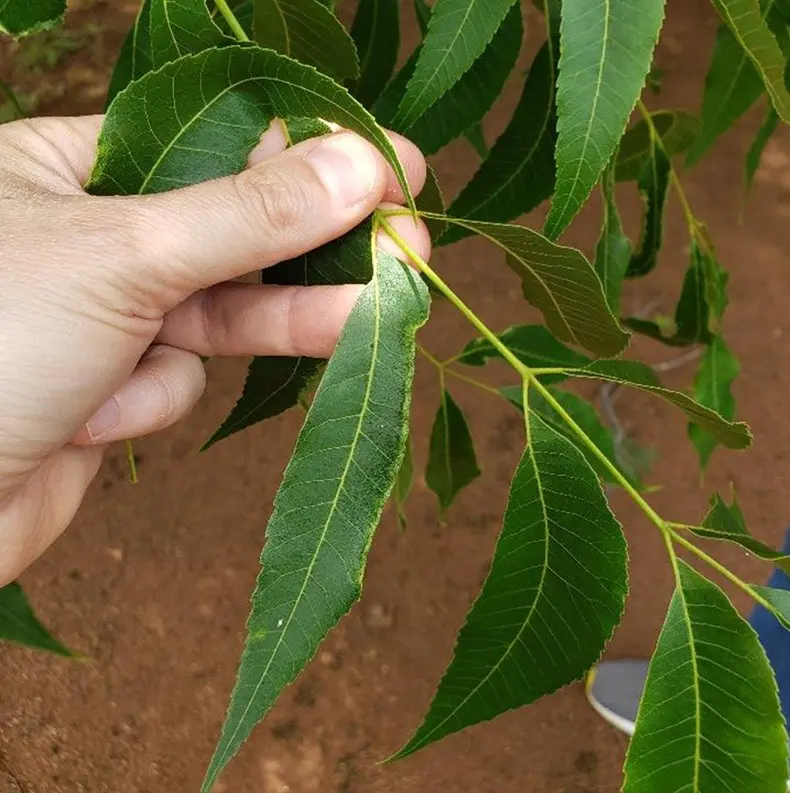
Infested leaflet distorted by the pecan leafroll mite (Image provided by Ted Cottrell)
To feed on pecan foliage, the pecan leafroll mite uses short, piercing mouthparts, which limit its feeding to leaf epidermal cells, but not just anywhere on the leaf. The adult pecan leafroll mite feeds on the lateral edge of the upper surface of young, expanding pecan leaflets during early spring. Like pecan phylloxera, the pecan leafroll mite can only damage new, expanding leaves. Feeding along the upper leaf edge causes the cells on the edge of the upper surface to grow at a slower rate than those cells at the edge of the lower leaf surface. This results in a long, gall-like deformation along the leaf edge, causing the leaf edge to curl up in a tight roll. It is for this feeding symptom that this mite derives its common name, the pecan leafroll mite. Although this gall-like distortion along the leaf edge occasionally turns brown, defoliation does not occur. Different species of leafroll mites occur on many different plants, and for most host plant species with leafroll mite injury, the damage is generally cosmetic and not a significant problem. In fact, pruning infested branches or removing damaged leaves on infested ornamental plants can be used toward leafroll mite control. Given the size of pecan trees and the acreage involved, this method of control is not economical for pecan trees.
These mites are somewhat protected within the leafroll, but during migration between plant tissues, the leafroll mites are more exposed and vulnerable to natural enemies such as predaceous mite species, the spider mite destroyer lady beetle, Stethorus punctum, and the larvae of a predaceous midge. Additionally, plants do have built-in defense mechanisms such as dense hairs (i.e., setae) on leaves or buds that make it difficult for the mite to reach and feed on the leaf epidermal cells, thicker plant cell walls that the short mouthparts of the mite cannot reach through, and defensive plant compounds (e.g., tannins and juglone) that act against mites feeding on the host plant.
To determine how pecan leafroll mites interact with pecan foliage, we assessed whether foliar feeding by the pecan leafroll mite negatively affects leaf area, leaf chlorophyll content, or leaf gas exchange of pecan. These measurements were taken monthly (July-September) from pecan trees in an approximately 25-year-old Desirable orchard near Fort Valley, GA, with a known leafroll mite infestation.
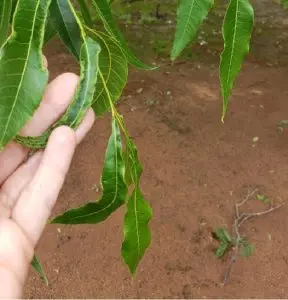
Infested leaflet distorted by the pecan leafroll mite (Image provided by Ted Cottrell)
Compound leaves, with or without pecan leafroll mite injury, were selected for examination of gas exchange parameters and leaf area. The leaf readings were taken from attached leaves, with and without leafroll injury, using a portable photosynthesis meter that measures net carbon assimilation rate, transpiration rate, and stomatal conductance to water vapor. These measurements were taken between 9:00 AM and noon under field conditions, each month sampling occurred. Differences in net carbon assimilation rate were not observed between treatments (i.e., leaflets with or without leafroll mite damage) among the monthly samples. However, significance was observed among dates and treatments for transpiration rate and stomatal conductance. Because stomatal conductance is a measure of the degree of stomatal opening, it can be used as an indicator of plant water status. A reduced stomatal conductance on leaves with pecan leafroll mite damage may indicate water stress and hence lower transpiration rate or water movement through the plant as the stomates close to preserve water.
Leaf chlorophyll content was determined on attached leaves using a portable chlorophyll meter on leaflets of compound leaves with and without pecan leafroll mite injury. Portable chlorophyll meter readings are a non-destructive measure of leaf chlorophyll concentrations in which the value is proportional to the amount of chlorophyll in the leaf. In this study, leaves with pecan leafroll mite damage had higher chlorophyll meter values. Still, no significant differences in chlorophyll content were observed between healthy leaflets and leaflets with mite damage.
Additional compound leaves with and without pecan leafroll mite injury were collected and taken to the lab for leaf area analysis. Compound leaves with pecan leafroll mite injury were collected from terminals having compound leaves with pecan leafroll mite injury. From the same trees, compound leaves without pecan leafroll mite injury were similarly collected from terminals without pecan leafroll mite injury. Because the number of leaflets per compound leaf varies, the total number of leaflets per compound leaf was recorded. Note that not all leaflets of an infested compound leaf exhibit mite injury. Hence, the number of leaflets with pecan leafroll mite injury on those compound leaves with pecan leafroll mite injury was documented. To capture leaf area, each leaflet on all compound leaves was measured in the laboratory using imaging analysis software. From visual inspection, pecan leaf roll mite damage on individual leaflets appears to decrease leaflet area, which could affect net photosynthesis, and in turn nut development, quality, and yield. However, our comparison of average leaflet area from compound leaves with pecan leafroll mite injury compared with compound leaves without this injury did not reveal a significant difference in leaflet area for July, August, or September. But on those compound leaves with mite injury, the leaflets with injury had lower leaflet area than those without injury, and the difference was significant in July and September.
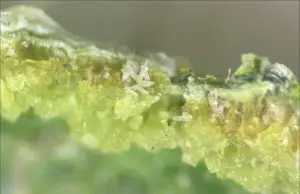
Pecan Leafroll Mite Colony Under a Microscope . (Photo courtesy of Shivakumar Veerlapati and Apurba Barman with the University of Georgia Cooperative Extension.)
It is worth noting that the compound leaves damaged by pecan leafroll mites remain on trees throughout the season. These damaged leaves are photosynthetically active, and the overall reduction in leaflet area is not different between compound leaves with or without pecan leafroll mite injury. Thus, the leaf parameters measured during this study indicated that the level of damage was cosmetic and did not require treatment. These results suggest, however, that pecan leafroll mite damage may increase leaflet water stress. It is possible that severe outbreaks of pecan leafroll mite may cause economic injury. In orchards with a history of increasing pecan leafroll mite damage where economic injury is a concern, miticide treatment soon after budbreak will alleviate the damage by this pest.
