
Managing the Critical Root Zone in Pecan Orchards:
A Practical Framework for Protecting Tree Stability and Productivity
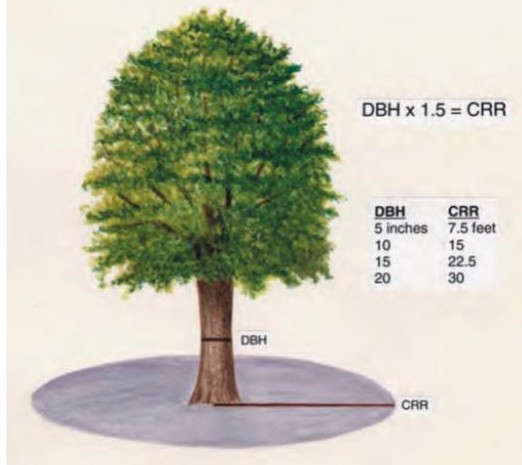
Image 1. Critical root radius : The CRR is used to define the portion of the root system nearest the stem that is critical for stability and vitality of the tree. This area is usually beyond the dripline of the tree. The radius of this circular area is defined as CRR (in feet ) = DBH x 1.5. Pokorny, et al. 2003. (Graphic provided by Stephanie Adams)
One concept widely used in arboriculture and urban forestry, but less familiar in orchard systems, is the critical root zone (CRZ), sometimes expressed as the critical root radius (CRR). These terms define the portion of the root system that must remain functional to preserve tree stability and vitality. While originally developed in the context of construction damage and urban tree protection, the same principles apply directly to orchard systems where soil disturbance, traffic, and targeted inputs are routine.
Defining the Critical Root Zone
The CRZ provides a measurable boundary for management. It is not an abstract concept; it is a calculable area based on trunk diameter.
Across multiple publications, suggested CRZ values range from 0.5 to 1.5 feet per inch DBH, with 1.5 ft/inch considered a conservative standard for high-value trees. For pecan growers, this provides a straightforward framework: measure diameter at breast height (4.5 ft above the soil line), apply the multiplier, and establish a radius that defines where roots critical to survival and anchorage are located.
Two points require emphasis. First, the CRZ frequently extends well beyond the canopy dripline. Second, the CRZ is not static; it expands as the tree grows, meaning management zones must be periodically recalculated.
Relevance to Orchard Systems
The CRZ concept has been historically tied to urban forestry, particularly construction-related root damage. That distinction is artificial. Disturbance occurs in both urban and agricultural systems. In orchards, disturbance may be chronic rather than acute caused by repeated equipment passes, localized soil compaction, trenching for irrigation or drainage, or cattle and animal gathering.
Whether disturbance affects a single tree or an entire block, the biological consequences are similar: reduced root function, impaired water uptake, decreased nutrient acquisition, and compromised nut production and yield.
In this context, the CRZ should be treated as a management unit. It defines where inputs should be concentrated and where mechanical disturbance should be minimized. This is particularly relevant when considering the cost and efficiency of fertilizer applications, soil amendments, and remediation efforts. Broadcasting inputs across an entire orchard without regard to root distribution is inefficient. Targeting the CRZ aligns resource placement with biological function.
Root Architecture and Functional Implications
Effective use of the CRZ requires an understanding of root system structure. In the genus Carya, root architecture is typically described as a combination of three components:
- Taproots – vertically oriented roots that contribute to early establishment and deep water access.
- Heart roots – diagonally oriented structural roots extending outward and downward.
- Lateral (surface) roots – horizontally oriented roots concentrated near the soil surface.
While the taproot is often emphasized in early tree development, long-term stability is governed primarily by the lateral root system. According to Coder (2010), anchorage is largely a function of the frictional interaction between lateral roots and surrounding soil. Loss of this network increases the likelihood of windthrow or structural failure.
Empirical data reinforces the shallow distribution of functional roots. Crow (2005) and Abdi et al. (2010) report that 90–95% of tree roots are located within the upper 3.2 feet of soil and more than 50% of root activity occurs within the top 12 inches.
This distribution has direct management implications. Most root biomass, and nearly all absorptive “feeder” roots, are located in the zone most susceptible to compaction, excavation, and mechanical damage.
Soil Compaction as a Limiting Factor
If root distribution defines where management should occur, soil condition determines whether roots can function. Soil compaction is a primary constraint in orchard systems and often goes unaddressed until symptoms become visible in the canopy.
Compaction reduces micro- and macro-pore space, limiting both oxygen availability and water infiltration. Root growth is mechanically restricted, and microbial activity declines due to reduced aeration. The result is a system where both physical and biological processes are impaired.
Penetration resistance provides a practical metric for evaluating compaction. Root growth is significantly inhibited when resistance approaches 300 psi (Pike et al., 2021). At this threshold, soil behaves as a mechanical barrier rather than a growth medium. Bulk density provides an additional measure. Zhao et al. (2010) found that a bulk density over 0.8 g/cm3 limited root growth and affected tree height. Values above these levels restrict root elongation and reduce overall root system function.
Using the CRZ to Guide Management
The practical value of the CRZ lies in decision-making. It provides a defensible boundary for both protection and intervention.
- Targeting Inputs
Fertilizers, soil amendments, and biological inputs should be concentrated within the CRZ. This increases the likelihood that applied resources intersect with active roots. It also reduces unnecessary input costs by avoiding application to biologically inactive zones. - Minimizing Mechanical Disturbance
Activities such as trenching, digging, or repeated equipment traffic within the CRZ should be evaluated carefully. When digging using heavy machinery is unavoidable, pre-severing roots by trenching can reduce the risk of roots being pulled off the tree causing extensive structural damage. Clean cuts allow for compartmentalization and more predictable wound responses. - Identifying Priority Trees
Not all trees require immediate intervention. Visual indicators can be used to prioritize management:
• Retrenchment or “staghorning” in upper canopy regions
• Reduced leaf size or leaf density in the outermost canopy
• Delayed recovery following stress events
These symptoms often indicate impaired water and nutrient transport, frequently linked to root dysfunction.
- Monitoring Soil Condition
Routine assessment of soil compaction within the CRZ should be standard practice. Penetrometers provide rapid field estimates, while bulk density measurements offer more precise data. Both approaches are valid; selection depends on available resources and required resolution.
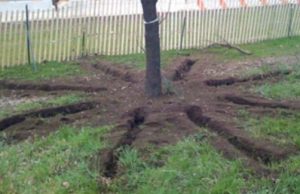
Image 2. Once radial trenches are opened using an air tool, amended soils can be backfilled. (Photo courtesy of AirSpade, 2016)
Remediation Strategies Within the CRZ
Where compaction is identified, intervention should focus on restoring soil structure while minimizing additional injury.
Radial trenching involves excavating narrow trenches extending outward from the trunk, typically beginning outside the structural root plate and progressing into the surrounding soil. These trenches are backfilled with amended soil to facilitate root proliferation.
Vertical mulching consists of augering or using an air tool (e.g. Air Spade or Air Knife) to create a grid of holes within the CRZ and filling them with amendments. This increases localized porosity and promotes microbial activity
Both methods aim to increase pore space, improve aeration, and restore conditions conducive to root growth. Selection among them should be based on site conditions, equipment availability, and economic considerations.

Image 3. Vertical mulching can be accomplished using an auger or an air tool (e.g., Air Spade or Air Knife). (Root drawing coutsey of ChatGPT and Stephanie Adams)
Reframing Orchard Management
The central issue is not whether the CRZ concept applies to pecan systems, it does. The issue is whether it is being used. Current management approaches often treat the orchard floor as a uniform surface. In reality, it is a heterogeneous environment structured around individual trees and their root systems.
Treating the CRZ as a management unit imposes structure on that variability. It aligns input placement, disturbance avoidance, and remediation efforts with the biological reality of how trees function.
Roots perform two essential roles: anchorage and resource acquisition. When either function is compromised, canopy performance declines. The lag between root damage and visible canopy symptoms can obscure the cause-effect relationship, leading to misdiagnosis and inefficient management responses.
A CRZ-based approach reduces that ambiguity. It provides a framework for anticipating where problems are likely to occur and where interventions will be most effective.
Conclusion
Pecan production systems are long-term investments. Tree longevity, structural stability, and consistent yield depend on maintaining a functional root system. The critical root zone offers a practical, measurable way to define and protect that system.
Adopting this framework requires a shift in perspective. The canopy remains important, but it is an output, not the driver. The driver is below ground. Management strategies that recognize and operate within this constraint are more likely to sustain both productivity and tree health over time.
Citations
Abdi, E., Majnounian, B., Rahimi, H., Zobeiri, M., Mashayekhi, Z. and Yosefzadeh, H., 2010. A comparison of root distribution of three hardwood species grown on a hillside in the Caspian forest, Iran. Journal of Forest Research, 15(2), pp.99-107.
AirSpade. 2016. Technical Applications Bulletin. https://cdn.shopify.com/s/files/1/2656/7538/files/AirSpade_Arbor_Applications_Guide_04e00a9f-469a-4c47-89c9-1747ed2800c4.pdf?v=1703877956. Accessed 5/5/2026.
Coder, K.D., 2010. Root Strength & Tree Anchorage. University of Georgia Warnell School of Forestry & Natural Resources monograph publication WSFNR10-19. 88 pp.
OpenAI. (2026). ChatGPT (GPT-5.3) [Large language model; image generation]. https://chat.openai.com
Crow, P. 2005. The influence of soils and species on tree root depth. Information Note FCIN078 Forestry Commission, Edinburgh. 8 pp.
Matheny, N.P. and Clark, J.R., 1994. A photographic guide to the evaluation of hazard trees in urban areas. International Society of Arboriculture. ISBN: 9781881956044.
Miller Jr, F.D. and Neely Jr, D., 1993. The effect of trenching on growth and plant health of selected species of shade trees. Arboriculture & Urban Forestry (AUF), 19(4), pp.226-229.
Pokorny, Jill; O’Brien, Joseph; Hauer, Richard; Johnson, Gary; Albers, Jana; Bedker, Peter; Mielke, Manfred. 2003. Urban Tree Risk Management: A Community Guide to Program Design and Implementation. USDA Forest Service Northeastern Area State and Private Forestry 1992 Folwell Ave. St. Paul, MN 55108.
Pike, K., O’Herrin, K., Klimas, C. and Vogt, J., 2021. Tree preservation during construction: An evaluation of a comprehensive municipal tree ordinance. Urban Forestry & Urban Greening, 57, p.126914.
Zhao, Y., Krzic, M., Bulmer, C.E., Schmidt, M.G. and Simard, S.W., 2010. Relative bulk density as a measure of compaction and its influence on tree height. Canadian journal of forest research, 40(9), pp.1724-1735.
