
A New Understanding of Pecan Water Use in Humid Conditions: Part 2
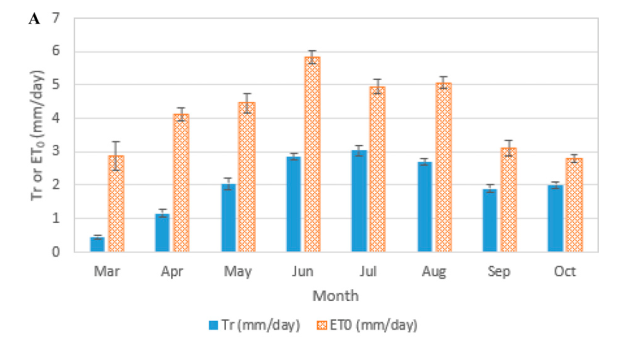
Figure 1. Pecan tree transpiration and orchard evapotranspiration from a south Georgia pecan orchard. (Figure provided by Lenny Wells)
As I mentioned in the previous article, much of the really good early work on pecan water use and irrigation was conducted in the desert southwest, which makes sense because irrigation is life in the desert. We are fortunate here in the Southeastern U.S. to have excellent water availability and enough rainfall to recharge those partially unconfined aquifers relatively quickly. Historically, we have adopted the results of Southwestern arid land pecan water use data as an assumption for how pecan trees use water everywhere they are grown, even in the warm, water-rich, humid climate of the southeastern United States. While our water resources are currently abundant, we need to steward them wisely. It is our greatest asset.
While the same general pattern of water use holds wherever pecans are grown, the warm, humid environment and relatively frequent rainfall of the southeastern U.S. lead to considerable differences in when and how much water the trees use compared to the arid Southwest. Through recent studies I’ve been involved in with UGA climate scientist Dr. Monique LeClerc, graduate students Kriti Poudel, Ibukunoluwa Adelekan, and technician Gengsheng Zhang over the last four or five years, for the first time, we are beginning to put some exact numbers on pecan water use in the growing conditions of the southeastern region of the U.S. Through this we are getting an understanding of how our environmental conditions influence this use. This will allow us to further tweak our irrigation schedule, making it much more efficient.
As mentioned, the last article on this topic focused on our sap flow studies. Here, I want to focus on pecan transpiration and evapotranspiration in our orchards. Transpiration is the process by which water is absorbed by plant roots from the soil, moves through the plant, and evaporates as water vapor into the atmosphere. It is a passive, vital process for cooling plants, transporting nutrients, and driving water movement, accounting for about 10% of atmospheric moisture. It can also give us a direct measurement of how much water trees are using. Evapotranspiration adds the evaporative losses from the soil and plant surface within the orchard to the transpiration values to give us a number for total water use in the orchard.
Pecan trees in the southwestern U.S use 1100-1400 mm (43”-55”) of water per growing season. Our annual average rainfall in South Georgia is 1270 mm (50”), but the problem is that it doesn’t necessarily come when we need it most. Thus, our irrigation systems should be supplemental. Still, over the years, we have used these systems in a way suited for pecan trees grown in a desert rather than trees grown in our own humid climate.
Through the use of Eddy-Covariance towers placed in orchards above the canopy of the trees, we were able to measure transpiration from the trees and evapotranspiration from the orchard. As a result, we now have sufficient data to show that pecan trees in south Georgia use 610-680 mm of water (24”-27”) per growing season, about half that used in the arid West. About half the water our trees use in a given growing season comes from rainfall. The trees themselves use a relatively small amount of water (as little as 0.004” per day) until the canopy has been fully developed and temperatures increase, about mid-May. Even if we under-irrigate a little prior to full canopy development, neither the trees nor the crop seems to suffer as long as the proper amounts are applied when peak water use begins. In other words, they are less sensitive to dry conditions until the canopy develops, and then they really need the water. Peak water use (0.25” per day) by the trees occurs during nut development (sizing and kernel fill) from June through August. Around late September, following kernel fill, there is a significant drop in pecan tree water use (to approximately 0.1” per day). They are still using water, and they still need soil moisture for the nuts to mature properly and for the shucks to split normally, but based on both transpiration and sap flow, they do not appear to use nearly the amount we have been providing in late September and October.
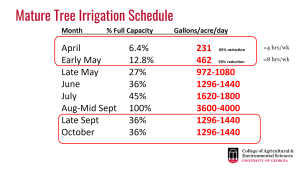
Figure 2. New recommended irrigation schedule for mature pecan trees in Georgia. (Figure provided by Lenny Wells)
The fact that water use falls off in September and October presents a challenge for production. The tree’s water demand is driven largely by crop load. Because of this, when we have a crop load on that tree, and we turn dry after kernel filling, from a production standpoint, there is still a demand for water. The problem is that the tree’s physiology seems to shift following kernel filling. As a result, the tree does not appear capable of taking up and using the amount of water it really needs if it is only getting it from the small percentage of the root zone covered by irrigation. The tree loses some of the efficiency with which it uses that water. It won’t matter how much you apply at this time, the tree just doesn’t appear capable of using it all. This leads to stick-tights, vivipary, and embryo rot during such conditions, even in irrigated orchards. Just one or two timely rains that cover the tree’s entire root zone following kernel filling can make all the difference.
The primary reason for lower water use by pecans in the southeast compared to the West is most likely the result of our humidity. This is expressed in the form of something called the Vapor Pressure Deficit (VPD). This is the difference between the amount of moisture in the air at any given time and the amount the air can hold when saturated—the more moisture in the air, the smaller the VPD. By and large, the VPD of the southeastern U.S. is much smaller than that of the arid Southwest, and as it turns out, this is an important factor in the uptake of water by pecan trees.
Our sap flow studies have helped shed light on what’s happening here. Coupled with the transpiration and evapotranspiration studies, we get a more complete picture of what’s going on. Sap flow increases around sunrise and accelerates early in the morning. It generally increases with air temperature and VPD in the morning, peaking around noon, then decreases gradually into early to mid-afternoon, and declines rapidly through the early evening. The precise timing of the peak in sap flow is related to stomatal control. Stomata are the small pores on the leaves that regulate gas exchange between the plant and its environment. Water loss by the plant is controlled as the size of the stomatal pore changes. Stomata must open to allow the gas exchange of carbon dioxide and oxygen for efficient photosynthesis, and light typically triggers stomatal opening. When stomata are open, water vapor is lost to the external environment, increasing transpiration and water use. As long as there is adequate water, even with a high VPD and temperature, pecan trees can keep pumping.
Stomata typically open during the day to favor CO2 diffusion when light is available for photosynthesis, and close at night to limit transpiration and save water. They will also close during the day when the tree needs to save water due to drought conditions, excessive temperatures, when VPD (and evaporative demand) is too high (under low water availability), or when VPD is too low.
As mentioned, stomata remain open, and transpiration generally increases to a point as temperature and VPD increase (drier air). This is primarily what drives the transpirational stream of water through the tree. But, in humid climates, VPD can also get too low. If VPD gets too low, then the moisture gradient becomes incredibly small between the humid air and the saturated leaf tissues. At that point, plants can’t pull water from their roots, up through their shoots, and out through their leaves due to excessively high humidity levels. So in effect, too much humidity limits the uptake of water by the tree, reduces water use, and thereby, photosynthesis. Consider how many foggy mornings last until near noon, how many days of 85-90% humidity, and how many rainy days we have during the summer, and you can see how this can limit our production.
Interestingly, if you consider the evapotranspiration occurring on a single acre in a pecan orchard, you must take into account not only the water use by the tree itself, but also by the vegetation growing between the tree rows. Not surprisingly, before the tree canopy develops, most evapotranspiration in the orchard occurs on the orchard floor. Our studies have demonstrated that orchard floor vegetation accounts for 73% of total orchard evapotranspiration in March, 56% in April, and just over 11% in May after the tree canopy develops. That percentage increases from 17% in June to 22% in August, with lush growth of understory vegetation through the summer, and then drops again in September and October.
So, what does all this mean for how you, as a pecan grower in the humid southeastern U.S., should irrigate your pecan orchard? Based on these studies and the previous studies we’ve conducted on pecan irrigation, we are changing our irrigation recommendations for pecans. This primarily involves reducing our recommended irrigation amounts in April and early May, as shown in the table accompanying this article. We will be leaving the irrigation application amounts for June through mid-September unchanged. We seem to be pretty accurate already with the rates we need to apply. However, we are reducing the recommended amounts for late September and October. When we get an inch or more of rain during the growing season, you can turn the water off for 3 days.
These studies are helping us better understand pecan tree water use in the hot, humid conditions of the southeastern U.S. and what that implies for how we should irrigate. Our transpiration/evapotranspiration studies have shown us how much water our trees use and when. Sap flow studies have shown us that VPD and the high humidity of our region can be one of our most limiting factors with regard to water use, and this gives us a better understanding of exactly what that means for photosynthesis and the ultimate effect on pecan production. It also shows us that there are certain times of the year, primarily April and early May, prior to full canopy development, when we really don’t have to apply much irrigation water at all. The real water demand begins in June and peaks in August. It has also helped us to learn exactly why late-season droughts following kernel filling can wreak so much havoc on our pecan crop, even in irrigated orchards. Hopefully, this information will help growers become more efficient with how they use our region’s most valuable resource and will help keep more money in growers’ pockets as well.
Literature Cited
Zhang, G., M. Leclerc, and L. Wells. 2026. Evaluation of pecan transpiration in a southeastern U.S. orchard using the sap flow method. HortScience 61: 297-306. https://journals.ashs.org/view/journals/hortsci/61/2/article-p297.xml
Poudel, K., M.Y. Leclerc, G. Zhang, I. Adelekan, and L. Wells, 2026. Variability of the crop coefficient in a southeastern U.S. pecan orchard. Frontiers in Agronomy (In Press).
Zhang, G., M. Leclerc, and L. Wells. 2024. Sap flow of pecan trees in a U.S. Southeastern orchard. Frontier in Agronomy 6:1513025. doi: 10.3389/fagro.2024.1513025. https://www.frontiersin.org/journals/agronomy/articles/10.3389/fagro.2024.1513025/full
Andersen, P., and B.V. Brodbeck. 1988. Net CO2 assimilation and plant water relations characteristic of pecan growth flushes. J. Amer. Soc. Hort. Sci. 113: 444-450.