
Beneficial Spotlight: Bats
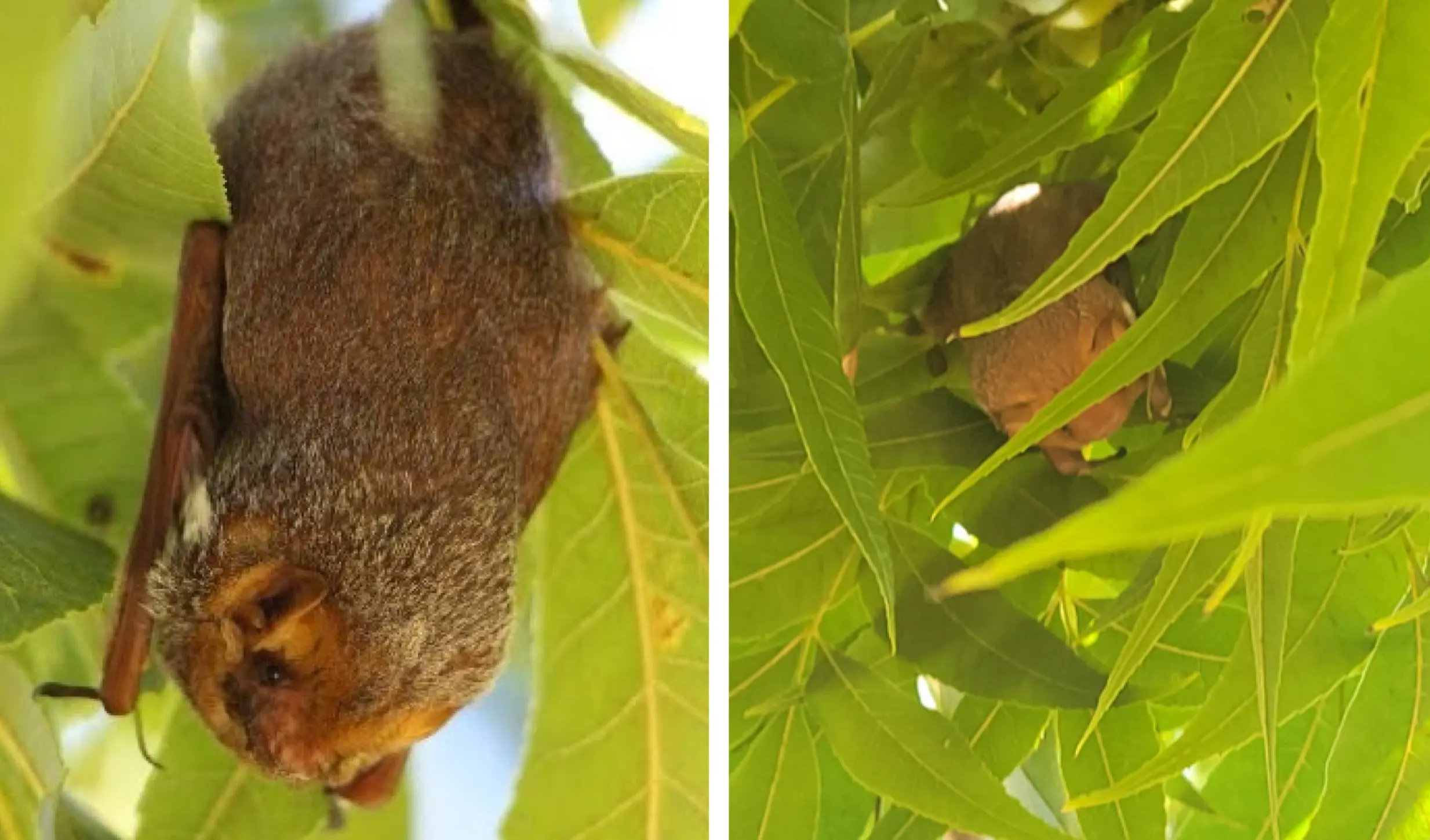
Eastern red bats (Lasiurus borealis) rest in pecan trees in Comanche County,Texas (left) and Somerville, TX (right). Photo Credit: Kyle Slusher, TexasA&M AgriLife Extension Service (left), USDA-ARS Pecan Breeding Station(right).
Bat Biology and Their Role in Agriculture
Bats are a unique group of mammals in that they are the only ones capable of true flight. Other ‘flying’ mammals, such as flying squirrels, don’t actually fly but rather glide (a fancy term for controlled falling) when they take to the air. All bats are in the order Chiroptera (“hand-wing”) and are characterized by wings made of a flexible skin stretched between very long fingers. Fun fact: bats have the same number of fingers as you do, the little finger you might see protruding from the top of each wing is the thumb, while the other four fingers are much longer and support the wing. Bats are extremely diverse, consisting of roughly 1,500 species accounting for 20% of all known mammals. Given this diversity, bats feed on a wide variety of food items. Despite early pop culture and the popularity of vampires highlighting blood feeding bats, there are only three living species of vampire bat which are found in Central and South America. Some bats are active carnivores such as the bulldog bat (Noctilio leporinus) which eats fish and the fringe-lipped bat (Trachops cirrhosus) which will consume frogs as part of their diet, while other bats lean more vegan, feeding on fruits and nectar from plants. However, most bats (and the reason they are potentially valuable to agriculture) are insectivores, meaning that they feed on insects.
There has been a substantial amount of research dedicated to documenting the economic value of bats to agriculture. A study conducted in 2011 estimated that the loss of bats in North America alone would lead to agricultural losses of $3.7 billion a year. A 2006 study on the economic value of a single species, the Brazilian free-tailed bat (Tadarida brasiliensis), to the cotton industry in a region of South-Central Texas (Uvalde, Medina, Zavala, Frio, Dimmitt, LaSalle, McMullen, and Atascosa Counties) was estimated at $741,000 per year due to feeding on pests such as cotton bollworm (Helicoverpa zea). The potential value of bats stretches across multiple agriculture commodities including corn, cotton, rice, and even pecans.
Bats in Pecans
While not as substantial as some other agricultural commodities, there has been interest in looking at the impact of bats on pecan pests. One of the simplest ways to do this is to collect bat guano (a fancy term for bat feces) and extract insect DNA from those fecal samples in order identify what the bat had been recently eating. This technique was used to look at the diets of bats near pecan orchards to see if they were eating pecan pests, with a focus on pecan nut casebearer (PNC) (Acrobasis nuxvorella) and hickory shuckworm (Cydia caryana).
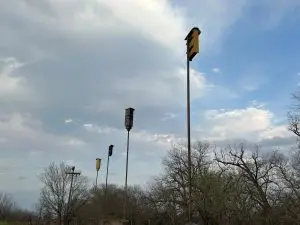
Bat houses deployed and monitored at Swift River Pecans in Fentress, Texas. Two types of houses were deployed: the rocket box (top left) and the zent box (top right). Bats primarily occupying these boxes include Brazilian free-tailed bats and evening bats. (Photo credit: Troy Swift, Swift River Pecans.)
The first study, done by Brown et al. 2015, collected bat guano from bat houses deployed in San Saba, Texas and Quitman, Georgia which primarily contained Brazilian free-tailed bats. Guano was processed and assessed to look for the DNA of PNC and hickory shuckworm. Guano was sampled throughout the summer of 2008 while 2009 sampling was done during the time of 1st generation PNC in May. Out of the fecal samples collected, 8 out of 576 (1.4%) screened for pecan nut casebearer tested positive for the moth’s DNA. Positive samples were found at the Georgia site in both years of the study, while positive samples were only found in one year of the study in Texas. Furthermore, 210 fecal samples were also screened for hickory shuckworm with three (1.4%) testing positive. All positive samples were obtained from Georgia. Lastly, DNA analysis of 22 insect fragments extracted from guano samples collected over four nights between August and September 2008 found that seven of these fragments were from southern green stink bug (Nezara viridula), a known pest of pecan.
A follow up study published in 2019 by Braun de Torrez et al. expanded upon the previously mentioned study by analyzing both bats that live in large colonies and those that live in small groups or alone. To do this, bats were captured via mist nets to collect fecal samples in San Saba, Texas. This allowed for collection of feces from bats that don’t use bat houses, such as eastern red bats. Bats were sampled across eight sites in both native pecan groves and improved variety pecan orchards. 368 viable fecal samples were collected from 5 species of bats: eastern red bat (n=69), cave myotis (n=119), evening bat (n=87), tri-colored bat (n=7), and Brazilian free-tailed bat (n=86). Bats were captured over 51 nights in both native pecan groves and conventional pecan orchards. Out of those samples, 33 (9.0%) contained PNC DNA across all five species. Among bat species, PNC DNA was detected at the highest frequency in eastern red bat (23.2%) followed by tri-colored bat (Perimyotis subflavus) (14.3%), cave myotis (Myotis velifer) (7.6%), Brazilian free-tailed bat (5.8%), and evening bat (Nycticeius humeralis) (2.3%). PNC pheromone trap captures in year one indicated that fecal samples tested positive for PNC only after a peak in moth flight subsided and bat captures during 1st generation PNC flight (April – May) were low. PNC and bat sampling was not conducted past mid-June. In year two of the study, PNC population peaks and bat sampling were conducted over three generations of PNC with consumption by bats found to be higher in the second and third generation than in the first generation.
These results suggest that among the bat species captured, red bats were most likely to feed on PNC moths when foraging. This coincides with evidence that red bats roost in the canopy of pecan trees and, as observed by Braun de Torrez, were observed roosting close to pecan clusters where they are likely to encounter PNC and were captured more near pecan orchards than surrounding woodlands. In addition, red bats also tend to forage near the canopy of trees and feed on moths as a regular part of their diet. Tri-colored bats had the second highest frequency of PNC feeding but were caught in such low numbers that this high frequency was likely due to low sample size. Evening bats were also observed roosting in pecan and were captured in pecan more than in surrounding woodland. However, studies have shown that while evening bats feed on moths, beetles make up the majority of their diet. Brazilian free-tailed bats were noted to be adapted for long-distance, open area flight where they are less likely to encounter PNC. Both Brazilian free-tailed bats and cave myotis were documented equally in pecan orchards and surrounding woodland, possibly indicating that they may not spend significant time in pecan orchards where they would encounter PNC.
Based on the evidence from these two papers, it is apparent that while several species of bat feed on PNC, the feeding is not equal across all bat species. Furthermore, it seems that while bat houses can be a good way to attract and collect information on bats in pecan orchards, they often attract species of bats that rarely feed on PNC, which are fed on primarily by tree roosting bats. Regardless, these studies are two of only a few studies to document bat predation of PNC pests and much more work is needed to confirm the predator-prey relationships between bats and pecan pests.
Current Efforts in the Pecan Industry to Document Bat Feeding Habits
There has been a multi-farm effort to attract bats to pecan orchards by deploying bat houses in or near pecan orchards. Currently, bat houses have been deployed at six different locations across Texas and Oklahoma:
- Cindy Sheffield, Love County, Oklahoma
- Mark Friesenhahn, Comal Pecan Farm, Comal County, Texas
- Micheal Ohlendorf, Caldwell County, Texas
- Micheal Willard, Guadalupe County, Texas
- Noble Research Institute, Carter County, Oklahoma
- Troy Swift, Swift River Pecans, Caldwell County, Texas (2 different farms)
- Zachary Swick, Belding Farms, Pecos County, Texas
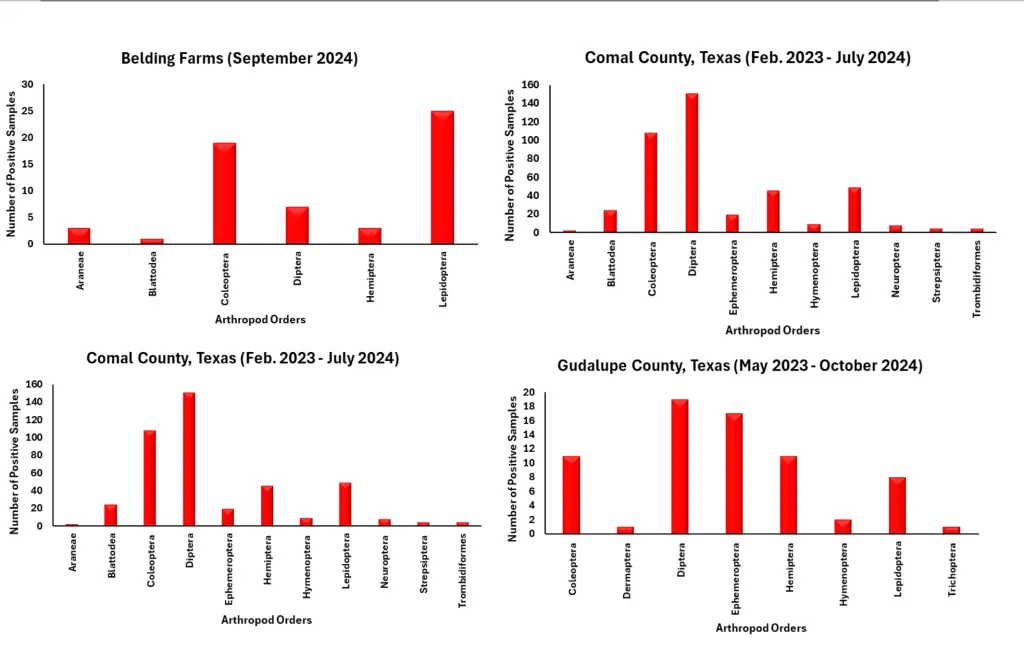
In addition, there have also been efforts to document what bats living in the houses are eating by collecting the guano and submitting it for DNA analysis through a collaboration with Merlin Tuttle’s Bat Conservation (MTBC) (Melissa Donnelly) and Faith M. Walker’s Species from Feces laboratory. Looking at the data from early sampling efforts, it is apparent that bats are feeding on a wide variety of arthropods including a lot of pest species. For example, several samples of DNA were found from mosquito species including Culex tarsalis, a vector of West Nile Virus, and Aedes vexans, a vector for West Nile Virus and Zika virus. The DNA of many moth species were found which was one of the target groups for the study as several moth species such as PNC, hickory shuckworm, and pecan bud moth are major pecan pests. For pecan, DNA of green stink bug (Chinavia hilaris) and pecan bud moth (Gretchena bolliana), both pecan pests, were found in feces. In addition, the DNA of few species of leafhopper, potential vectors for pecan bacterial leaf scorch (Xylella fastidiosa) were found. However, given the small number of samples for these pests, it is unknown whether bats feeding is suppressing these pests below economic thresholds. It is important to note that due to sensitivity of DNA barcoding techniques, that some arthropods may have been identified as prey items even when they were not the targeted prey. For example, there was evidence of feeding on mites and strepsiptera parasites which may have been attached to host when they were eaten. DNA barcoding even found cow DNA in bat feces, which may have been the result of a mosquito being eaten that had recently fed on a cow.
Overall, it seems that while bats feed on a wide variety of arthropods when attracted to pecan orchards with bat houses, substantial feeding on pecan pest insects has yet to be documented. Unfortunately, the bat species that show the most promise for biocontrol of moth pests such as PNC and shuckworm, the eastern red bat, does not use bat houses, preferring to roost in trees, with pecan trees being a suitable habitat. This highlights the importance of conserving native pecan groves to protect tree roosting bat populations. Future work should focus on developing techniques that promote the colonization and populations of this bat species in pecan orchards. Work is also being done to refine DNA techniques and timing to account for confounding issues that may skew what we are seeing when analyzing DNA from guano collected from bat houses. For example, guano collected from underneath bat houses only represents what the bat recently ate and may not represent its diet throughout the night. It is important to realize that the bats we are seeing in pecan are generalists (they eat many kinds of prey) and as such they will often take what is most available to them. Therefore, more work may need to be done to understand the role bats play in pecan systems and if they are proving economically beneficial pest control services.
Literature Cited
Boyles, Justin G., Paul M. Cryan, Gary F. McCracken, and Thomas H. Kunz. “Economic importance of bats in agriculture.” Science 332, no. 6025 (2011): 41-42.
Braun de Torrez, Elizabeth C., Veronica A. Brown, Gary F. McCracken, and Thomas H. Kunz. “Sympatric bat species prey opportunistically on a major moth pest of pecans.” Sustainability 11, no. 22 (2019): 6365.
Brown, Veronica A., Elizabeth Braun de Torrez, and Gary F. McCracken. “Crop pests eaten by bats in organic pecan orchards.” Crop protection 67 (2015): 66-71.
Cleveland, Cutler J., Margrit Betke, Paula Federico, Jeff D. Frank, Thomas G. Hallam, Jason Horn, Juan D. López Jr et al. “Economic value of the pest control service provided by Brazilian free‐tailed bats in south‐central Texas.” Frontiers in Ecology and the Environment 4, no. 5 (2006): 238-243.
Frick, Winifred, and M. Teague O’Mara. Bats of the World: A Guide to Every Family. Princeton University Press, 2026.
Main, Bradley J., Jay Nicholson, Olivia C. Winokur, Cody Steiner, Kasen K. Riemersma, Jackson Stuart, Ryan Takeshita, Michelle Krasnec, Christopher M. Barker, and Lark L. Coffey. “Vector competence of Aedes aegypti, Culex tarsalis, and Culex quinquefasciatus from California for Zika virus.” PLoS neglected tropical diseases 12, no. 6 (2018): e0006524.
Thiemann, T. C., D. A. Lemenager, S. Kluh, B. D. Carroll, H. D. Lothrop, and W. K. Reisen. “Spatial variation in host feeding patterns of Culex tarsalis and the Culex pipiens complex (Diptera: Culicidae) in California.” Journal of medical entomology 49, no. 4 (2012): 903-916.
Whitaker Jr, John O., and Phil Clem. “Food of the evening bat Nycticeius humeralis from Indiana.” American Midland Naturalist (1992): 211-214.
