
Cracking Open Indian Market Opportunities: An All-Women Reverse Trade Mission
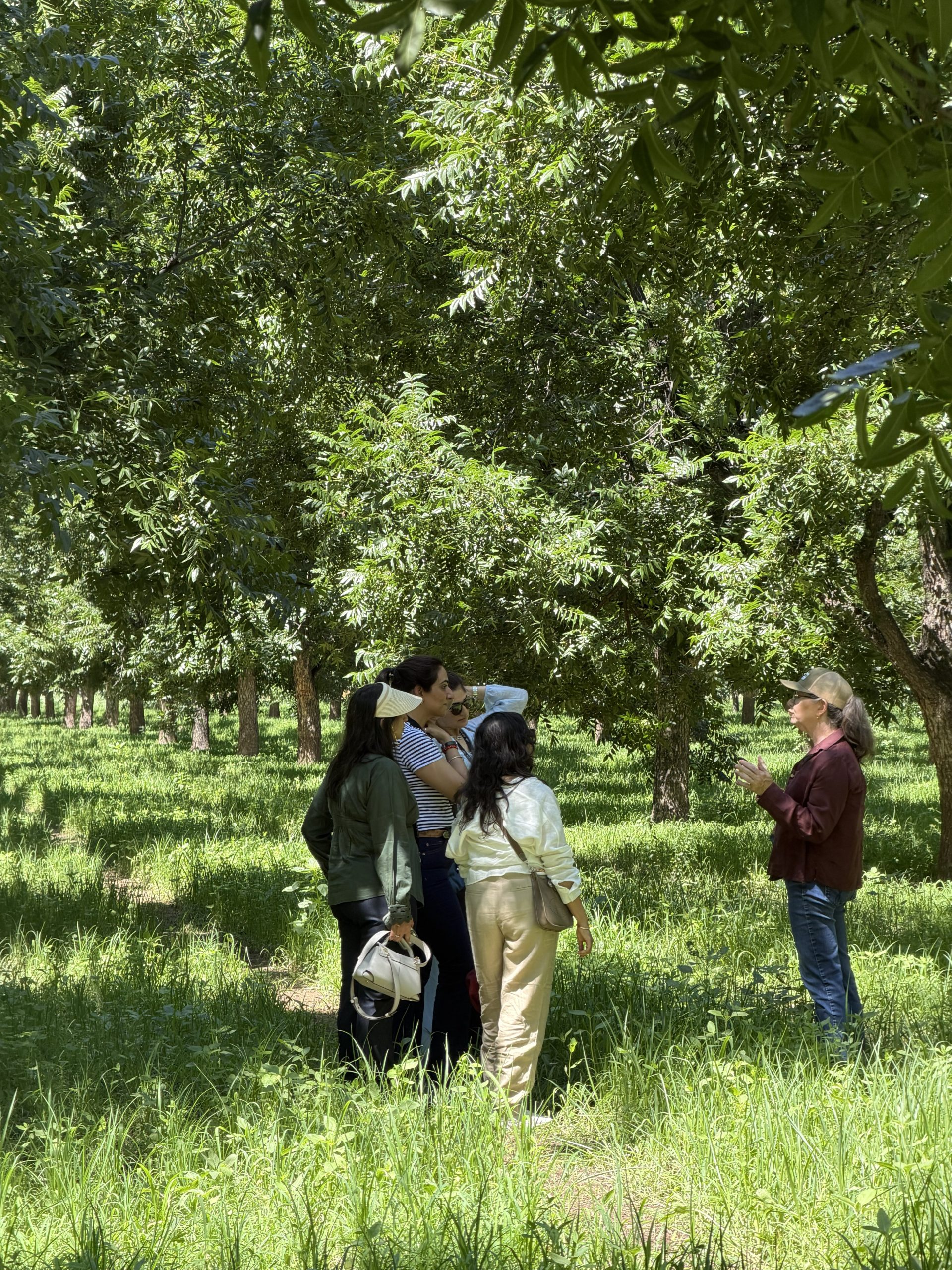
Mary Santos with Paso Pecan Farms connected with the group as she shared details about their farming operations, history, and lifestyle. Jeffrey Ivey Rancho La Isla, not pictured here, also helped discuss with the group what they are doing differently to improve their farming and business. (Image provided by Blair Krebs)
Cracking open market opportunities for U.S. pecans in India has been in development for years, with many organizations putting different blocks in place to build the market. I have been able to take part in, or witness, much of the development of the international market for U.S. pecans in India. I remember being in meetings about opening up this market over 15 years ago. Since then, each major step has brought the industry closer to realizing this market opportunity. First came early market development work to raise awareness of pecans among Indian consumers, but those efforts ran up against a major trade barrier: a staggering 100 percent tariff. In response, the National Pecan Federation (NPF) worked for over 5 years to reduce the tariff. In April 2023, NPF succeeded and coordinated to reduce the tariff by 70 percent, sparking a surge of interest in pecans from the U.S.
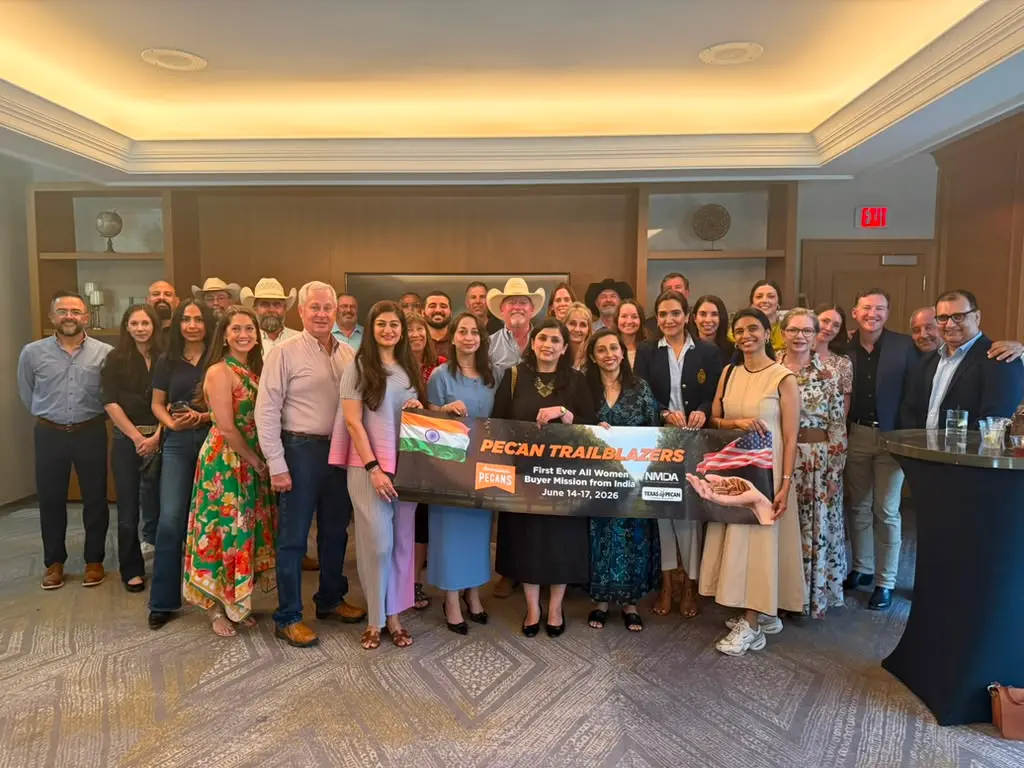
The opening reception in El Paso brought together growers, processors, and industry members to help welcome the group to the U.S. after the long trip from India. (Image provided by Blair Krebs)
Since then, the American Pecan Council (APC) has been spearheading market development through USDA Foreign Agricultural Service (FAS) funding. In addition, state and regional organizations, Departments of Agriculture, and private companies have worked in partnership to expand the market. These efforts have worked hand in hand with in-country promotions and trade shows organized by APC, as well as training for chefs and roasters with APC and the Texas Board. Furthermore, over the years, inbound missions have brought in buyers, influencers, and more due to the efforts of different organizations and funding sources, such as APC, Georgia Pecan Growers Association, Texas Pecan Board, Texas Pecan Growers Association, and New Mexico Department of Agriculture. I would also be remiss not to note that much of this coordination and development has been accomplished through a solid in-country contractor in India: S.S. Associates, hired by APC. Each project and effort by these groups has made its mark in raising awareness and interest in U.S. pecans in India.
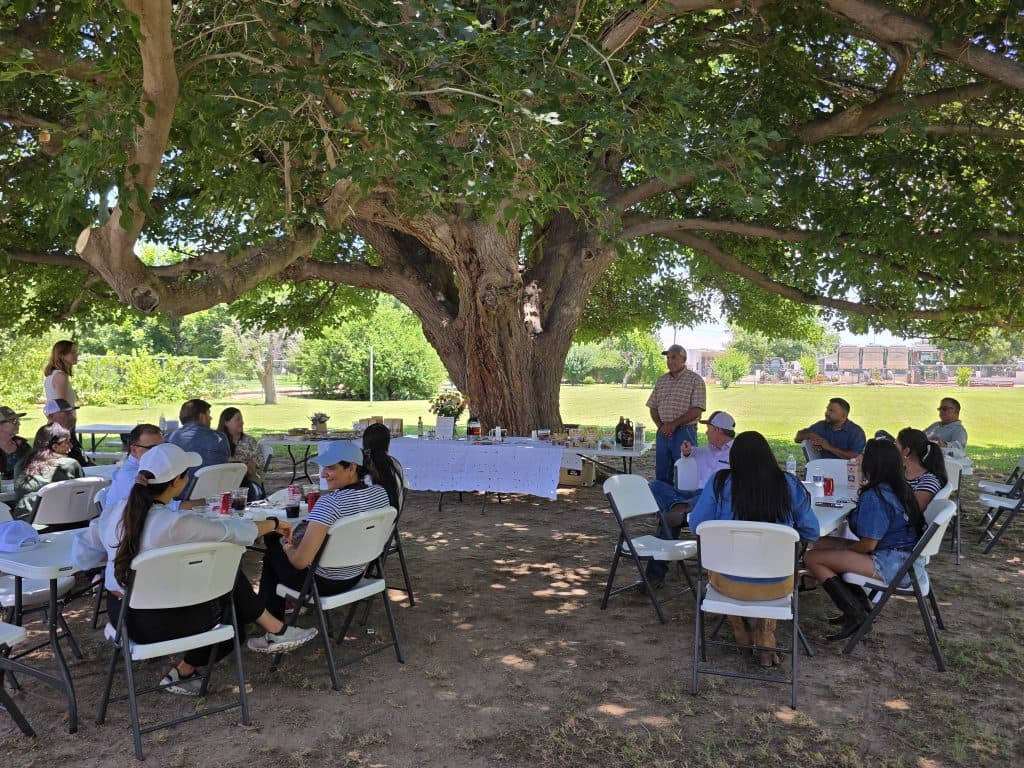
The group was treated to lunch and a pecan product showcase at the beautiful setting of Rio Bravo Farms. Industry members joined the lunch to highlight all the pecan products available and different ways to use them, including beauty products, beer, tea, flavored pecans, candy, oil, and more. Jim Montes, a pecan grower in El Paso County, is seen here speaking to the group about all the local businesses he partners with to use pecan products, including a local brewery creating pecan beers and a pizza restaurant using pecan wood in their pizza oven. (Image provided by Blair Krebs)
In what felt like a culmination of the industry’s work coming to a beautiful focal point, this June a reverse trade mission brought an all-female Indian buyer delegation to El Paso, Texas, and Las Cruces, New Mexico. To make the mission a success, the Texas Pecan Board (TPB), Texas Pecan Growers Association (TPGA), New Mexico Department of Agriculture (NMDA), and American Pecan Council (APC) partnered to educate and connect buyers and industry through this project. I want to give special thanks to the team who organized the event on behalf of the industry: Juan Sanchez, Nichole Hejl, Kelsey Morley, Serena Schaffner, Sumit Saran, as well as all the producers and industry members who helped host the event.
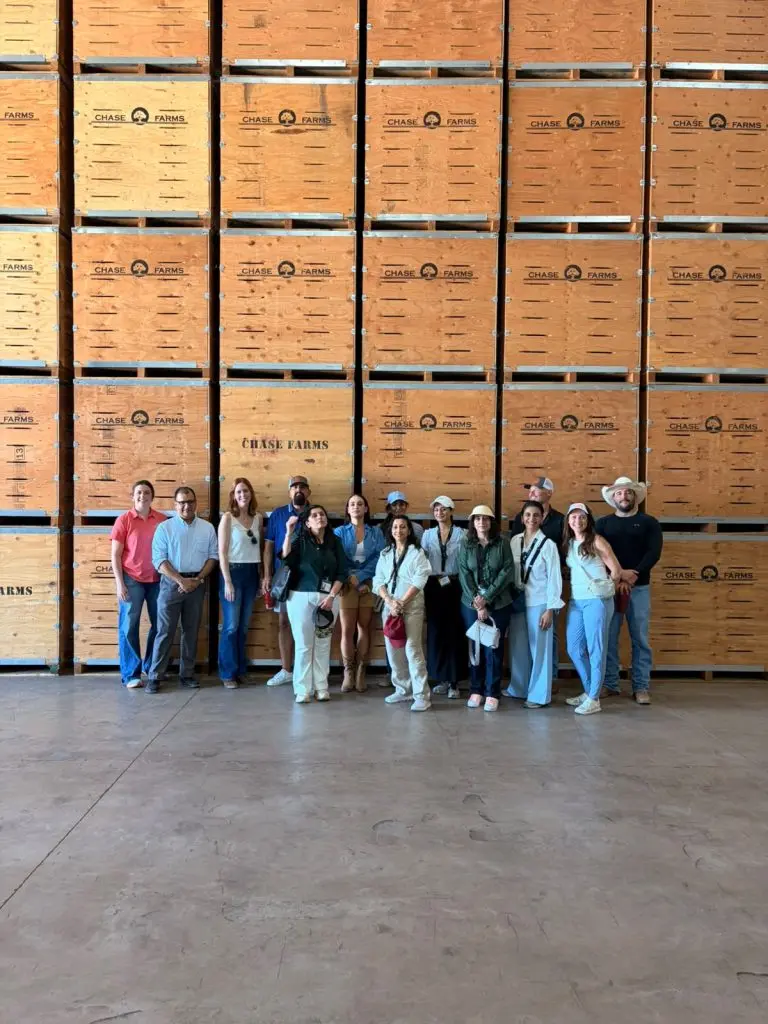
Meeting at Chase Pecan Farms in Fabens, Texas, the group toured the large scale operation and later learned about their flavored pecans and pecan milk. (Image provided by Blair Krebs)
The state groups planned an almost week-long tour featuring visits to orchards, shelling plants, retail operations, and a pecan product showcase highlighting all the different pecan producers available. To balance the week, the group also enjoyed a minor league baseball game, a pizza-making class, a retail tour, and even a group-requested early-morning hike in the mountains near El Paso. The full program gave the buyer’s group a true connection to the industry, with many growers and processors noting their continued contact and discussions with group members.
In the first inbound mission of its kind, the all-female delegation arrived at the perfect time to celebrate the International Year of the Woman Farmer, allowing us to highlight some of our female farmers as well. The six buyers represented powerhouses in the Indian dried fruit and nut industry, not only as part of their family’s multigenerational companies, but also as brand builders spurring innovation. The group is expanding ways to bring nuts and dried fruits to the Indian market through inventive ways of processing, branding, and new product development. After enjoying their company for a week, and likely learning as much from them as they did from us, I strongly believe they can bring the same breakthroughs and innovative thinking for pecans in India.
For our part, the trade mission gave our industry in West Texas and New Mexico a moment to shine. During this trip, I saw the buyers connect with the families and businesses of the operations we visited like no other. They were looking to engage not only with the products, but with each visit, they demonstrated how the connections to industry members’ lifestyle and culture were quite a story to tell in itself. New Mexico Secretary of Agriculture Jeff M. Witte shares why “India is an important emerging market for New Mexico pecans. Consumers are increasingly interested in healthy, premium foods, and pecans offer a unique combination of nutrition, flavor, and versatility. By bringing Indian buyers to New Mexico, we’ve shown them firsthand what makes our pecans special and connect them directly with the producers who grow them.” The trade mission highlighted why these kinds of connections build lasting business relationships that advance markets.
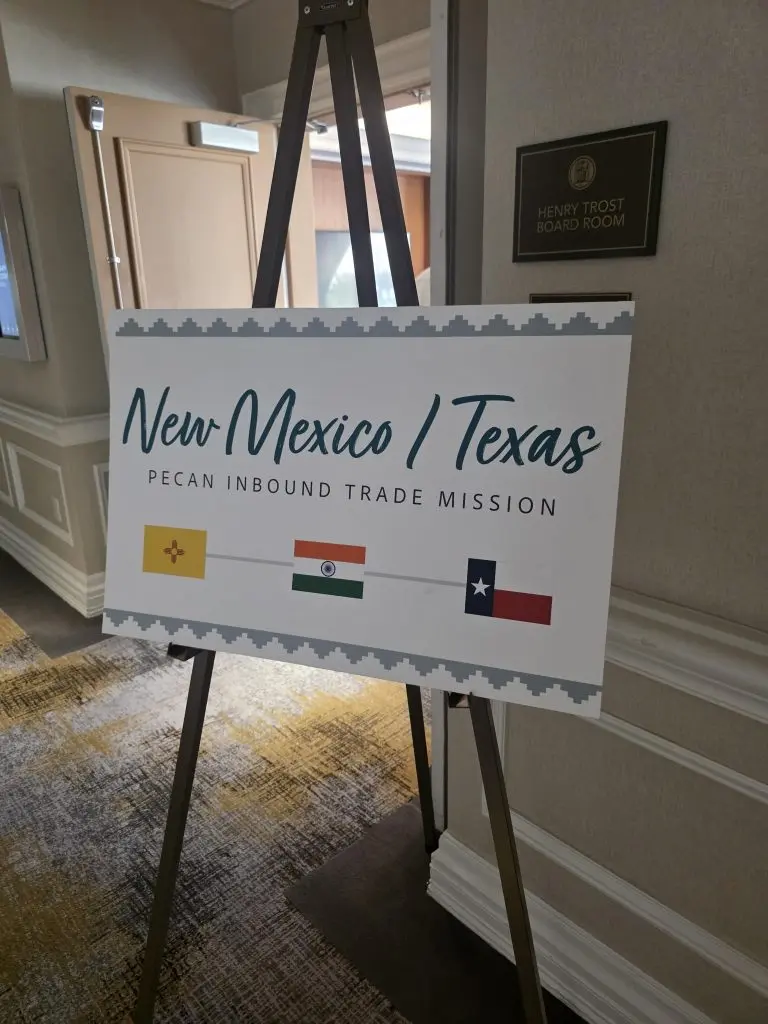
The reverse trade mission was a natural and well received partnership between Texas and New Mexico, given the high level of pecan production in the region and similar growing styles. (Image provided by Blair Krebs)
I have taken part in a number of reverse trade missions, but I have never been this impressed with the engagement, knowledge, passion, and curiosity this group of ladies demonstrated before, during, and after the event. Mary Santos, President of the Texas Pecan Growers Association and grower who helped host the group at their farm, felt similarly. “Warm and gracious are not the adjectives that come to mind when thinking about buyers, but these women are exactly that! I was overwhelmed by their enthusiasm for our farms, our practices, and especially our family heritage. The values that are most important to us are also most important to them.” The consensus among pecan growers and shellers taking part in the event was pure, much-needed optimism.
However, as we hold those reflections of optimism and continue to stack those building blocks for the market in India, there is still more work to be done. The U.S. pecan industry is still waiting for approval from the Indian government to obtain the necessary legal code to export inshell pecans from the U.S. into India. This essential code may be caught in a political hot potato, though this is not uncommon in export markets. Without the code, the industry is left to only export shelled meats, thus limiting the market opportunities. In speaking with these buyers, the possibility of inshell sales would open a world of opportunities for pecans in their market, and we know it would also offer advantages for pecan producers to sell inshell directly into this market. As the industry plays a waiting game for the code, marketing and additional projects will continue at a steady pace to educate the food industry in India and build awareness and demand among Indian consumers.
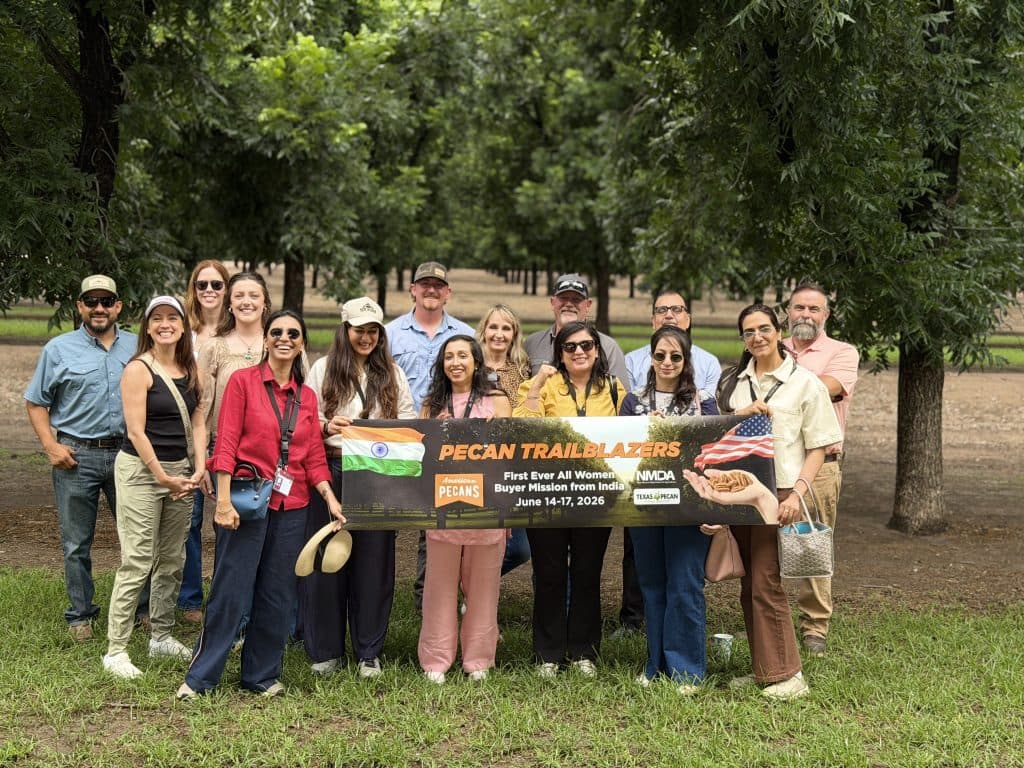
The trade mission literally stopped traffic as the group posed along the often photographed tree lined New Mexico Highway 28 in front of Stahmann Farms. (Image provided by Blair Krebs)
Those not selling into export markets have asked, “How does this affect me?” It is a fair question, because this kind of work seems like such a high-achieving task. However, whether you sell into export markets or not, developing international markets is important for improving the overall economic situation for all pecan producers and shellers. If you were around during the years U.S. pecans were going into China, you have seen this firsthand. Studies and market assessments have shown that having a healthy export market, particularly one that purchases both shelled and inshell pecans, is essential in keeping a healthy industry. As we have seen in recent years, overseas markets can be more volatile, but they provide additional demand and higher prices, which often put supply and price pressure on domestic buyers. In addition, national and state groups have funding available for international marketing that is not available for work in the domestic market. These sorts of industry benefits and external funding opportunities are why industry groups highlight export development as important work.
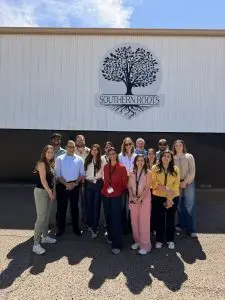
Visiting Southern Roots Nut Company was one of a couple stops to witness pecan processing methods and see products that are being produced using pecans. (Image provided by Blair Krebs)
So, are we cracking open the market for U.S. pecans exports into India? There is still work to be done, but the momentum is building. Sometimes it just takes a gathering of passionate pecan farmers and a group of six all-women buyers to remind us of how far we have come and the opportunities that still lie ahead.
For more content and an extra look at interviews with the buyers during this reverse trade mission, check out the extra content and videos on Pecan South online. Visitwww.pecansouthmagazine.com.
Youtube Video 1 – https://youtu.be/fOT_VoRTAXM
Youtube Video 2 – https://youtu.be/3Liz3AcYeXY

Blair Krebs
Blair Krebs is the Publisher of Pecan South and the Executive Director of the Texas Pecan Growers Association. For questions regarding the magazine or advertising, you can reach her at blair@tpga.org.