
Diversity and Management of Stink Bugs and Leaffooted Bugs in Pecan Orchards
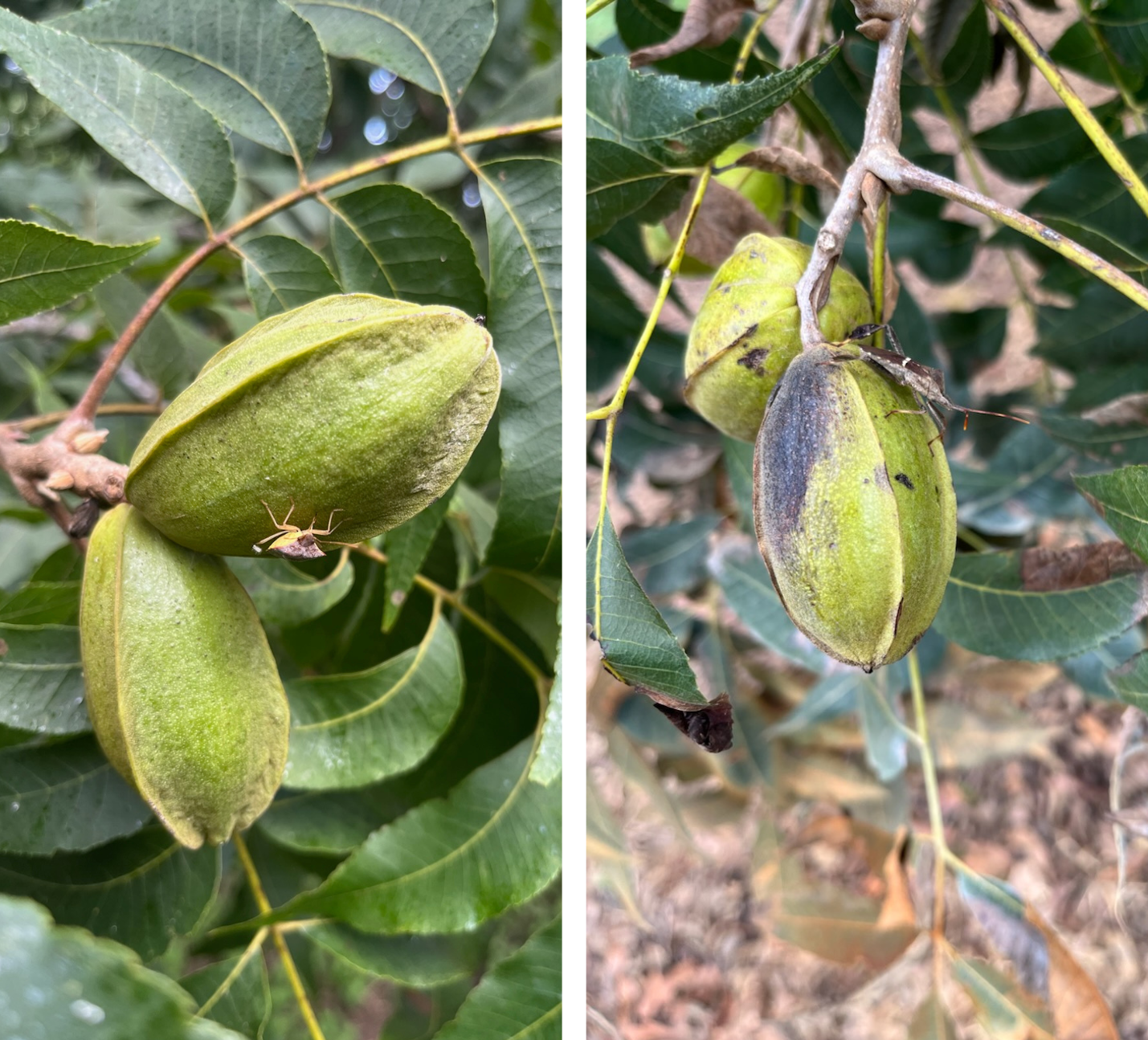
A stink bug (left) and leaffooted bug (right) feeding on pecan nuts. (Photos by Monte Nesbitt, Texas A&M University)
Biology and Damage
Several species of stink bugs and leaffooted bugs can be found in pecan orchards. Among these, some can be severe pests that have the potential to damage yield, while others are less damaging. Stink bugs and leaffooted bugs can be present in pecan orchards all season. Because they feed on many host plants, they will often move in and out of orchards throughout the year. Adults generally lay eggs in the summer on alternative hosts outside pecan orchards but some egg laying does occur on pecan. Common breeding hosts include soybeans, peas, and sorghum. Populations are highest during the late season from September to shuck split.
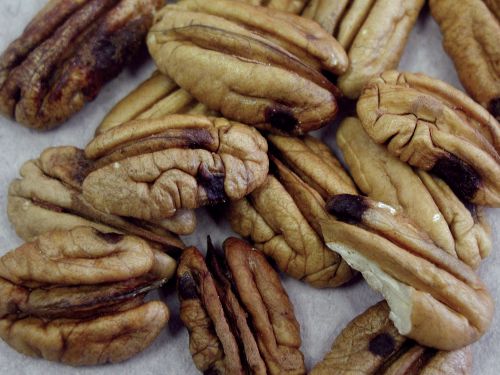
Kernel spots caused by feeding; these spots taste bitter, ruining the flavor of the kernel. (Photo by Bill Ree)

Stink bugs and leaffooted bugs can cause two different types of damage to the nut because of feeding with their piercing-sucking mouthpart. Feeding on the nutlets pre-shell hardening causes a condition known as black pit, which causes nutlets to abort. Feeding after the shell hardens does not lead to nut drop, but black spots will form on the kernel at the feeding site. This damage causes the kernel to have a bitter taste and lowers its market value. After the shell hardens, feeding by leaffooted bugs is believed to be restricted to the shuck, so this second type of damage is thought to be reduced in these insects.

Damage caused by stink bug and leaffooted bug feeding. Black pit caused by pre-hardening feeding. (Photo by Louis Tedders)
Stink bugs diversity
All stink bugs are characterized by their shield-shaped bodies and the pungent odor they emit when disturbed. Immature stink bugs look like small adults and are wingless. Not all stink bugs are plant pests though; some are predators that can be beneficial in orchards. Predatory stink bugs can be distinguished from plant-feeding stink bugs by the presence of a shorter, thicker mouthpart. While most stink bugs will not use pecans as a breeding host, they will overwinter at the base of pecan trunks and beneath the bark. Stink bug species encountered in pecan orchards include:

Various plant-feeding stink bug species found in pecan: Brown marmorated stink bug (Photo by Susan Ellis), Brown stink bug (Photo by Russ Ottens, University of Georgia), Conchuela stink bug (Photo by Bill Ree), Harlequin bug (Photo by Russ Ottens), Green stink bug (Photo by Louis Tedders), Dusky stink bug (Photo by Susan Ellis), and Southern green stink bug (Photo by Bill Ree).
- Plant Feeding
- Brown marmorated stink bug (Halyomorpha halys (Stål))
- Feeds on over 300 plants. Adults are 0.5 to 0.7 inches long. Although similar in appearance to other stink bugs, they are distinguished from other brown stink bugs by the white bands on the antennae.
- Brown stink bug (Euschistus servus (Say))
- Brown stink bugs are 0.4 to 0.6 inches long and are a dull gray with a yellow underside. This species will feed on soybeans, corn, cotton, alfalfa, sorghum, fruit, tobacco, and pecan.
- Conchuela stink bug (Chlorochroa ligata (Say))
- Conchuela bugs are 0.5 to 0.75 inches long, and their color varies according to location, with bugs in the southern U.S. being black, bugs in the northern region of the U.S. being green, individuals in-between may have a purplish green color. Feed on fleshy fruits such as agarita, balsam-gourd, and mesquite.
- Dusky stink bug (Euschistus tristigmus (Say))
- The dusky stink bug can range from 0.3 to 0.5 inches in size and vary in color. They can often be distinguished from similar looking stink bugs by the one to four black spots running down their underside between the hind legs.
- Green stink bug (Acrosternum hilare (Say))
- Green stink bugs are 0.5 to 0.75 inches in size and green in color. Will feed on soybean, cotton, fruit trees, and vegetables.
- Harlequin bug (Murgantia histrionica (Hahn))
- The harlequin is 0.3 to 0.5 inches in length and black with distinctive orange markings. They feed on a variety of host plants ranging from brassicas to fruit trees. While they may be spotted in orchards on occasion, they do not feed on pecan.
- Southern green stink bug (Nezara viridula (L.))
- The adult southern green stink bug is 0.4 to 0.7 inches long and is light green on top and yellow on bottom with green antennae. They sometimes turn a rusty color in the fall. This is one of the species that often causes the most fruit damage in pecan.
- Brown marmorated stink bug (Halyomorpha halys (Stål))
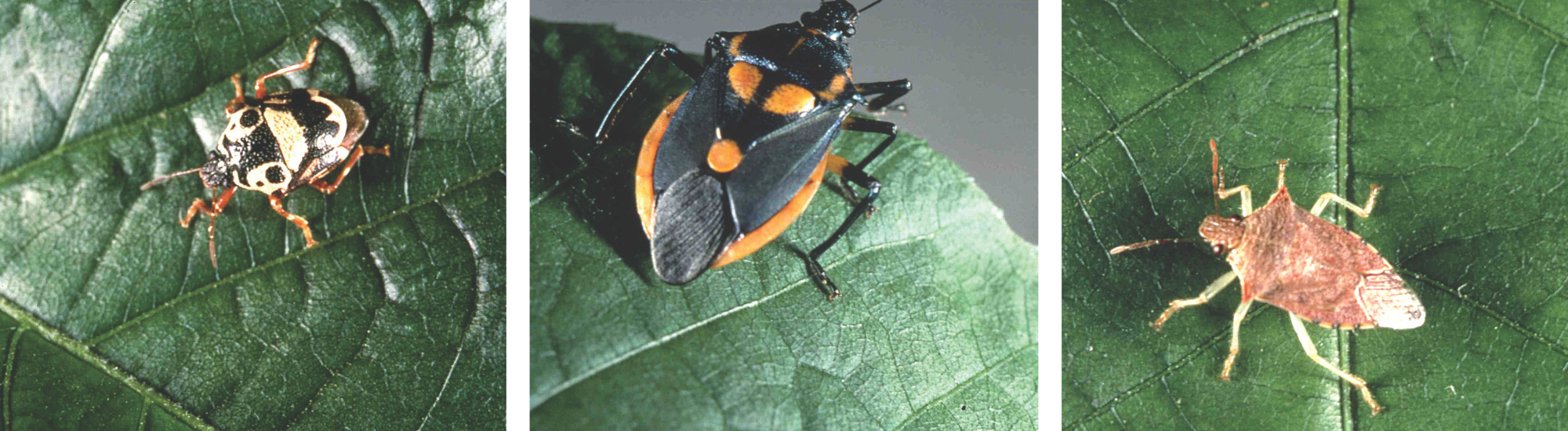
Predatory stink bugs from the left: Anchor stink bug, Florida predatory stink bug, spined soldier bug. (Photos by Louis Tedders)
- Predatory
- Anchor stink bug (Stiretrus anchorago (Fabricius))
- The anchor stink bug is 0.3 to 0.4 inches long and black with markings that are orange and white, with some other colors present. They will prey on caterpillars and beetle larvae.
- Florida predatory stink bug (Euthyrhynchus floridanus (L.))
- Also called the Halloween bug, this stink bug is 0.5 to 0.7 inches long. They are easily distinguishable by their black body with a pattern of red or orange. As generalist predators, they prey on a variety of different insects and may attack prey in groups akin to a pack of wolves.
- Spined soldier bug (Podisus maculiventris (Say))
- This bug is 0.33 to 0.51 inches long and pale brown in color. Its common name comes from the spikey extensions on the “shoulder.” Feeds on a variety of insects including several major crop pests such as caterpillars.

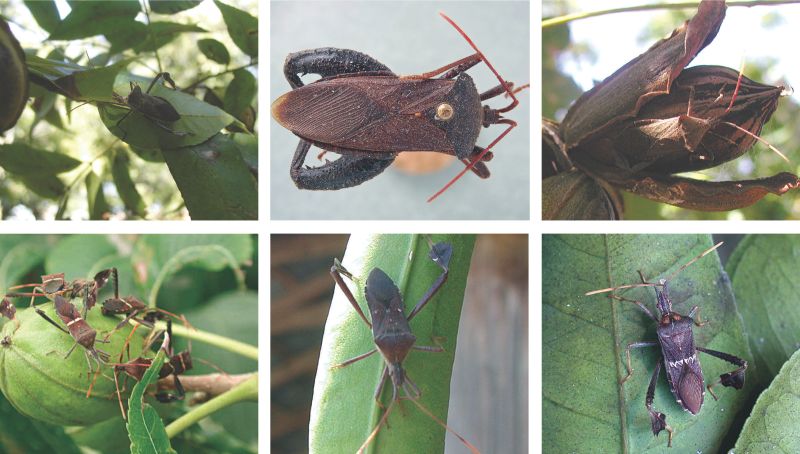
Various leaffooted species found in pecan, clockwise from the top left: Giant leaffooted bug, Florida leaffooted bug, A. terminalis, L. oppsitus, Eastern leaffooted bug (Photo by N. Troxclair); Leptoglossus zonatus (All other photos by Bill Ree)
- This bug is 0.33 to 0.51 inches long and pale brown in color. Its common name comes from the spikey extensions on the “shoulder.” Feeds on a variety of insects including several major crop pests such as caterpillars.
- Anchor stink bug (Stiretrus anchorago (Fabricius))
Leaffooted Bug Diversity
Leaffooted bugs are characterized by longer and more slender appearance than stink bugs. Most have a flattened leaf-like segment on the leg section of the hind leg. They bear a resemblance to assassin bugs but can be easily distinguished by their long, thin mouthparts as opposed to the broader mouthparts of an assassin bug. Immatures look like miniature wingless adults but can be very colorful in appearance.
- Giant leaffooted bug (Acanthocephala declivis (Say))
- Giant leaf-footed bugs are about 1.1 to 1.3 inches long and look like they are wearing shoulder pads. The males have much larger hind legs than the females.
- Florida leaffooted bug (Acanthocephala femorata (Fabricius))
- Florida leaf-footed bugs are 1 to 1.1 inches long. The shoulders are more reduced in this species. The male’s upper leg is swollen and bears a large spike, while a female has slender legs with several small spikes.
- Acanthocephala terminalis (Dallas)
- A. terminalis are 0.7 to 0.98 inches in length and are easily distinguishable by the orange or yellow tips at the ends of the antennae.
- Leptoglossus oppositus (Say)
- L. oppositus are a dark reddish-brown with three white spots above the wings. The leaf-like structures on the legs are deeply scalloped.
- Eastern Leaffooted Bug (Leptoglossus phyllopus (Linnaeus))
- Eastern leaffooted bugs are 0.7 to 0.8 inches long. They have a straight white or yellow bar across the back. This species is regarded as the most significant nut pest of all leaffooted bugs.
- Leptoglossus zonatus (Dallas)
- L. zonatus is 0.75 to 0.82 inches long and like the Eastern leaffooted bug. However, it bears two yellow spots behind the head and the white bar across the back bears a more zigzag shape.
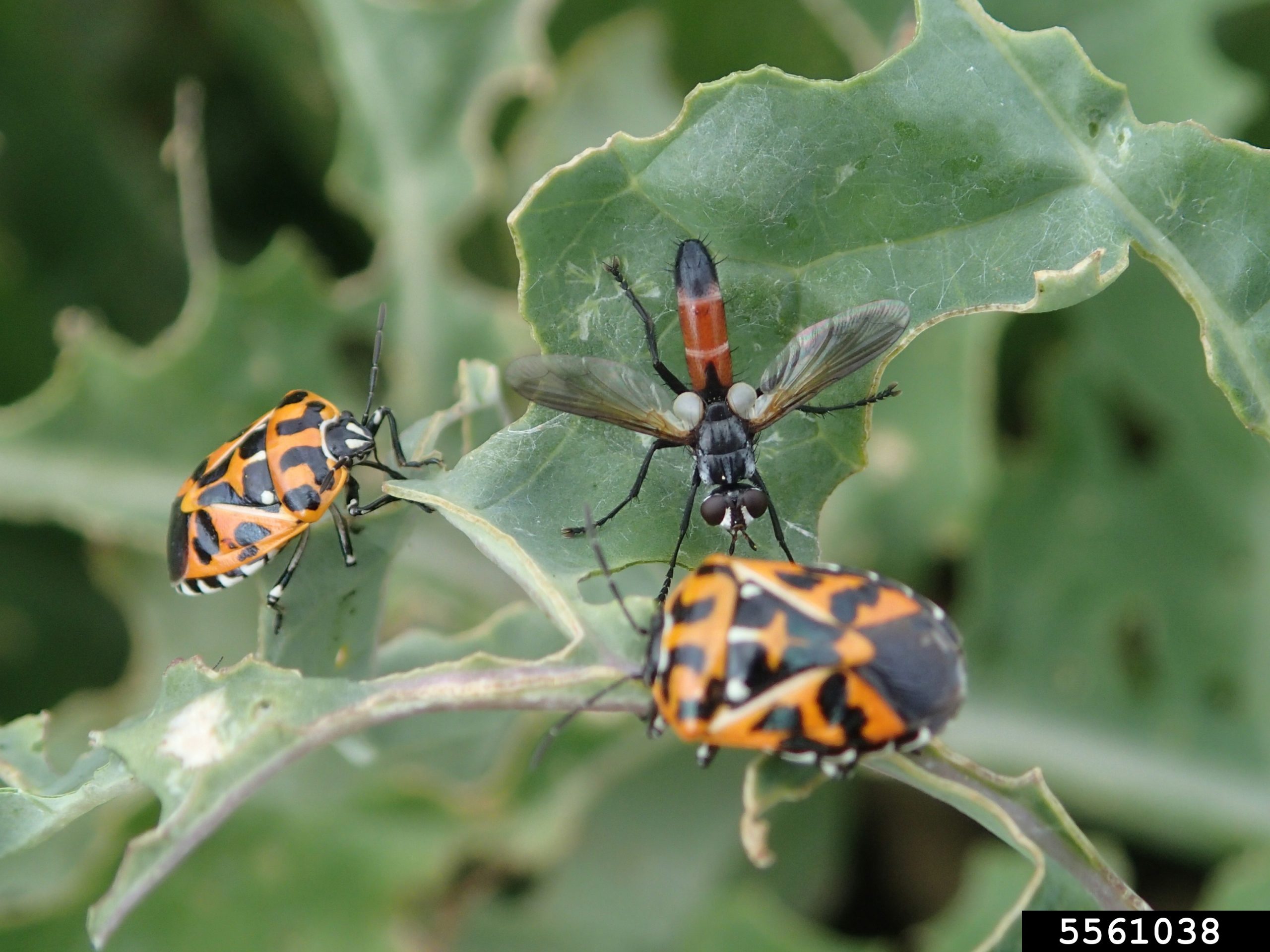
A feather-legged fly attempting to parasitize a Harlequin bug. (Photo by Whitney Cranshaw, Colorado State University)
Management
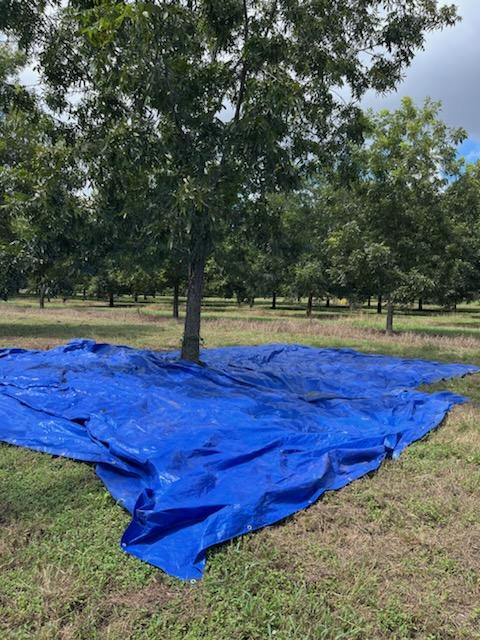
The ability to feed on many different types of plants makes the control of stink bugs and leaffooted bugs difficult. While they will attack pecans primarily during two stages, fruit enlargement and kernel filling, the length of these stages makes timing tough. Several pyrethroid insecticides such as bifenthrin or zeta-cypermethrin can be used for management but will only temporarily suppress populations because stink bugs and leaffooted bugs can quickly recolonize from outside habitats. Broad-spectrum insecticides have the disadvantage of causing post-treatment aphid flares, thus it is important to forestall use of these as late in the season as possible and as few times as possible to achieve control. The recommended treatment threshold in pecan orchards is to spray when one bug (be sure it is a pecan pest species) is found per 40 terminals. Or a knockdown spray can be used by placing a sheet around 20 percent of the area under the tree. When five or more bugs are found following a knockdown spray, treatment of the orchard is necessary.

Management of these pests in pecan orchards should consider the surrounding habitats. Common breeding hosts include many row crops such as cotton, soybeans, peas, and sorghum. If at all possible, it is also advised not to plant other crops that serve as hosts for stink bugs and leaf-footed bugs near orchards, especially if these are harvested earlier in the season than the pecan orchard. Harvesting these alternative food sources pushes stink bugs and leaffooted bugs into the orchard as they look for food.
Planting ‘trap crops’ can lure stink bugs and leaf-footed bugs away from pecans. These may be established in strips within the tree rows or fringe plots outside the orchard footprint. They can consist of wild hosts, or crops such as black eye pea, purple hull, crowder pea, or millet planted along the edge of an orchard. Plant crops in late July to early August and then monitor for leaffooted bugs and stink bugs. Apply an insecticide at least once during the life of the trap crop when stink bug and/or leaffooted bug populations are building. It is important that these pests be controlled on the trap crop to prevent it from becoming a source of these pests moving into orchards. Trap crops use resources, such as water, that could go towards that main crop, so trap cropping may not be a viable option if additional resources are not available for use.
For biological control, the parasitic feather-legged fly, Trichopoda pennipes (F.) has been reported to attack all leaffooted bug and stink bug species commonly found in pecan orchards. Overall, careful monitoring and research should be done to determine which methods are ideal for one’s operation. Combining these methods should ideally provide the best outcome.
Acknowledgements:
I would like to thank Ted Cottrell (USDA-ARS, Byron, Georgia) and Monte Nesbitt (Texas A&M AgriLife Extension Service, College Station, Texas) who reviewed this article.
