
Hurricane Helene Damage to Georgia Pecan Crop
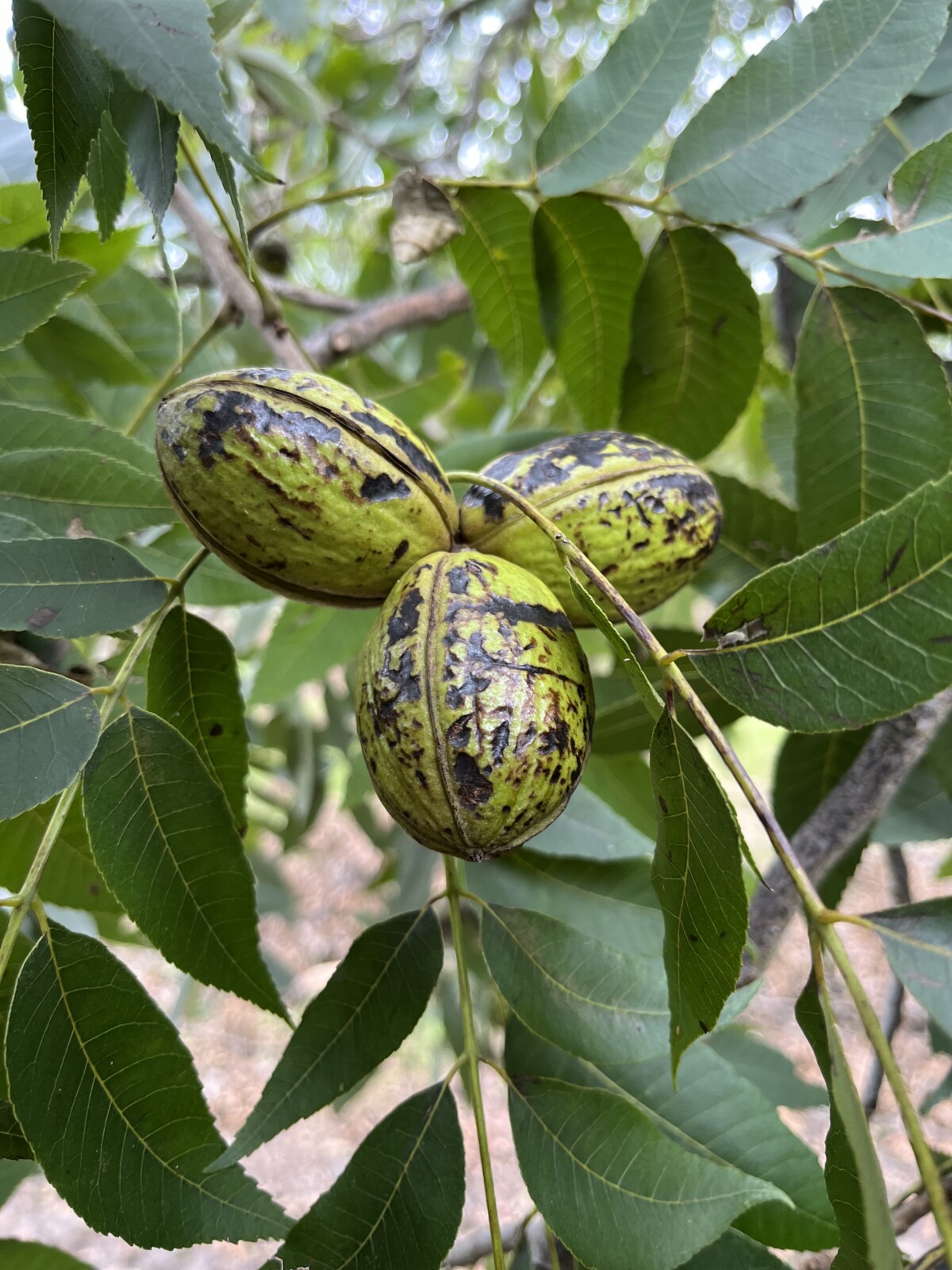
A nut cluster that has been damaged by Hurricane Helene. (Photo by Andrew Sawyer)
Recently, activity has picked up. Since Hurricane Irma in 2017, Georgia has seen several storms significantly impact its pecan industry. Hurricane Michael in October 2018 became the most damaging storm to tear through Georgia’s pecan belt, causing $100 million dollars in crop loss, $260 million in direct tree loss, and $200 million in future income loss, for a total loss of $560 million to Georgia’s pecan industry. Some growers in southeastern Georgia have suffered storm losses three times over the last 12 months.
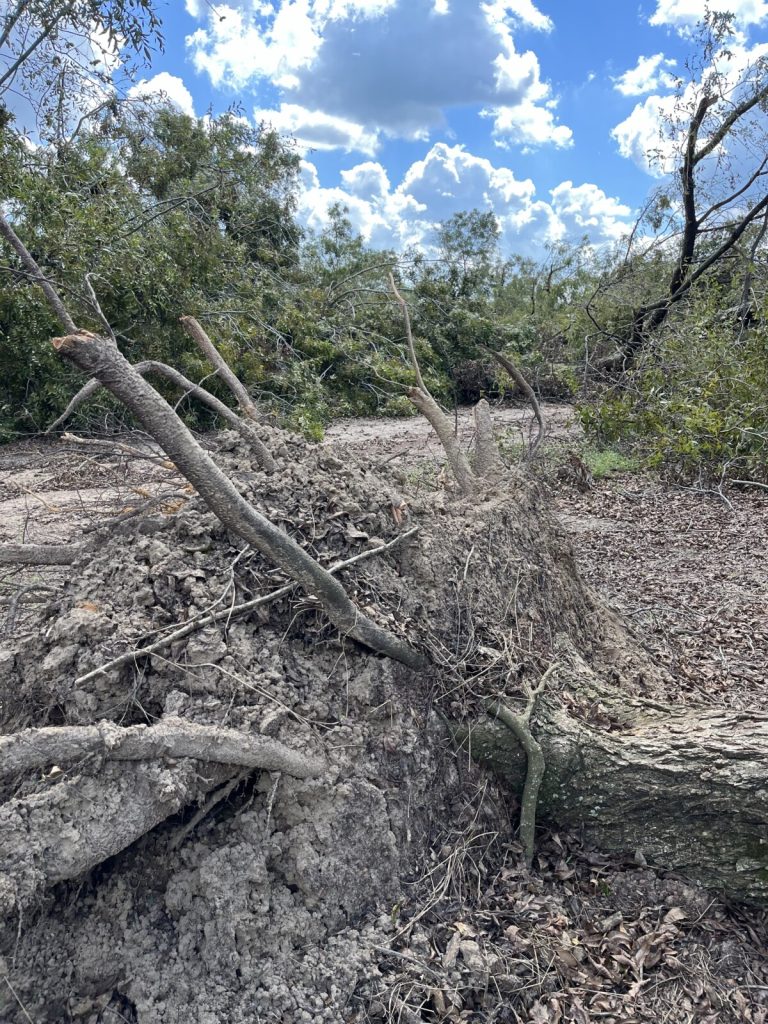

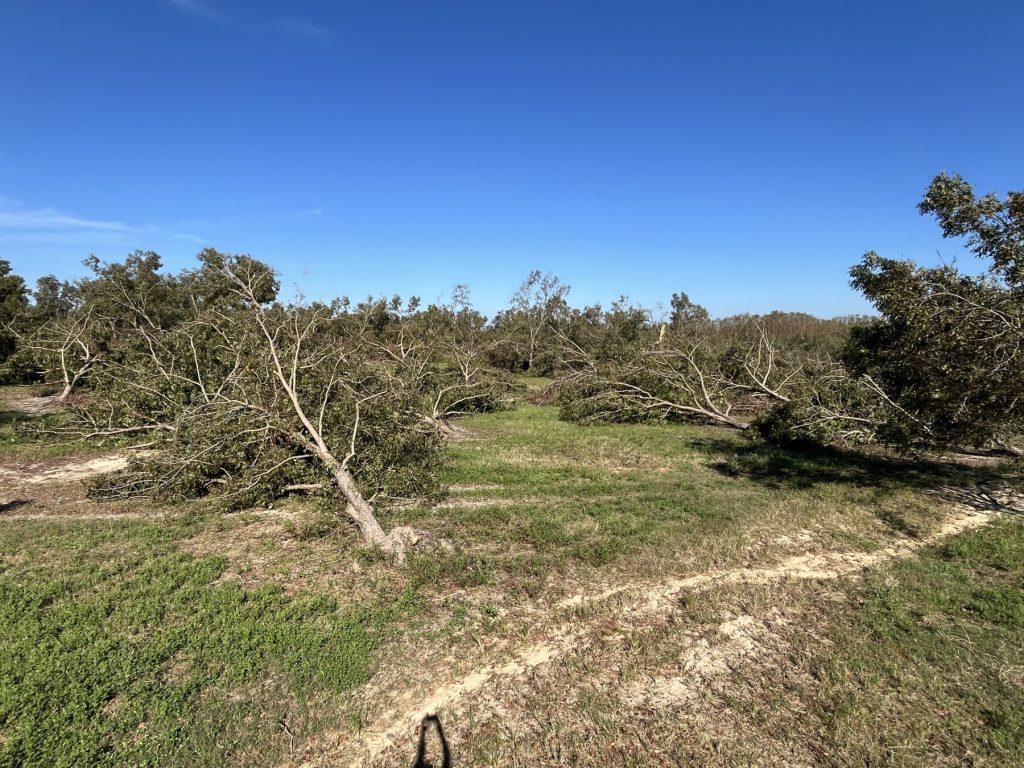
Nothing we have experienced in the past could have prepared us for Hurricane Helene, which moved into the state in the early morning hours of Sept. 27 with wind speeds near 110 miles per hour in Lowndes County, Georgia. Unlike most storms, Helene failed to weaken as it moved further inland cutting an unprecedented swath of damage. Along the path of the storm’s eye, the damage is similar from Valdosta on up to Augusta, 260 miles away. Almost all of this damage is to the east of Interstate 75.
Pecans are grown throughout this area, and while there are large pecan producers in this region, many of the growers in East Georgia are small producers. The storm affected 51 counties, almost all of which grow pecans. Perhaps the greatest description of the storm’s unprecedented severity is found in the fact that prior to this storm, the most power poles lost to a single storm in Georgia was 1,700. According to Georgia’s Governor Brian Kemp, 8,000 power poles were lost during Hurricane Helene. A similar unprecedented scale of destruction has occurred for Georgia’s pecan acreage.
The counties affected by Hurricane Helene account for about 33 percent, or a third, of Georgia’s pecan acreage. I spent the week following the storm driving throughout much of the area. The damage is severe, perhaps less so on the fringes, but still significant. The eye’s path seems to be found on a line from Valdosta to Douglas and Vidalia and on up to Augusta. All along this path, orchards on the eastern edge of the eye have been destroyed.
Prior to the storm, many areas experienced 6 to 8 inches of rainfall. The arrival of the storm’s winds sent trees toppling. In this storm, we seem to see many more large trees (aged 30 years and up) blown over than younger trees. This is the opposite of what we saw with Hurricane Idalia in 2023, in which the majority of trees lost were in the 8- to 20-year-old range. We still see losses from that age range with Helene, but to a much lesser extent than with older trees. Early estimates are that 70 percent of trees 30 years and older were lost to Helene, while 30 percent of trees aged 8 to 29 years were lost. Of course, there is considerable variation in damage throughout the area, with some orchards along the path near the eye losing 100 percent of producing trees.
At this time, our preliminary crop loss estimate is at least 75 percent in the affected region. This equates to just over 36 million pounds of pecans lost from the 2024 crop. Most of the nuts on remaining trees have been blown off. As we all know, there could be more losses that we do not yet see as a result of nuts beating against each other in the storm, bruising the shucks, and damaging the pedicel holding the nut to the tree. Such injury can interrupt maturity causing further nut losses.
When we evaluate losses for a perennial crop like pecan, we have to look at three different kinds of loss: direct crop loss, direct tree loss, and future income loss. Based on our estimate of the volume of direct crop loss, we estimate the direct financial loss to the 2024 crop at $61,790,850. Direct tree loss takes into account the cost of a replacement tree and the inputs to that tree over the course of 7 years until that new tree is in production. Based on the 2024 University of Georgia pecan budget and an estimate of nearly 400,000 trees lost, we estimate the value of direct tree loss at $118,569,776. Future income loss is estimated at $1,050 per tree over 7 years. At nearly 400,000 trees lost that comes to just over $417 million. These are all preliminary numbers, but based on these figures, the total financial loss to the Georgia pecan industry by Hurricane Helene is estimated at just under $600 million. I know that sounds like a huge number, but those who have seen it with their own eyes would not be surprised.
We are continuing to assess tree losses and will likely update these preliminary estimates, but it will take some time. Fortunately, the American Pecan Council has agreed to assist by retaining the services of Land IQ to obtain satellite imagery and data analysis of the storm-affected region before and after Hurricane Helene. These numbers will be corroborated with ground truthing onsite. This will hopefully help us develop a much more accurate picture of our losses to the storm than what we could obtain with subjective on-ground surveys alone. Many thanks to Anne Warden and the APC Board for this assistance. I am also working with Dr. Jeff Cannon, a special ecologist with the Jones Center at Ichauway, a non-profit ecological research foundation, on a number of satellite imagery projects related to the effects of Hurricanes Helene and Idalia on pecan. So, we should have much more information available soon.
Mary Bruorton, Executive Director of the Georgia Pecan Growers Association, and her team have been instrumental in helping to gather information and communicate with state and federal officials as well as Congressional representatives, which will be of great use as they work on disaster assistance for growers. Georgia’s pecan producers are a resilient bunch and are working hard to adapt and deal with this horrific storm. Please keep them in your prayers.