
Innovation at the Pecan Post‑Harvest Research Workshop
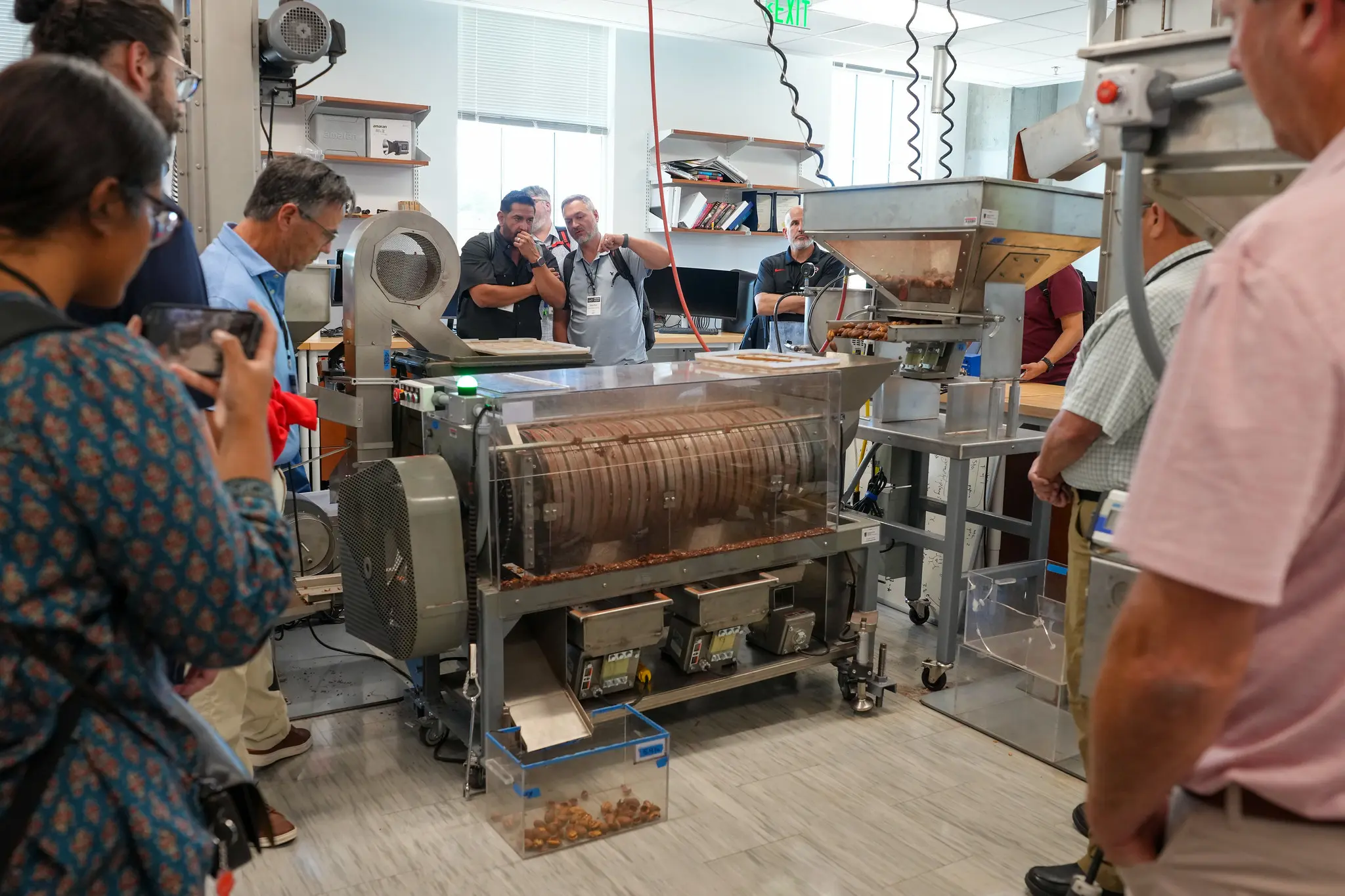
Group takes a look at a 14'' sheller in action at the I‑STEM Research Building at the University of Georgia. (Photo credits from the University of Georgia College of Engineering.)
Research team leaders from the USDA-ARS, the University of Georgia, and Fort Valley State University welcomed attendees. The team announced that Dr. Ted Cottrell has been appointed as Acting Research Leader of the USDA-ARS Fruit and Nut Tree Research Station in Byron, Georgia, while Dr. David Shapiro-Ilan will be serving as the Director at the European Biological Control Laboratory in France.
During the welcome reception, Bailey Segars, Senior Manager of Industry Relations for the American Pecan Council (APC) and the American Pecan Promotion Board (APPB), shared updates on the Unified Pecan Promotion Plan, including targeted marketing efforts and a new growers’ toolkit that includes updated nutrition fact sheets and labels available for free download for industry use. The APC will soon launch a series of free training videos and printed materials focused on food safety and ethics in collaboration with the IEH Academy.

Louisiana Pecan Festival Queen Sarah Brown during this year’s workshop. (Photo credits from the University of Georgia College of Engineering.)
The second day of the workshop launched into research updates. The University of Georgia Manufacturing Living Labs (UGA MLL) shared presentations on conditioning, enhancements in cracking technology, and research to improve the shelling process. The UGA MLL team has been evaluating two different cracking machines to determine the ideal parameter settings for increasing pecan half yield. Claire Floyd, doctoral research student, shared recommended settings for the Meyer Cracker and JC Cracker machines. Details about the research and results are available on this year’s workshop webpage: https://pecanresearch.uga.edu/2026-workshop/
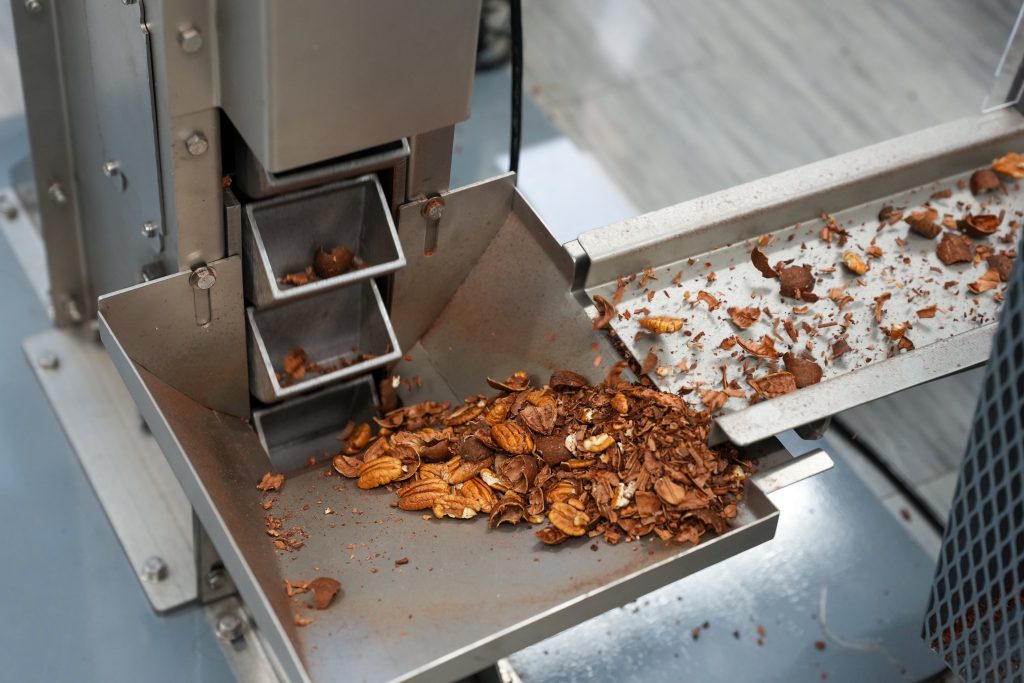
Dr. Seyed Alireza Vaezi, postdoctoral researcher with UGA MLL, presented on computer vision technology to enhance the cracking and shelling process. The UGA MLL team integrated GigE network cameras with high-intensity lighting to rapidly capture images of the entire pecan shelling process. Team members trained the models by labeling over 2,400 images across 1,100 augmented samples using a YOLO Ultralytics framework to identify intact halves, kernel pieces, shell pieces, and occluded images. The computer vision model also has the capacity to instantly calculate half-to-full yield ratios, serving as a live metric for process optimization.
Doctoral students Bruna Karoline Valiate and Ayoub Heydarzade presented their research on smart processing and multi-state experiments focused on industry workflow. One key finding is that conducting these research experiments at the University of Georgia’s Manufacturing Living Labs saves each pecan producer over $226,000 in time, effort, energy, and supplies compared to conducting their own independent research to determine optimal conditions for increasing throughput and final kernel half-yield results.
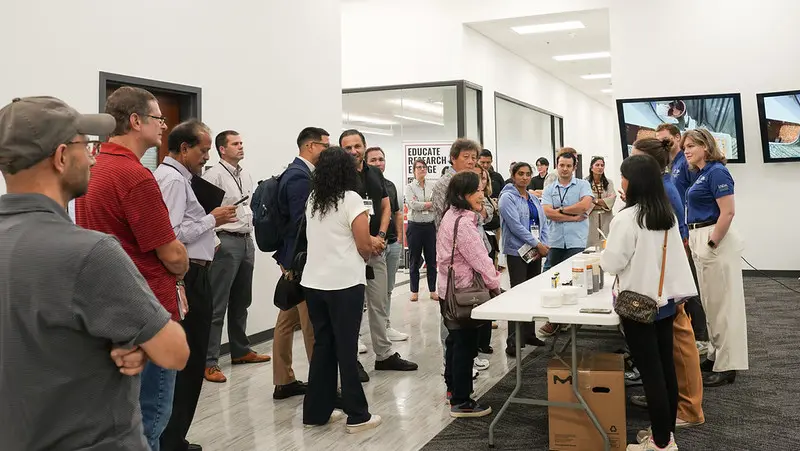
Dr. Cameron Bardsley and his team discuss electron beam irradiation treatment to reduce Salmonella contamination on pecan kernels. (Photo credits from the University of Georgia College of Engineering.)
Researchers from Fort Valley State University’s Food Engineering Laboratory focused on innovative technologies to enhance pecan food safety. Dr. Rabin Gyawali studied how lactic acid can reduce pathogens such as Salmonella and Listeria. Research results suggest that a one percent concentration of lactic acid significantly reduces microbial contamination on processed pecans. The FVSU team also evaluated potential negative impacts on pecan kernel quality, including reduced texture and kernel darkening, and found that lactic acid showed no adverse effects. Future trials will combine methods to enhance food safety, such as integrating blue light with various photosensitizer compounds, applying sonication to in-shell pecans, utilizing pulsed light systems, and using gaseous chlorine dioxide (ClO2) to reduce aflatoxin levels in pecan kernels.
Scientists at the USDA-ARS Fruit and Tree Nut Station in Byron, GA, presented their research to enhance food safety and extend shelf life of pecans. Dr. Cameron Bardsley and his team compared X-ray treatments and E-beam treatments designed to reduce pathogen contamination while maintaining kernel quality. The team is also researching pulsed ultraviolet light to target and reduce pathogens such as E. coli and Salmonella. Dr. Xiuxiu Sun shared her research on using natural, food-safe compounds, edible coatings, and techniques designed to extend storage life, prevent pathogen contamination, and reduce kernel oxidation and rancidity after processing. Other ongoing projects at the Byron Station include exploring new pecan products such as pecan flour and pecan beverages, and opportunities to utilize pecan byproducts.
USDA Research Scientist Kaicie Chasteen-Ko also shared research on food safety trials, and USDA Research Scientist Samantha Sherman presented her research on the quality characteristics of pecans from varieties grown in Georgia and Texas. Several newly crossed varieties show significant potential for increased profitability.
The workshop also included industry lunch presentations. Blair Krebs, Executive Director of the National Pecan Shellers Association (NPSA), emphasized the significant impact of industry-supported research. Through collaborative efforts led by the National Pecan Shellers Association and the National Pecan Federation, the industry has cumulatively secured approximately $27.5 million over 6 years in research funding focused on pecan processing, food safety, and other post-harvest projects.
Eric Lyddy of Modern Electronics and Equipment discussed ME&E’s research collaboration with the University of Georgia to improve pecan shelling equipment efficiency. By partnering with Dr. Beshoy Morkos and his research team at UGA, they have successfully increased the percentage of pecan halves while also enhancing processing throughput. Pecan shellers who have added this technology in commercial shelling plants stated they have seen a consistent 13% increase in pecan half yields, with production rates exceeding 2,000 pounds per hour.
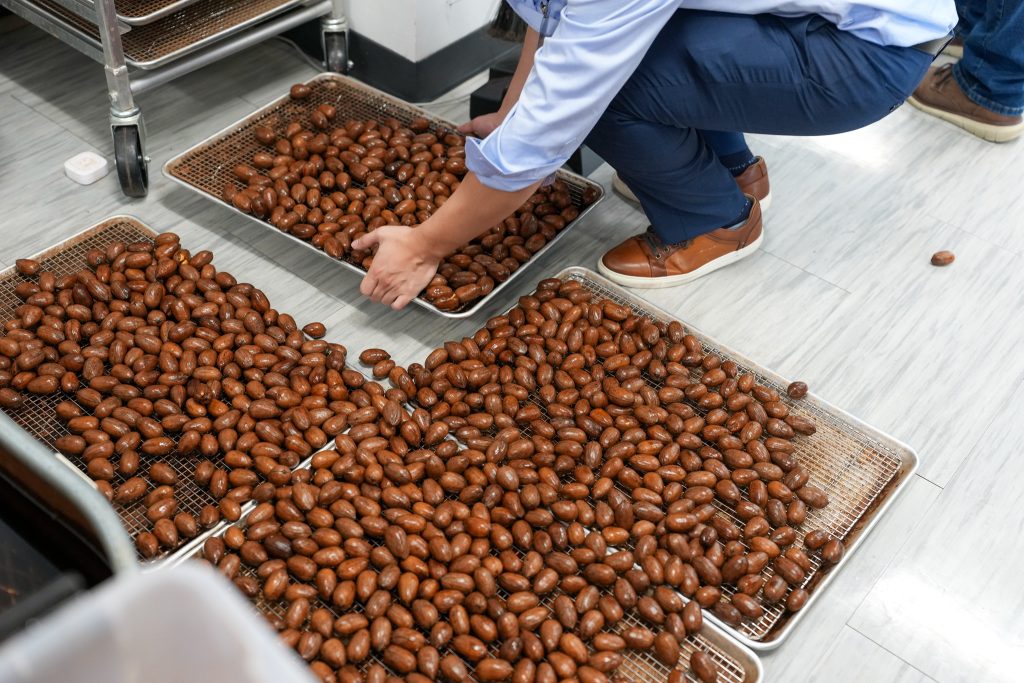

Adam Harrell, Gustavo Ponce, and Hari Manohar shared how Southern Roots Nut Company has implemented artificial intelligence (AI) and programmable logic controllers (PLCs). AI-powered sorting has transformed pecan processing at Southern Roots Nut Company. The company is also researching precise moisture management and drying systems to maximize kernel quality, reduce breakage, and minimize product loss. Hari further highlighted AI’s growing role in food safety and quality assurance.
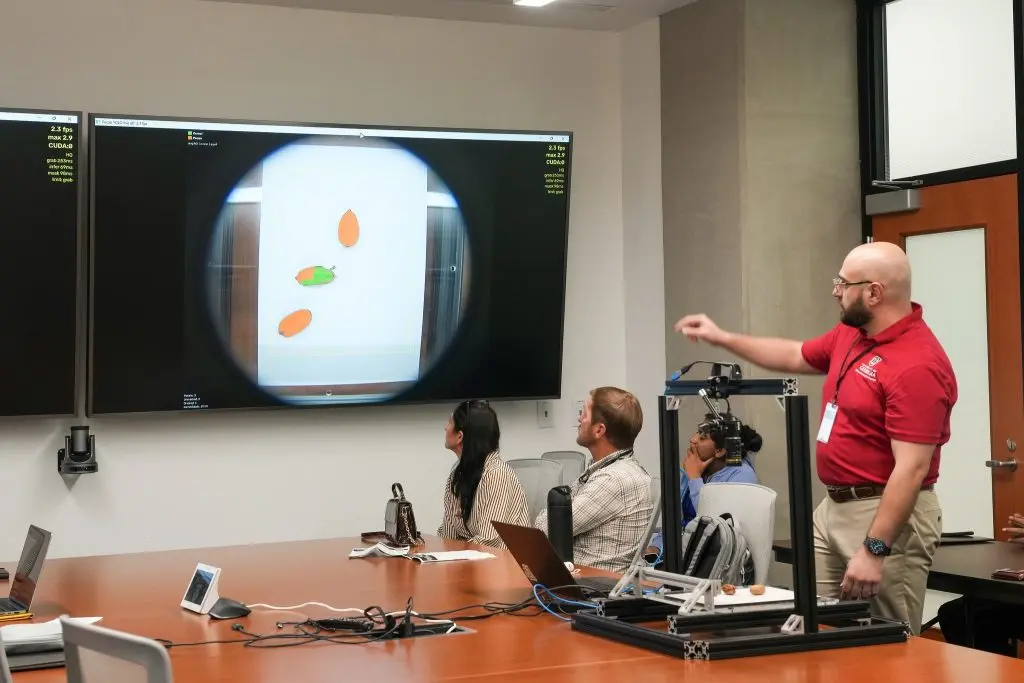
Dr. Seyed Alireza Vaezi discusses Computer vision integration for in-line inspection. (Photo credits from the University of Georgia College of Engineering.)
Later, workshop attendees boarded a charter bus and headed to the UGA research labs to see the research equipment and demonstrations. Senior Research Engineer Hunter Halloran demonstrated how motors, sensors, cameras, feedback controllers, AI, and machine learning have been integrated into the existing pecan cracking and shelling system to improve production. Doctoral research students Aiyana Mozaffar and Mozhdeh Rahmanpour presented a demo of negative pressure to condition pecans before cracking. Dr. Seyed Alireza Vaezi delivered an interactive presentation on using computer vision to enhance pecan cracking. Dr. Xiuxiu Sun, along with Research Scientists Samantha Sherman and Kaicie Chasteen-Ko, presented novel waxes, coatings, and packaging to enhance pecan food safety and storage. Dr. Cameron Bardsley and Dr. Ajit Mahapatra demonstrated Intense Pulsed Light (IPL) and Cold Atmospheric Plasma (CAP) treatments to reduce pathogens.
The workshop concluded with a feedback session on industry research needs. One request was for the UGA team to include other pecan varieties in their research. Currently, the team has been using Desirable pecans as the standard variety for setting parameters and training the AI models, but will incorporate other varieties soon. The UGA team also plans to host hands-on training workshops on computer vision and AI applications. The team is also asking stakeholders to share their research needs using an online survey: https://forms.gle/qDmVmBdTJPGNXaum9.
We appreciate feedback on the needs of the pecan industry, and hope to see you at our next Pecan Post-Harvest Research Workshop.