
Late-Season Pecan Pest Management

Pecan nut casebearer damage to a pecan nut cluster. (Photo provided by Ted Cottrell)
Except for the pecan nut casebearer (PNC) in Texas and westward from there, early to mid-season pests generally tend to be low and not a significant threat. During this period, pest monitoring (e.g. pheromone traps for PNC and scouting for aphids) provides confidence that treatments are not needed, saving you time and money. But sometimes we can be our own worst enemy when it comes to pest management. If you find that pecan aphid or pecan leaf scorch mite populations are high before mid-to-late July, check your early season spray records. For example, some active ingredients (such as the insect growth regulator diflubenzuron) used against the pecan nut casebearer can disrupt natural enemies. There are other pecan nut casebearer products that will get the job done without this adverse effect (see the Commercial Pecan Spray Guide, https://secure.caes.uga.edu/extension/publications/files/pdf/B%20841_14.PDF). If an early season treatment has disrupted these beneficials that play a role in keeping aphids and mites in check, the added cost of an additional treatment application may be needed.
Overall, pecan aphid management has changed for the better over the years. First, the establishment of the exotic, multicolored Asian lady beetle in the U.S. has been highly beneficial for pecan aphid control. Early season populations of the blackmargined aphid and the yellow pecan aphid provide food for population buildup of this lady beetle, and other natural enemies such as lacewings and parasitic wasps, in orchards thus negating the need for early season insecticide intervention. Another change in pecan aphid management is the move away from broad-spectrum organophosphates for pest control. Those products flare aphid populations thus requiring additional treatment applications for aphid control. Now we use more target specific products such as acetamiprid, imidacloprid, sulfoxaflor, and flonicamid. These chemistries can have a negative impact on natural enemies but not nearly so great as with organophosphates. But again, let the natural enemies control the aphids early and save these products for the late season when the black pecan aphid is a threat.
As we move into the late season, the usual group of culprits must be managed, and usually their control must be done concurrently. This late-season group includes the pecan weevil, hickory shuckworm, stink bug/leaffooted bug, and pecan leaf scorch mite. Understanding the biology and seasonal abundance of these pests and their potential to cause damage during the late season helps us keep them in check.
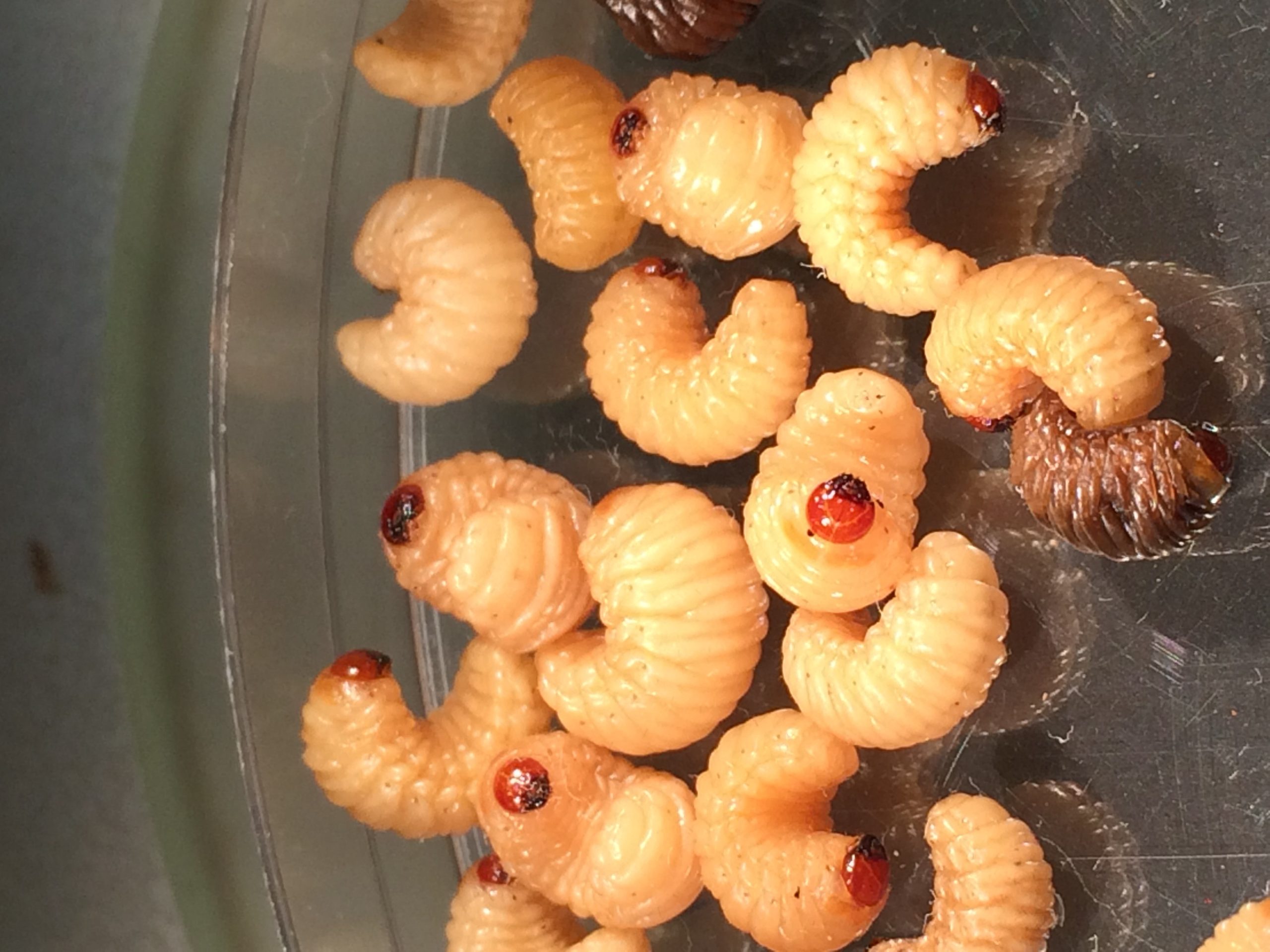
Pecan weevil larvae. (Photo provided by Ted Cottrell)
The feeding and reproductive biology of the pecan weevil dictates its seasonal activity attacking host trees. In pecan orchards, the pecan weevil typically begins emergence shortly before shell hardening. Weevils emerging before shell hardening will feed on nuts generally leading to nut abortion. After the pecan shell hardens, feeding on shucks will continue and mated females will bore through the shell to lay their eggs on the kernel. If this pest is in your orchard, it must be controlled. Lack of control leads to a buildup of pecan weevil that will absolutely destroy your crop. Detecting weevils in orchards has been studied using different passive traps. Several traps focus on capturing weevils crawling up the pecan trunk (e.g., Circle trap, burlap bands) or a simulation of the trunk (i.e., Tedders pyramidal trap). Cone emergence traps have also been used but a single trap samples a small area and only captures weevils emerging from soil directly beneath this trap. Sampling harvested nuts for weevil emergence holes will also identify infested orchards. Across much of the pecan belt, larval pecan weevils begin to emerge from nuts in late September, so their damage is visible when harvested after this time.
Those natural enemies that can handle the pecan aphids up to the mid-season usually cannot prevent economically damaging chlorotic leaf injury elicited by low numbers of the black pecan aphid. This relates back to pecan foliage becoming increasingly susceptible to black pecan aphid injury as the season progresses. Even when there is a late-season population of blackmargined aphids and yellow pecan aphids, low numbers of the black pecan aphid that persist can cause sufficient damage leading to leaflet abscission. Eventually, the natural enemies will increase and decimate populations of late-season aphids. But this will not happen before the increased late season susceptibility of pecan foliage to low numbers of black pecan aphid leads to economic damage.
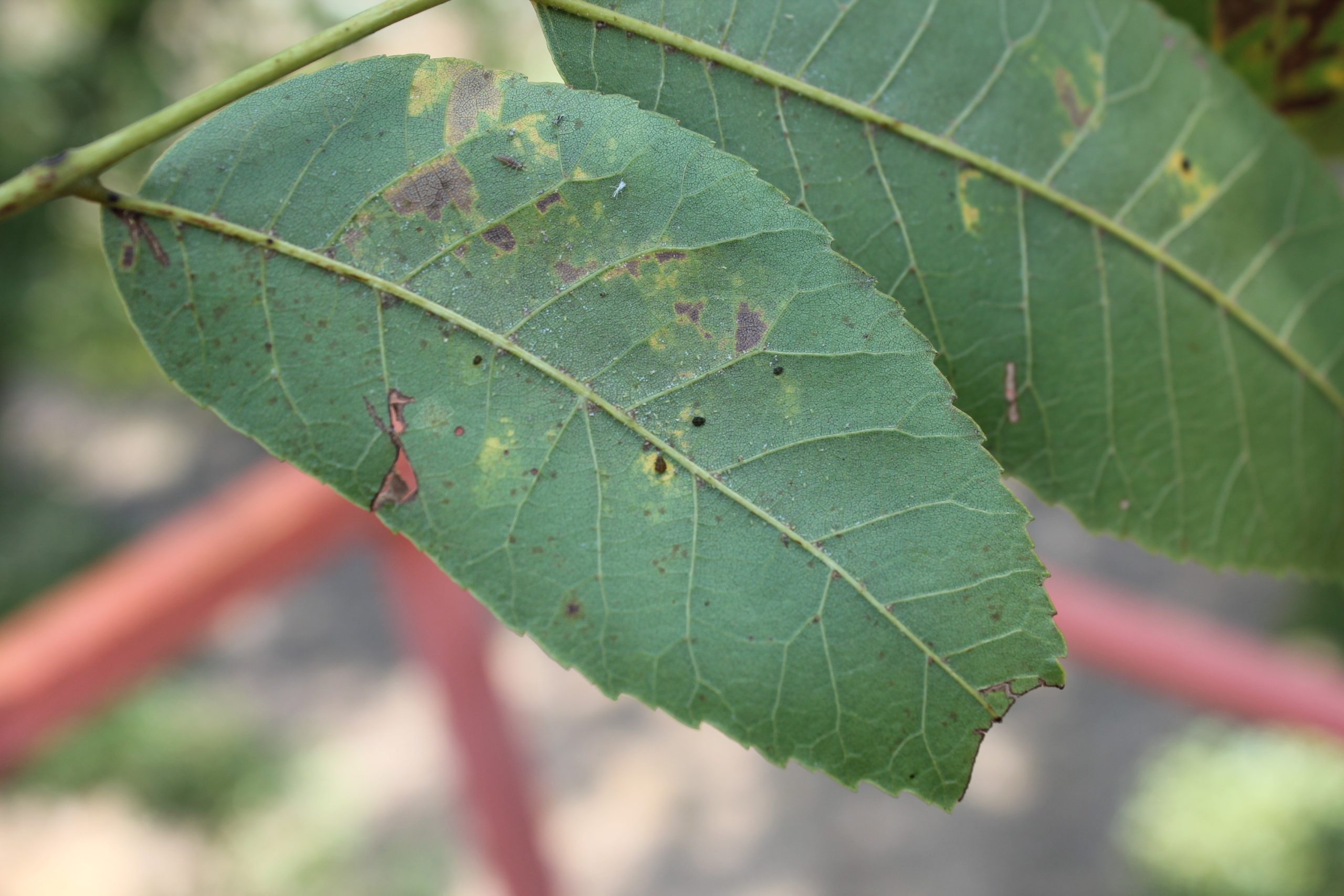
Black pecan aphid and mites. (Photo provided by Ted Cottrell)
Hickory shuckworm damage can occur from early June (when pecan nutlets reach a size that the hickory shuckworm can attack) through the end of the season. Before shell hardening, hickory shuckworm feeds in the shuck but also tunnels into the developing nut causing nut abortion. After the shell hardens, the hickory shuckworm is limited to feeding within the green shuck. Feeding in the shuck at this time of year leads to ‘sticktights’, a condition where the damaged shuck does not split away from the nut. However, keep in mind that sticktights are also caused by certain disease and physiological conditions, not just the hickory shuckworm. A tell-tale sign of a shuckworm infested pecan is the presence of the shuckworm pupal skin protruding from the exit hole of the shuck. Populations of hickory shuckworm usually build during the season leading to damaging population levels during the late season.
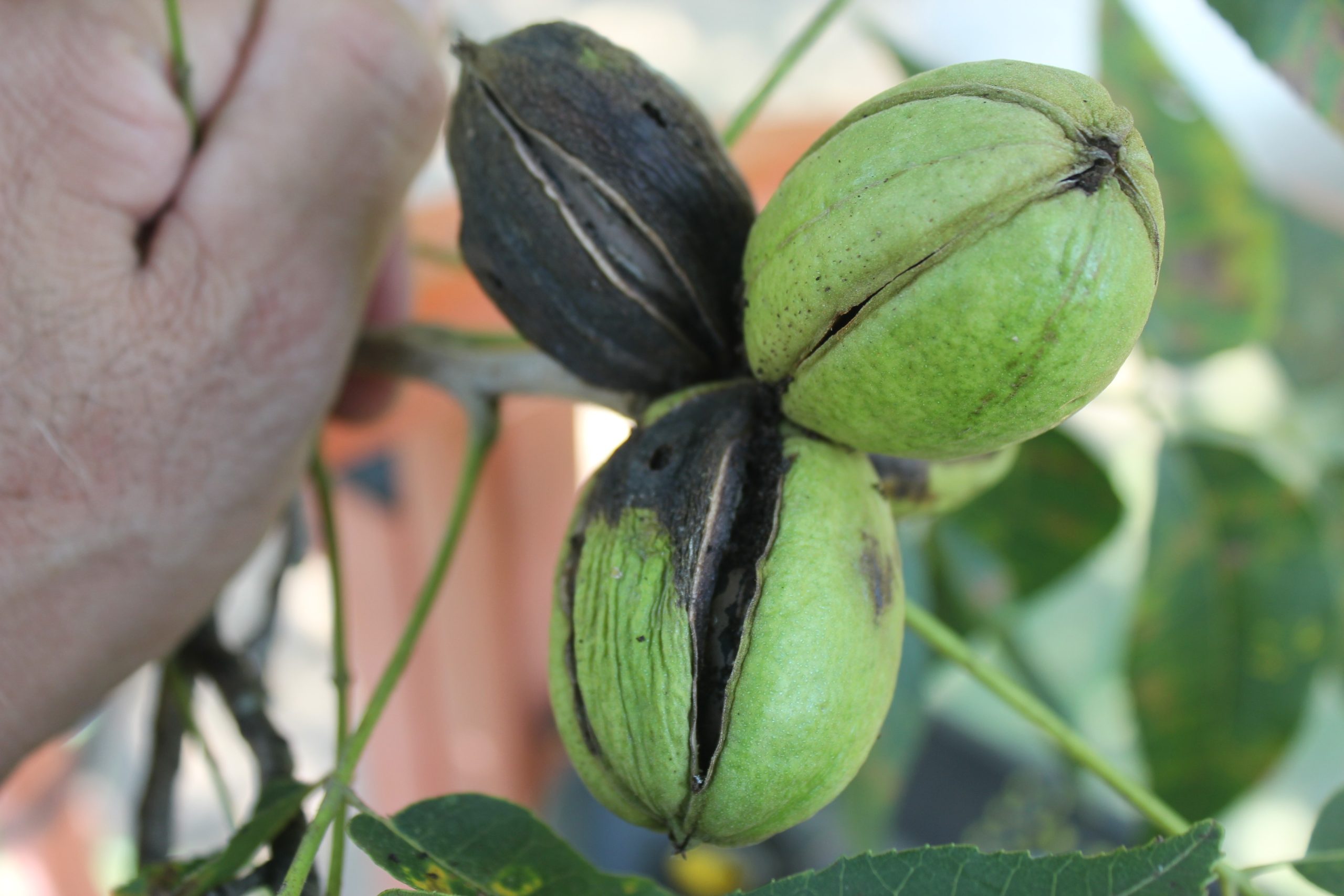
A cluster of pecan nuts with hickory shuckworm damage to the shuck. (Photo provided by Ted Cottrell)
Stink bugs and leaffooted bugs are a difficult group to manage. This pest group operates at the level of the landscape and is greatly influenced by the dispersion of food plants across that landscape – your orchard is just a part of their landscape. Because of this, their seasonal activity in any particular pecan orchard is dictated by numerous factors which may change from year to year. Stink bugs disperse across a landscape in search of food. As the quality of food on a given host plant decreases, they move to another more-suitable host plant. Food availability can be affected by drought leading to tree hosts being more reliable sources of food and moisture. Throughout the season, stink bugs will move into and out of pecan orchards. This makes it difficult to establish effective thresholds for management. The availability of suitable host plants near a pecan orchard affects stink bug abundance in orchards and may serve as a sink keeping stink bugs out of orchards. But when that host plant is no longer suitable, the sink may become a source for stink bugs entering orchards. Each year these factors can change – availability of favored row crops, naturally occurring host plants and drought – leading to every season being different for stink bug presence in an orchard. The fact that multiple species of both stink bugs and leaffooted bugs attack pecans further complicates things, as we lack a thorough understanding of the factors that determine individual species feeding patterns and how each threatens pecans.
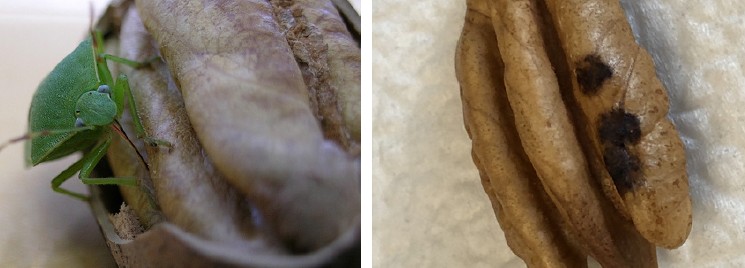
Adult green stink bug feeding on a pecan kernel (Left). A pecan kernel showing stink bug feeding injury, kernel spot (Right). (Photos provided by Ted Cottrell)
The pecan leaf scorch mite, a species of spider mite, is one of many mite species encountered on pecan foliage. Most mites found on pecan are insignificant and can be ignored. Of those mite species feeding on pecan foliage, the pecan leaf scorch mite is the only one, so far, that may need to be controlled. Identifying that the mite you have observed is truly a scorch mite is important, otherwise mite control can be costly for no good reason. Correctly identifying that leaf damage is caused by the scorch mite is important. Scorch mites on undersides of leaves are messy, leaving silk and molted exoskeletons. When examined under a microscope or a hand lens, they are white with two red ‘eye’ spots on the top. If you have what appears to be mite damage but the underside of the leaf does not show evidence of mites, that damage was likely caused by something else. Generally, scorch mites are a late season pest, especially during hot, dry years or when broad spectrum insecticides have been applied that reduced natural enemy populations.
It is inevitable that several of these pests will need to be managed concurrently during the late season, and this is possible with the insecticidal chemistry available. Management of the pecan weevil, and the other late season pests, is different in large acreage orchard tracts than in small native stands. This may lead to diminished efficacy of the same product under one management practice versus the other but is usually related to application differences of the practices. Remember that 1) adult pecan weevils fly and are adept in finding trees with nuts and 2) orchard floor treatments and trunk sprays do not protect against outside weevils flying directly into the pecan canopy.
The benefit of spraying the pecan canopy is that certain insecticides (e.g., bifenthrin) with broad spectrum activity will control pecan weevils, stink bugs and hickory shuckworm at the same time, when all three need to be controlled. However, the broad-spectrum nature of this treatment can flare aphid and mite populations. This can be countered with a tank mix using one of the aphid treatments and a miticide with the broad-spectrum treatment. The time, effort and cost required to get a crop this far into the season demands that late-season pests be controlled to ensure a good harvest.
