
Optimizing the Use of Beneficial Nematodes for Control of Pecan Weevil
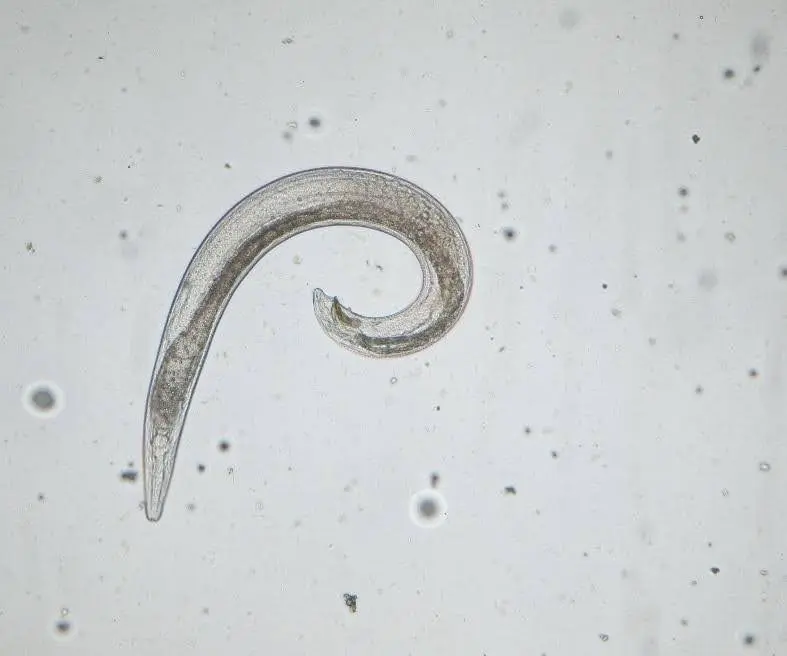
Figure 3. Adult male Steinernema feltiae. Imagine by Kate Anderson.
SUMMARY
- Pecan weevils are a significant pest of pecan, causing damage through feeding on the nut.
- Entomopathogenic nematodes (EPN) are beneficial organisms that cause high mortality to pecan weevil with studies showing a 1% survival rate of the pest after 2 years of nematode applications to the soil beneath the tree canopy.
- Methods of application and formulations to improve EPN in the field are a key aspect of current research.
- Commercially available strains of EPN can provide control of weevils one year after an application and further research is being conducted to determine if lower rates of application can provide sufficient pest control.
- EPN treated with pheromones, or chemical signals among nematodes, increase the rate of infectivity and pest mortality compared to EPN alone.
- Nanoparticle formulations can provide protection from environmental stressors such as ultraviolet radiation, which can reduce EPN viability.
INTRODUCTION
The pecan weevil, Curculio caryae, is a significant pest of pecan in regions where it occurs. The current distribution of pecan weevil extends from New York to Iowa, south to Oklahoma, and across the Southern United States from West Texas to Florida. They are absent from pecan growing regions west of Val Verde and Crockett County, Texas with the exception of a few isolated populations in Far West Texas and New Mexico. Both adult and larval weevil cause economic damage by feeding on the nut. Adult weevils emerge from the soil beginning in late July through October, where they climb up the trunk or fly to the canopy. Prior to the gel stage, adults can cause damage by directly feeding on pecan nuts leading to premature dropping. Once the nuts reach the gel stage, females lay eggs in the nut where developing larvae feed and cause significant damage to the kernel. Once the developing larvae reach their final larval stage, they exit the nut, drop to the ground and tunnel between 8-10 inches into the soil to create a pupal cell, or a protective chamber, where they will remain to transition to adults. The majority of the weevil population (approximately 90%) that enter the soil during any one season will remain in the soil for two years developing, first as larvae, then as adults before emergence, but roughly 10% will delay emergence until a third year (Harris 1985).
The primary control in conventional orchards relies on insecticides applied to the canopy to target adult weevils (Wells et al. 2016). Monitoring adult emergence using traps, such as Circle traps or pyramid traps (also called Tedders traps), is key to timing insecticidal sprays to target adults before eggs are laid. While highly effective against adults, once eggs are laid within the nut, the insecticidal sprays are unable to reach the eggs or larvae. Since pecan weevils spend the majority of their lives in the soil, and multiple generations coexist at any given time, incorporating management practices that target the soil dwelling life stages may reduce insecticide applications during nut production. While there are no chemical insecticides labeled to target the pest in the soil, beneficial nematodes known as entomopathogenic (insect-killing) nematodes (EPN) are an alternative to chemical insecticides, which can target weevils in the soil before they can cause damage to the pecans with high levels of control (Shapiro-Ilan and Gardner 2012; Shapiro-Ilan et al. 2017).
Entomopathogenic nematodes are beneficial round worms that infect insects without harmful effects to plant or human health. EPN are highly effective at controlling a variety of pests such as thrips, fungus gnats, various wood borers, white grubs, and many more. (Shapiro-Ilan and Lewis, 2025). EPN have a mobile, free-living stage (the infective juvenile) that can search for and infect insects in the soil. Once inside the insect, the EPN kill their host with the help of a bacterial symbiont stored within their gut and the EPN reproduce inside the insect before exiting to find a new insect and begin the cycle again. Commercially available EPN can be applied with water in the pecan orchard using standard equipment such as irrigation systems or pressurized sprayers for drench or band applications. Because EPN are living organisms, special consideration to environmental conditions and application equipment must be taken to ensure they remain viable during the application process.
Applications should be applied when ground temperatures are between 60°F-85°F. It is also important to consider the length of time the EPN will be sitting in a tank-mix and the tank-mix temperature as these conditions may affect viability. When applied through drench or spray methods, it is essential that the nozzles and screen mesh are no smaller than 50 microns to allow nematodes to pass through the spray system. Agitation may also be required to allow for even distribution of EPN during a spray application. While EPN can withstand spraying pressures of 200 to 300 psi, lower pressures (30-90psi) are ideal to minimize mortality to the EPN (Moriera et al 2013). Once applied, EPN are susceptible to environmental conditions such as desiccation or ultraviolet (UV) radiation. Irrigation before and after application can help to reduce EPN mortality from desiccation. To maximize the efficacy of EPN, applications should be avoided when the UV exposure is highest, midday; though this issue is less important when applying EPN under the tree canopy.
EPN have shown to be a promising biological method of control for pecan weevil (Shapiro-Ilan and Gardner 2012; Shapiro-Ilan et al. 2017). In a two-year field study in which EPN were applied to pots with a known quantity of weevils, two applications of EPN (one per year) provided substantial mortality, with only 1% of weevils surviving after the second-year application (Shapiro et al. 2012). This study showed that successive applications to a single generation provided substantially higher mortality than a single application.
Despite the excellent capability of EPN to control pecan weevil, the approach can be costly. Therefore, improvements to increase efficiency, consistency and sustainability (persistence in the soil) are needed to foster broader adoption. Below we outline several approaches to improving the use of EPN in the field including increasing EPN persistence, decreasing application rates, incorporating EPN pheromones to increase infectivity, and protective formulations against environmental stressors.
IMPROVING THE USE OF EPN
Increasing EPN persistence and decreasing application rates
In addition to timing and number of applications, addressing the persistence of EPN strains and rate of application is also an important consideration to reduce costs to growers. While EPN can persist in the soil from one year to the next, some EPN strains (referred to as persistent nematodes) have been found to survive in the soil for multiple years at levels sufficient to reduce pest damage in a variety of crops (Shields et. al. 2018, 2021). A two-year field study in pecan orchards in Georgia and Oklahoma was conducted to compare two persistent nematode strains to two commercially available strains, Steinernema carpocapsae (All strain) and S. feltiae (Slusher et al. 2025). A single application of either persistent EPN or the commercially available strains was made to the base of individual pecan trees in 2022. Any emerging adult weevils were collected in Circle traps during the 2022 and 2023 field season.
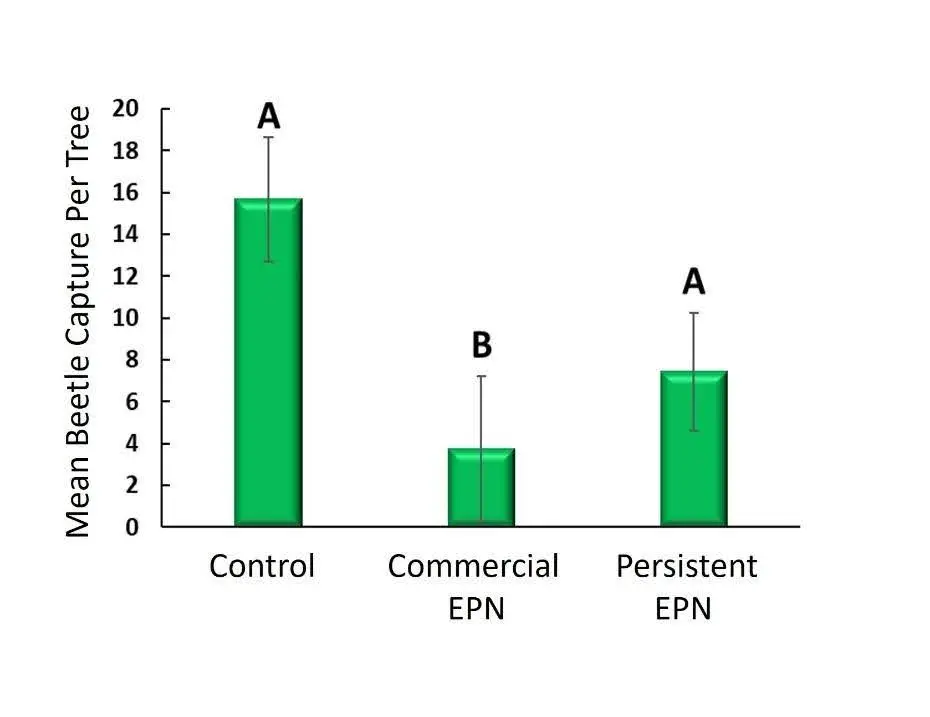
Figure 1: Bars represent the mean number of pecan weevils collected per tree during a two-year study in Oklahoma. Control received was water only and received no EPN (beneficial nematodes), “Commercial EPN” are commercially available strains of EPN and “Persistent EPN” are selected persistent strains of EPN. Letters above the bars indicate significant differences among the means. Graph produced from data produced in Slusher et al. 2025.
Adult emergence collected in Oklahoma one year after EPN application showed a significant reduction in weevil emergence with commercial strains (Fig. 1). In this study, EPN were applied 20-times below the standard rate of 2.5 billion nematodes per ha, and while control was observed one year after application in Oklahoma, this rate may not provide sufficient control consistently, especially for large orchards. Further research is needed to determine the level of control that can be achieved at reduced rates, while 20-times below the standard was not sufficient, five or 10-times less than the standard rate may be effective. While ongoing research aims to address the effective rates, additional research is needed to address factors that impact the persistence of EPN in the soil, such as soil type, ground cover, and management practices (i.e. irrigation, chemical inputs).
Incorporating EPN pheromones to increase infectivity
EPN pheromones, or chemicals signals linked to communication among the nematodes, enhance EPN behaviors such as dispersal and host penetration, increasing overall infectivity (Kaplan et al. 2012). EPN use these pheromones to signal to one another when it’s time to leave the host and forage through the soil to find a new insect host and infect it. In a field study, the efficacy of a commercially available strain of EPN, S. feltiae, with and without a pheromone treatment against pecan weevil was assessed (Perier et al. 2024). Buckets roughly 1.5 L in volume were placed in the ground around in an organic pecan orchard with field soil and five weevil larvae. Individual pots were drenched with non-treated EPN, EPN treated with pheromone, or a water only control. Seven days after the treatment the larvae were evaluated for mortality. The buckets that received EPN treated with pheromones had higher level of mortality compared to the non-treated EPN (Fig. 2) This study shows that we can use these pheromones to manipulate EPN behaviors such as dispersal. Increased EPN dispersal in the soil increases the likelihood of EPN encountering and infecting pests in the soil like the pecan weevil. EPN, along with pheromones, can also enhance the soil microbiome, attracting microbes that reduce plant stress and diseases (Shapiro-Ilan and Kaplan, 2026). Additional research is needed to address pheromone treated EPN applications on a large scale to better understand the level and consistency of control this amendment provides.
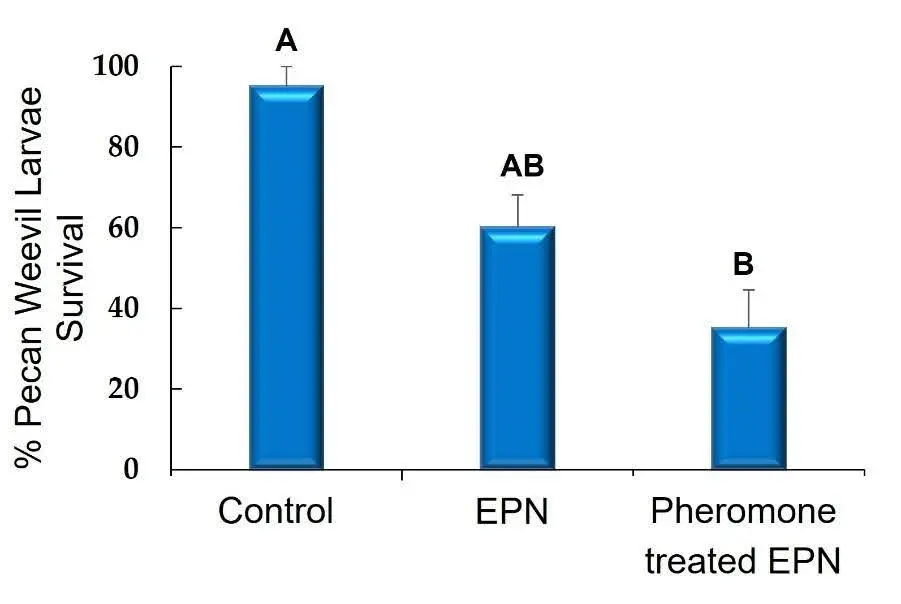
Figure 2: Bars represent the percentage of surviving weevil larvae in a field study conducted to assess the effect of EPN pheromone treatments. Controls received no treatment (water only); “EPN” represents beneficial nematode only treatments and “Pheromone treated EPN” represents EPN that were exposed to EPN pheromones. Letters above bars indicate significant differences among the treatments. Graph produced from data Perier et al. 2024.
Protective formulations against environmental stressors
Incorporating EPN into formulations that can increase their resilience to adverse conditions such as UV exposure, heat, and desiccation can increase their effectiveness in the field. Nanoparticle formulations that are compatible with EPN have been studied to provide protection from desiccation as well as UV radiation from the sun, which can damage the EPN and reduce their viability. Nanoparticles are microscopic in nature and serve to coat or wrap individual nematodes in a protective layer. Under laboratory and natural sunlight conditions, zinc oxide, a compound commonly found in sunscreens, provided protection for EPN against high levels of UV radiation (Wu et al., 2022). Current studies are assessing plant-derived nanoparticles in place of zinc oxide, which have promising results in providing protection for EPN. Under intense UV exposure in the lab, these plant-derived compounds provided high levels of protection compared to a water control and to a Barricade® formulation, which has previously been established as a protectant from both UV radiation and desiccation. In this study, EPN incorporated into the nanoparticle formulations were virtually unaffected and subsequent insect pest mortality was 100% (Kropf et al. unpublished). However, when exposed to natural sunlight, with less intense UV radiation compared to the laboratory, the plant derived compounds did not provide sufficient protection compared to the Barricade® treatment. Although the nanoparticle formulations provided protection from UV radiation, they were not as effective against moisture loss. Future studies will assess these plant-derived compounds in combination with moisture barriers as well as for their ability to provide protection against other environmental stressors such as heat. Furthermore, field studies will be an important text step to address the efficacy of these formulations in pecan orchards.
While EPN are effective at causing mortality to pecan weevils in the soil, research has focused on increasing performance and consistency in the field. Field studies have shown that the commercially available strains of EPN provide greater protection in pecan orchards than strains known to be persistent (at least in the short term) and that when applied in two consecutive years, weevil survival is greatly reduced. The use of EPN in pecan orchards provides growers with an avenue to target pecan weevils in the soil before they cause feeding damage. Currently, research is ongoing in pecan orchards to assess effective EPN strains and application rates in the field to manage pecan weevil. Additionally, research efforts to improve formulations have identified that the use of pheromones and UV protectants can substantially improve EPN infectivity. Through the culmination of these and other ongoing research, we aim to increase the effectiveness of EPN in the field and to lower the economic impact of pests like the pecan weevil by reducing annual populations which translates into less feeding damage, and by reducing the cost of managing this pest with sustainable approaches.
1USDA-ARS Southeastern Fruit and Tree Nut Research Station, Byron, GA, USA
2 Central Mississippi Research and Extension Center, Raymond, MS, USA
3Texas A&M AgriLife Research and Extension Center, Stephenville, TX, USA
Citations
Harris, M., K., 1985. Pecan phenology and pecan weevil biology and management. Pp. 51-85. In W. W. Neel (ed.), Pecan weevil: research perspective Quail Ridge Press, Brandon, MS.
Kaplan, F., Alborn, H.T., von Reuss, S.H., Ajredini, R., Ali, J.G., Akyazi, F., Stelinski, L.L., Edison, A.S., Schroeder, F.C., Teal, P.E., 2012. Interspecific nematode signals regulate dispersal behavior. PLoS One 7: e38735.
Kropf, A.L., Brichka, M., Mechrez, G., Ment, D., Shapiro-Ilan, D.I., 2026. Novel environmentally friendly nanoparticle formulations confer protection against Ultraviolet radiation of Steinernema carpocapsae infective juveniles. Unpublished work.
Moreira G.F., Batista E.S.dP., Campos H.B.N., Lemos R.E., Ferreira M.dC., 2013. Spray nozzles, pressures, additives and stirring time on viability and pathogenicity of entomopathogenic nematodes (Nematoda: Rhabditida) for greenhouses. PLoS One 8(6): e65759
Perier, J.D., Fatma, K., Lewis, E.E., Alborn, H., Schliekelman, P., Toews, M.D., Schiller, K.C., Shapiro-Ilan, D. I., 2024. Enhancing entomopathogenic nematode efficacy with Pheromones: A field study targeting the pecan weevil. J. Invertebr. Pathol. 203, 108070
Shapiro-Ilan, D. I., Cottrell, T.E., Bock, C., Mai, K., Boykin, D., Wells, L., Hudson, W.G., Mizell III, R.F., 2017. Control of pecan weevil with microbial biopesticides. Environ. Enomol. 46(6) 1299-1304
Shapiro-Ilan, D.I., Kaplan F., 2026. Docket No. 0014.22; Compositions and methods for promoting soil microbials for plant health and stress tolerance. Patent Allowed 4/10/2-26. Serial No. 18/061,528. Patent # US 12,653,194B2, issued 6/16/2026.
Shapiro-Ilan, D. I., Gardner, W.A., 2012. Improved control of Curculio caryae (Coleoptera: Curculionidae) through multi-stage pre-emergence applications of Steinernema carpocapsae. J. Entomol. Sci. 47 (1), 27–34.
Shields, E.J., Testa, A.M., O’Neil, W.J., 2018 Long-term persistence of native New York entomopathogenic nematode isolates across crop rotation. J. Econ Entomol. 111(6), 2592-2598
Shields, E.J., Testa, A.M., Rusinek, T., Bornt, C., 2021 Management of wireworms in sweet potatoes with persistent NY entomopathogenic nematodes. Gt. Lakes Enomol. 54 (2), 73-80
Slusher E.K., Shields, E., Harges, W., Perier, J.D., Shapiro-Ilan, D.I., 2025 Evaluation of persistent vesrus commercial nematode strains for management of Curculio caryae (Horn) and other weevils in pecan. Biol. Control. 202, 105705.
Wu, S., Mechrez, G., Ment, D., Toews, M.D., Mani, K.A., Feldbaum, R.A., Shapiro-Ilan, D. I. 2023. Tolerance of Steinernema carpocapsae infective juveniles in novel nanoparticle formulations to ultraviolet radiation. J. Invertebr. Pathol. 196, 10785.
