
Preserving Texas’ Pecan Legacy Part 1
Revisiting and Listening to History

Native pecan, age unknown, Swift River Pecan Co., Fentress, Texas, (Photo by Monte Nesbitt)
Legacies, as the definition suggests, can simply be “the past”. Important pecan trees in history like the Grigsby Pecan Tree in Jefferson County and the Mother San Saba Pecan Tree in San Saba County weakened or died. As living things, trees are vulnerable to weather, pestilence, and stress from change. The legacy of the pecan industry in Texas, its continued creation and sustaining of homes, jobs, and way of life is similarly not guaranteed. It too is vulnerable to change, and thus it is worthwhile from time to time to assess its health and vulnerability.
Preserving Texas’ pecan industry legacy was the justification for a grant awarded to the Texas Pecan Grower’s Association by the Texas Department of Agriculture and Industries in late 2022. The objectives of the $58K project proposal was to “assess the Texas pecan industry development, sustainability, and research needs by three evaluation efforts: 1) qualitative in-person ‘town hall-style’ listening sessions that elucidate grower attitudes, perceptions, and needs, 2), a crop cycle survey focused on crop management and production problems and 3) a mixed mode quantitative survey of Texas pecan growers that define its demographic and geographic influences on scope and health”. The proposed outcomes of these survey projects were collectively intended to bring awareness to the current condition of pecans as a specialty crop industry in Texas, identify research and Extension priorities, and define critical needs for sustainability and growth of pecan production in Texas. The grant team was Meghan Mabry and Blair Krebs, Texas Pecan Growers Association, and Drs. Monte Nesbitt, Larry Stein, and Amit Dhingra, faculty members with the Department of Horticultural Sciences, Texas A&M University. To expedite the two formal survey efforts, TPGA contracted the Social and Economic Research Services Center at Washington State University, led by Dr. Rose Krebill-Prather.
Much like any legacy has a past, present, and future, we are presenting the results of this grant-sponsored effort as a three-part series in Pecan South; Revisiting History (the past)-July, Growing Differences (the present)-August, and Pressing Forward (the future). Portions of these results were presented at the TPGA Annual Conference in 2023, 2024, and 2025.
Revisiting History
Spanish explorers Lope de Oviedo and Cabeza De Vaca (ca 1530’s), gave us the oldest glimpse of pecan history in Texas, making observations we believe in the Guadalupe River valley of how indigenous people gathered pecans seasonally for raw food and ingredients in corn cakes and fermented drinks (Stuckey and Kyle, 1925). It took an additional 250 years of native American and European immigrant exchange and increased awareness of this “new world tree” for it to be to be intentionally planted from seed as a nut tree (in 1772 by William Prince, (McEachern, 2018), its wood used for tool handles, and given its own scientific name, Juglans pecan in 1785 by Humphrey Marshall (McEachern, 2018). Approximately one hundred years later native pecans were deliberately harvested and transported to populous communities like San Antonio for accumulated trade of over one million pounds (Corsa, 1906). Texas native pecans sold at values of 5 to 6 cents per pound at that time, escalating the value of the states crop to five times that of the cotton crop in 1871 (McEachern, 2018).
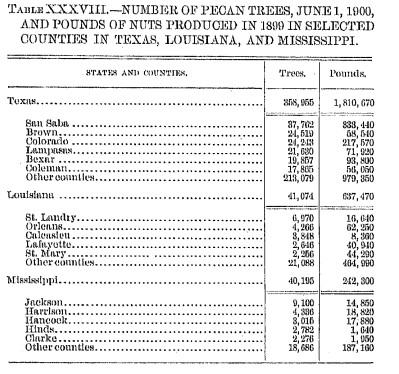
Figure 1. Pecan production shown in the 1900 USDA Census report of agricultural statistics. Only three states, each producing at least 75,000 pounds of pecans were included in this table. Other states are assumed to have produced less. United States Census Reports, Volume VI, Twelfth Census of the United States, Taken in the Year 1900, Agriculture Part II, Crops and Irrigation. https://agcensus.library.cornell.edu/wp-content/uploads/33398096v6p2ch8.pdf
The highest report of native pecan acreage for Texas in any formal census (many years are missing), which presumably involves those acres being used for commerce, was 91,900 acres in 2007. It’s never been calculated in totality, but opinions suggest at least one to two million acres of native pecan trees may cover the 171 million acres of the entire state. The earliest USDA census document describing pecans specifically, the Report on the Statistics of Agriculture in the United States (1890) undoubtedly ignores native pecan trees by reporting Texas as having just 23,635 bearing and 60,449 nonbearing pecan trees in 1889, which was approximately 10% respectively of the nation’s total. These reports may have only tabulated domesticated (formally planted) seedling pecan orchards, the first sizable one of 400 acres having been planted by F.A. Swinden in Brownwood in 1880. The Swinden orchard is an example of one that was started from seed and later partially grafted to improved varieties. Grafting of pecan trees of course was only first successfully performed in 1846 or 1847 by a slave gardener named Antoine at Oak Alley Plantation (Brison, 1974), and thereafter the expansion of pecan production was a blend of native, seedling, and grafted trees.
The 1900 USDA Census gave statistics of pecan production for three states reporting at least 75,000 pounds in 1899 which included Louisiana, Mississippi, and Texas with a nation leading 1.8 million pounds (Figure 1). It is unknown what the U.S. total production was for that period, but it’s believed to have included Florida, a small amount from trees in California, and “all the states in the South.” Pecan production nationally increased 221.6% during the ten-year period between the censuses of 1910 and 1920. Total US pecan production was 31.8 million pounds for the 1919 crop year, with Texas coming in as the leading producer with 16.8 million pounds valued at $3.09 Million (18.4 cents per pound). Oklahoma and Georgia were the second and third leading states with 4.3 million and 2.5 million pounds respectively.
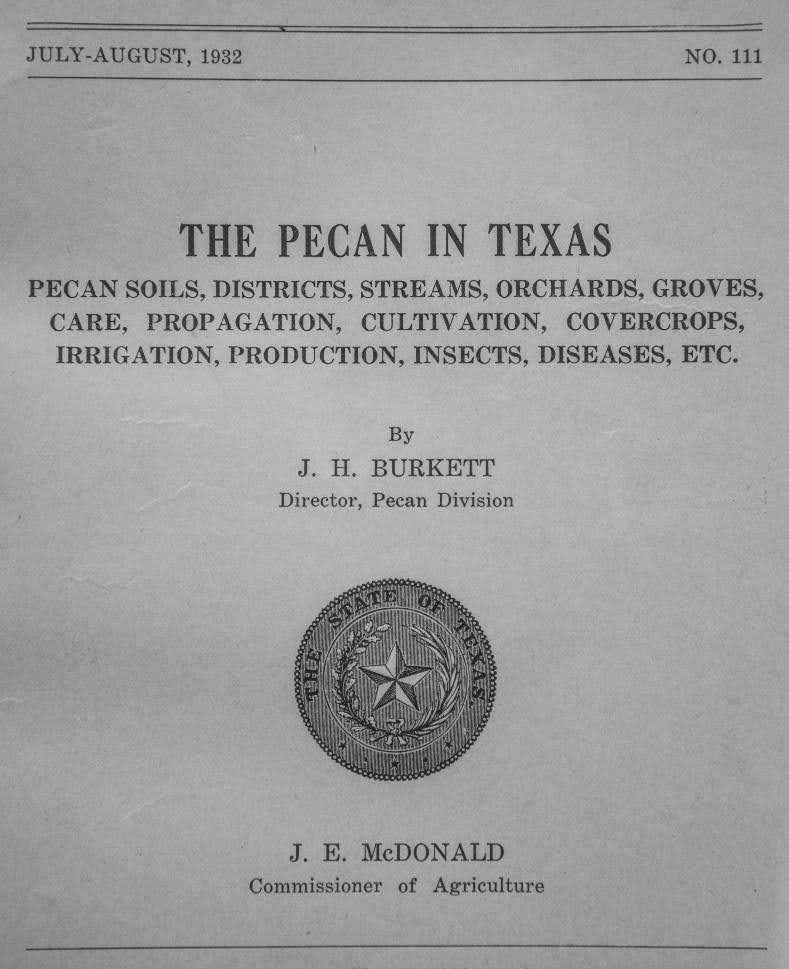
Figure 2. TDA developed a “Pecan Division” and installed field advisors like J.H. Burkett to continue disseminating technical knowledge of propagation and orchard development to growers in Texas
It was during the 1910 to 1920’s period that a lot happened to spur growth of the Texas pecan industry. Texas A&M College (AMC, now Texas A&M University) and Texas Department of Agriculture (TDA) devoted personnel resources toward pecan husbandry. E.J. Kyle, a horticulture professor with AMC authored TDA Bulletin No. 19: The Pecan and Hickory in Texas in 1911, which discussed topworking native trees and emerging varieties like ‘San Saba’ and ‘Stuart’. TDA developed a “Pecan Division” and installed field advisors like J.H. Burkett to continue disseminating technical knowledge of propagation and orchard development to growers in Texas (Fig. 2). The USDA Pecan Breeding Program was moved from Philema, Georgia, to Bastrop, Texas, and directed by L.D. Romberg, a Texas A&M-trained horticulturist, who began formally breeding and releasing to the public improved pecan varieties like ‘Barton’, ‘Choctaw’, and ‘Wichita’. The program was moved to Brownwood in 1938 and then to College Station in 1987, where it continues today. Also very important was the organization of the Texas Pecan Grower’s Association in 1921, their engagement with AMC/TDA, platform for shared knowledge among growers, and publishing of annual conference proceedings that covered the rapidly evolving information of how to farm pecans for profit in Texas. It can be argued that the cementing of Texas’ legacy as a pecan producing state happened during this period.
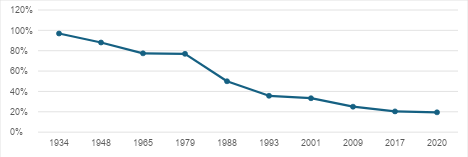
Figure 3. Percentage of native pecans in Texas’ total annual production of all pecans. Texas native pecan contribution to the national total of all pecans was 31% in 1934 and 3% in 2020. (Graphic provided by Monte Nesbitt)
Texas’ place in the national production of pecans continued to be at or near the top for the next 20 years. The 1940 Census reported that Texas produced 1.8 million pounds improved pecans and 8.3 million pounds of natives, making it third nationally in total production that year. Oklahoma produced over 11 million pounds natives and less than half million improved pecans that same year. Georgia though had leapt to the nation’s lead in pecan production with over 17 million pounds improved pecans and 3.3 million pounds “native” (likely seedling, since there are no true native pecans in Georgia). Texas, entrenched in a business model built heavily on opportunistic farming of natives had been surpassed by Southeastern farmers gravitating toward higher yielding improved pecan cultivars from intentionally planted orchards. The Texas pecan industry would change significantly in its relative composition of natives and improved pecans from the 1930’s to present day with expansion to the western, arid regions of the state (El Paso, Fort Stockton, Eagle Pass, etc.) (Fig. 3).
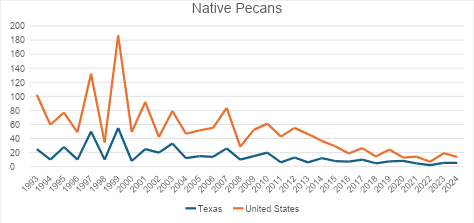
Figure. 4. U.S. vs Texas native pecan utilized production, 1993 to 2024. (Graphic provided by Monte Nesbitt)
Over the five-decade period that followed World War II, the Texas pecan industry, as it did in other states, expanded its industry presence and annual economic contribution to the state economy by greater utilization of existing native tree acreage, increased planting of “papershell” (improved variety) pecans, and greater yield potential from incorporation of modern tree spraying, harvesting, cleaning, and shelling equipment. The 1948 Texas pecan crop was 50.9 million pounds, of which only 680,000 pounds were improved varieties. The 1965 and 1979 crops were 62 and 91 million pounds, of which 14 million and 21 million pounds respectively., were improved varieties. Examining utilized pecan production of the most recent thirty-two years (1993-2024), Texas demonstrated the ability to produce at or near 50 million pounds of improved pecans five times (1995, 2001, 2005, 2010, 2014) with an average of 35 million pounds per year. Texas native production those same years reached 50 million pounds twice (1997,1999), averaged 15 million pounds in 32 years, but has declined to an average of 7 million in the last 14 years. Decline in native pecan production in Texas and its aforementioned reduced contribution to the national total is better explained by loss of interest due to low native market prices, rather than some change in production potential of this vast resource in the state. The downward trend in native pecan production in Texas mirrors the same trend for U.S. total native production (Fig. 4), of which Louisiana and Oklahoma are key contributors.

Figure. 5. U.S. vs Texas improved pecan utilized production, 1993 to 2024. (Graphic provided by Monte Nesbitt)
Picking up native pecans in a creek bottom, city park, or grandparent’s backyard and turning them into Thanksgiving pecan pie or selling them for Christmas money is part of the legacy of pecans in Texas that’s doubtlessly changing due to several socio-economic factors. What about improved pecans in Texas, around which more intentional farm enterprises and their associated jobs and family livelihoods are built? Texas improved pecan production in contrast to U.S. improved pecans shows a slight downward trend in the same evaluation period of 1993 to 2024 (Fig. 5.) The trend divergence appears in the last ten years (2015 to 2024), during which time Texas averaged 28.9 million pounds against a national average of 255 million pounds. Is this trend cause for concern about the health and strength of the Texas pecan industry or is it simply a reflection of a series of challenging weather events (drought, excessive heat), along with an asynchronous on-year/off-year pattern among important pecan production subregions (El Paso vs. Central Texas)? These questions were justification for the survey projects proposed in this grant. When answers for something as large and complex as the Texas pecan industry are unclear, a formal assessment is simply good stewardship by those who care about its legacy.
Listening to History
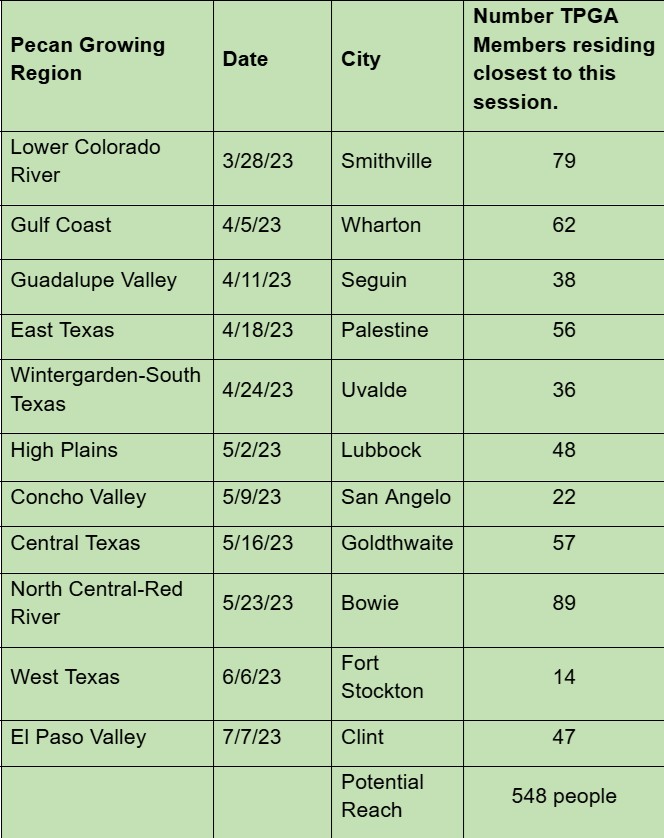
Table 1. Location and grower access to eleven town hall-style pecan listening sessions, 2023. (Graphic provided by Monte Nesbitt)
Written documentation doesn’t capture all aspects of history. Smartphones, selfies, and posting on social media bring an indelibility to recent history that we haven’t always had in society, but even those can fall short of the collective human experience. To learn the historical experiences of current Texas pecan growers, the grant team held a series of town hall meeting-style “listening sessions” as a preliminary step for conducting formal surveys. Pecan growing is a fellowship of sorts; of people who appreciate the trees themselves, love the food and its contribution to human nutrition, and are motivated to continue the challenge of producing more and better-quality pecans. Our hope was that a forum for “talking pecans” would accomplish the following: 1) Identify appropriate survey participants, 2) Discern perspective differences in pecan industry sustainability by region, 3) “Set the table” for appropriate future survey questions, 4) Serve as a timely place for vetting of concerns among growers, and 5) Contribute to overall project objectives to assess industry needs.
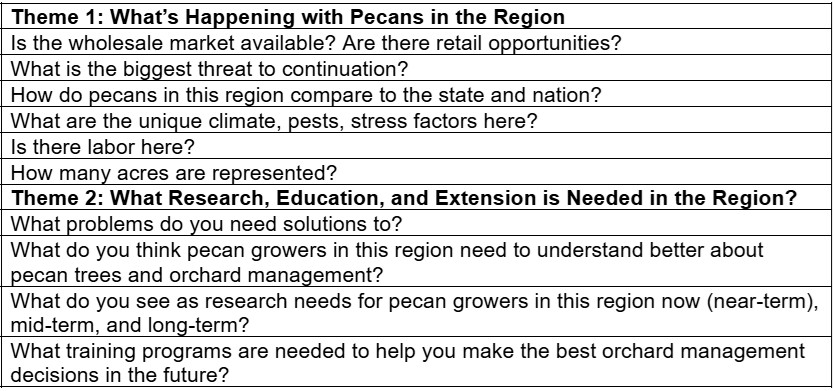
The Texas pecan industry is widely dispersed across a large state. Where to hold listening sessions and how to communicate them to growers posed a challenge. A combination of the TPGA membership list, Pecan South subscriber list, and pecan growers identified by Texas County AgriLife Extension offices were used to locate host sites for eleven town hall meetings, conducted April to July 2023 (Table 1). County Extension offices and TPGA social media and newsletters communicated the dates and locations. The discussions were intended to be open, candid, and naturalistic conversations, with university and TPGA personnel as listeners and pecan growers/marketers as talkers. Two sets of guiding question themes were used to direct the discussion (Table 2).
Results and Findings
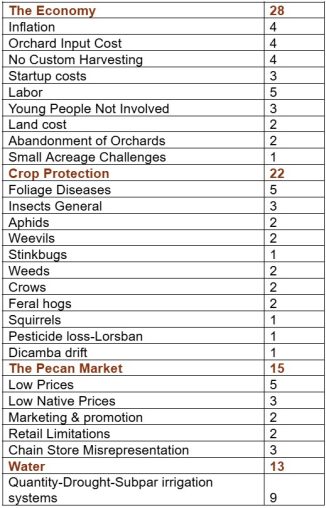
Table 3. Problem themes manifested from Texas pecan growers participating in eleven town hall listening sessions, 2023.(Graphic provided by Monte Nesbitt)
Participation was lower than anticipated across the eleven sessions. Sixty-six growers participated in total, representing 13,200 acres in 36 Texas counties, which represents approximately 15% of the improved pecan acreage in the state. Fifty-four non-growers from TPGA, Texas A&M University, and Texas A&M AgriLife Extension (county agents and specialists) participated in the eleven sessions. Despite the low turnout, the discussions were lively and informative. Participants were affected by recent crop failure/quality problems, market prices, and production challenges. We heard emphatic sound bites at each session, including: “We had the worst quality ever in 2022 on later varieties” (Smithville session), “We’re having a lack of good production from the freezes” (Wharton session), “There is no next generation to take over these aging orchards” (Palestine session), “Our aquifers are dropping from population growth” (Uvalde session), “Hail is too frequent” (Lubbock session), “We’re dependent on family members alone; can’t find labor” (San Angelo session), “Every orchard is one real estate transaction away from the land being too expensive to farm pecans” (Goldthwaite session), “Pawnee doesn’t ripen uniformly here, it needs to get better” (Bowie session), “This market nosedive is not something we can survive for long” (Fort Stockton session), “Salinity in our groundwater is something we have to solve” (El Paso session), “Small growers simply can’t compete with the West” (Seguin session).
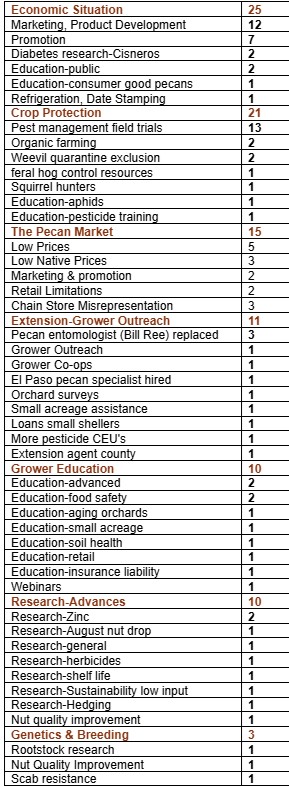
Table 4. Expressed needs of Texas pecan growers participating in eleven town hall listening sessions, 2023.
Verbal comments of the problems and needs were recorded, coded, and comparatively sorted into common theme groups. Themes were collated and unified where possible and tabulated into frequencies across all sessions, shown in Tables 3 and 4. The Economy, including everything from labor availability/cost to economy of scale for small acreage producers and inflation emerged as the greatest problem theme. Crop Protection; the threats to a pecan crop was the second most prevalent theme. Specific issues influencing the pecan market and water were also very important. The needs that were fomented from this discussion overlayed the problems well, with Pecan Promotion and New Product Development cited as offsets to problems with the economy. Pesticide field trials were similarly cited as an offset to the problem theme of crop protection. Revisiting and listening to recent history tells the story of how a tremendous pecan legacy has been created in Texas. The growers living out that legacy today face a variety of challenges and have tangibly expressed what they feel will help them the most moving forward.
References
Brison, Fred R. 1974. Pecan Culture. Capital Printing, Austin, Texas.
Corsa, W.F. 1906. “Pecans”, pp. 48-64 in: Nut Culture in the U.S. USDA Bull. 1906.
McEachern, G.R. 2018. A Pecan History. Texas A&M University, Department of Horticultural Sciences, College Station, TX.
Stuckey, H.F. and E.J. Kyle. 1925. Pecan Growing. McMillan Co., New York, N.Y.
