
Read the Trees
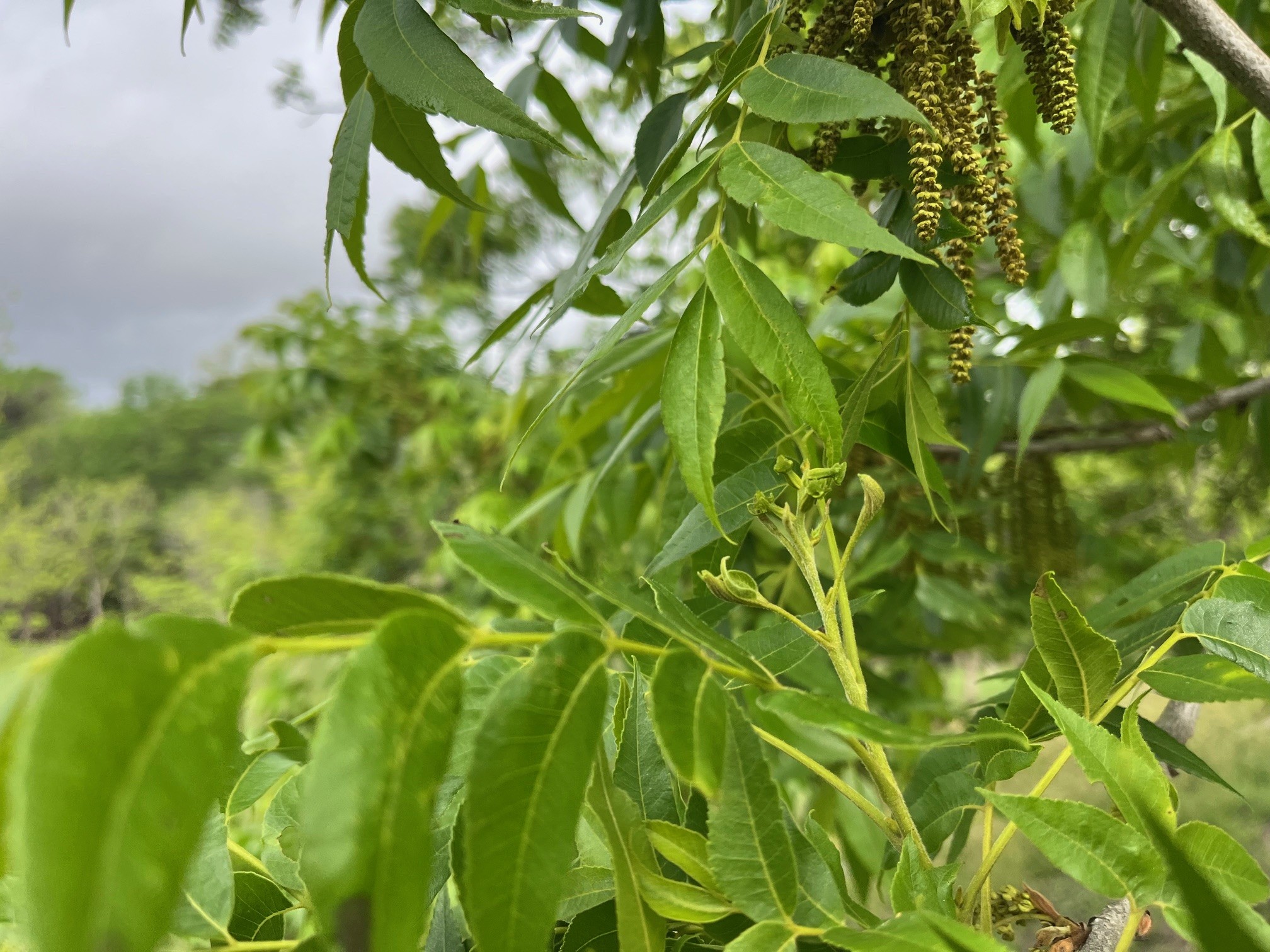
The ideal situation would be to have all your mature trees leafing well, with a full crop of catkins and potential female flowers. That is where we want to concentrate our discussions this month. So, another scenario is, what is wrong with my trees, or perhaps better said, is there something wrong with my trees? Often, it is easier to ignore what you see, but if you are honest with yourself, you need to pinpoint the issue.

Strong catkin crop setting the stage for the season. (Image by Larry Stein)
Some may question the amount of time we have been in a drought, but suffice to say it has been a long time, and no doubt 4 plus years. There is no substitute for rain and never will be. Rain is a true cleaning of the soil and trees, along with a bit of nitrogen fertilizer, which is the reason I personally think it is so good. In addition, it wets the entire root system, not just parts here and there, as with our supplemental irrigation systems. As you well know, the key to how much good rain does, though, is how fast it comes and where the water goes. More often than not, the rain comes down faster than the ground can absorb it, and the water runs off, so it does not soak in deeply. That is where pecan “bottoms” came to be known, as pecan trees proliferated in the “bottomland” where water accumulates after a rain. So, a one-inch rain above may lead to a 3 inch rain below.
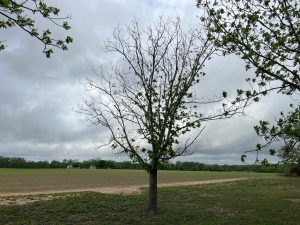
Upper‑canopy dieback caused by drought. (Image by Larry Stein)

Overcropped trees from last season with dead branches still in place. (Image by Larry Stein)
Regardless, we are seeing many trees come out this spring with drought issues. Basically, the trees die from the top down. The tree dies back to the number of shoots the root system can support. Remember, native pecan soils are 20-plus feet deep, well-drained, and typically underlain with a gravel layer. Pecan tree roots can exploit this soil for water, but even in these soils, the deeper the tree roots go to find water, the more energy they expend. Also, these drought challenges are cumulative, meaning that over the last 4 plus years they have aggravated the trees’ roots, and over time, this has a negative effect on the trees. Hence, we are not only seeing trees die back, but we have seen numerous trees die, and the end is not in sight in some situations. Usually, it is the trees on the less desirable soil sites, shallow, rocky, etc., that die first, but as the lack of water expands, the area of trees dying widens as well. Note the photos of dead and dying trees from a lack of water.
Another factor that has to enter into the tree death is the occasional hard freezes we have had in January over the last few years. Winters have been nil except for a few cold spells, which can also have a negative effect. Realize stored food in the trees is the “antifreeze” for the tree, per se, and if the trees do not have much due to drought and/or overcropping, too many pecans, they are super susceptible to cold damage.
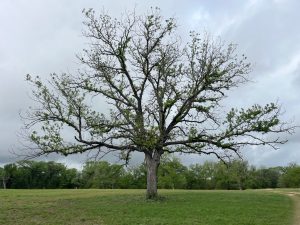
Visible drought damage (Image by Larry Stein)
So, in some cases, we see trees begin to leaf with few, if any, catkins and sparse yellow foliage. In most of these cases, the trees were heavily cropped the year before, and you can see this from the broken limbs at the tops of the trees. If you think back, the kernel quality was minuscule at best, and when such trees are subjected to severe cold, they can get severely injured.

Native pecan slow to leaf (Image by Larry Stein)
However, please keep in mind that not everything you see is a problem. Take this massive native pecan tree; as you can see, it is way behind the leaf-out of other trees, so in this case, you have genetics involved. All native trees are different from each other, and late leafing can be a trait. Other varieties also have different leaf-out characteristics; Choctaw, Stuart, and, in some cases, Pawnee were slow to leaf this year. Perhaps a lack of cold chilling was involved. In addition, all pecan rootstocks are currently grown from seed, which is genetically diverse and may again influence budbreak.
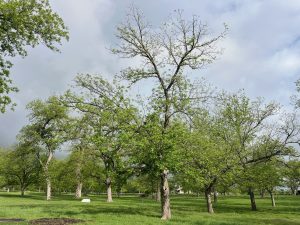
Choctaw pecan tree slow to leaf (Image by Larry Stein)
We are also seeing trees, seemingly die for no reason. Yes, we have been dry, but most serious pecan growers do their best to water their trees as best as they can, so can it really be water? Perhaps, as I said earlier, the effects are cumulative. But another factor that may be involved is tree planting depth. If trees were planted too deeply initially, this can become a problem as they get older, and in some cases, they have died 20+ years after planting. So, perhaps investigate the depth at which trees were planted when you find a tree dying for no apparent reason.
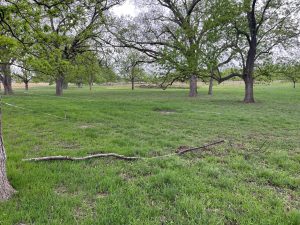
Shaded‑out limb dropped to the ground. (Image by Larry Stein)
Finally, don’t ignore what your trees are telling you. If you find limbs lying on the ground realize that these trees are becoming crowded and these limbs are shading out, so you need to have a plan in mind as to how you will solve this issue. Remember, it is the limbs that shade out first, followed by poor kernel quality and lastly reduced tree production.
So, please take the time to “read” your trees and take note of what they are telling you.
