
Revisiting The Use of Clover & Poultry Litter in Pecan Orchards
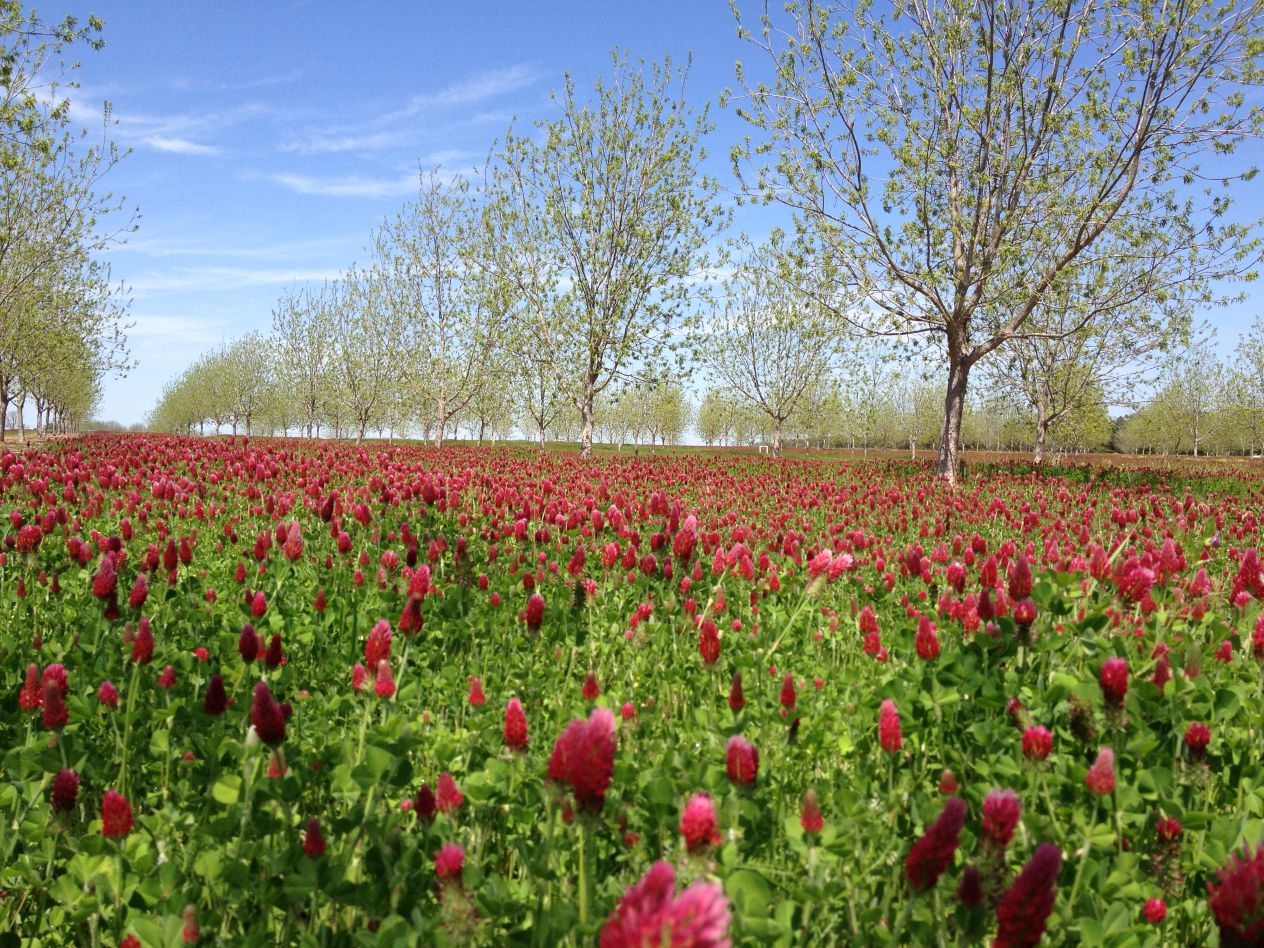
Pecan orchard and crimson clover in springtime (Image by Lenny Wells)
We conducted several multi-year studies investigating the use of both on pecans years ago. Sometimes it is helpful to revisit such topics.
This was a large study in which we covered multiple aspects of the effects of clover and poultry litter on pecan leaf nutrients, yield, quality, soil nutrition, various aspects of soil quality, and N release. Each of these was compared with standard N fertilizer and with a non-treated control. I’ll try to summarize each of those in this article.
Leaf elemental tissue analysis, pecan yield, and quality indicate that poultry litter and clover provide adequate N nutrition for pecan production. There is an obvious time lag between poultry litter application and maximum N fixation in clover and the availability of N for pecan trees. Poultry litter application did not increase total available soil N as compared with synthetic fertilizer application in the upper 8” of the soil profile in a pecan orchard system. Tree roots reduce N leaching partially as a result of deeper soil profile tree water uptake. This “safety net” in pecan orchard systems may make it less susceptible to N leaching than are other cropping systems.
Poultry litter also supplies many other essential nutrients for pecan. Application of poultry litter with or without clover often led to higher soil phosphorus (P) and potassium (K). Excess soil P accumulation is often a serious concern in cropping systems using poultry litter due to the potential for surface runoff and pollution. Although always a concern, there appears to be a reduced potential for P runoff in the pecan orchard system as managed in the southeastern United States as compared with other cropping systems because the orchard floor is maintained with grass alleyways between the tree rows. Although P is relatively immobile in the soil environment, as mentioned previously, deep-rooted orchard crops such as pecan, as mentioned earlier, can play a significant safety-net role in the alleviation of excessive nutrient loss. Where P is concerned, pecan roots may also help to stabilize soil, minimizing soil erosion and P runoff into streams. The addition of clover to this system would further reduce the likelihood of surface runoff because clover is actively growing at the time of poultry litter application and uses some of the P and other nutrients from the litter.
Soil K was unaffected by clover as compared with the control; however, pecan leaf K was reduced by the clover treatment in each year of study, except year 2, in which additional K was applied to all treatments. This reduction may have been the result of use of available K by the clover itself, making less available for the pecan trees. Poultry litter apparently provided an adequate supply of K for both the pecan trees and the clover in Year 4 because pecan leaf K concentration was higher for the clover + litter treatment than for clover alone. The recurring low pecan leaf K in the presence of clover without additional K application suggests that K nutrition may be especially important in orchards where clover is used. Clover and poultry litter alone and in combination increased SOM. It is likely that the addition of organic matter to the orchard soil in the form of clover and poultry litter also plays a role in enhancing nutrient availability for pecan over the long term.
Poultry litter with and without clover can occasionally enhance pecan leaf sulfur (S) concentration. Poultry litter supplied from 6 to 13 lbs per ton of S annually; however, treatment effects were only observed in 2 of the 4 years of study. Sulfur availability is affected by a variety of factors, including SOM, temperature, rainfall, soil moisture, and soil pH.
Clover and/or clover + litter occasionally led to enhanced leaf concentrations of Fe, Cu, and Zn, particularly after the first year of study. The accumulation of these heavy metals is often a concern where poultry litter is applied to agricultural land. However, pecans have a relatively high requirement for these elements and may benefit from their application. As a result, poultry litter can be a good source of Fe, Cu, and Zn for pecan. Clover alone or in combination with poultry litter led to higher pecan leaf Zn concentrations than the control and/or ammonium nitrate treatments.
Initially the synthetic fertilizer treatment had higher yields than the clover and clover + litter treatments. During the final 2 years of study, the clover + poultry litter treatment had higher yields than the control; however, there were no differences between the remaining treatments. Over the course of the study, yields were more consistent from year to year, with less alternate bearing in the clover, litter, and clover + litter treatments.
The major period of N accumulation in pecan occurs as new leaves, shoots, and flowers are developing in the spring. Pecan trees preferentially use stored N during the initial spring canopy growth flush. Rapid N absorption by the tree follows after the endogenous pools are nearly depleted. In addition to the peak N demand for pecan occurring in the spring, pecan trees also absorb as much as 30% of their N during tree dormancy. Each of the treatments we examined, particularly poultry litter and clover, could provide a beneficial source of N during this secondary dormant season period of N demand for pecan. Leaf N has been shown to be the primary source of N for fruit development. Additionally, pecan fruit development appears more dependent on current-year N absorption than stored N reserves, because fruit development begins after most of the current year’s N is absorbed. If available N is low, large pecan crops may deplete the subsequent year’s tree N reserves. Thus, an adequate, season-long supply of available soil N is needed for pecan under such conditions.
Under optimal conditions, N availability with synthetic fertilizer peaked at 30 d and again at 240 d after application. Based on pecan tree N demand and orchard soil N dynamics, it appears that synthetic fertilizer applications should be targeted at or 2 to 3 weeks after pecan budbreak. This would allow for the rapid uptake of available N when the N demand of pecan trees is at its peak.
Crimson clover provided from 20 to 75 lbs/acre N over three growing seasons, suggesting that crimson clover can indeed provide supplemental N for pecan trees. This would allow pecan producers to reduce the amount of applied synthetic N fertilizer used in the orchard. However, most of the mineralized N from crimson clover became available later in the growing season after the clover had senesced and the tissue was broken down by microorganisms.
Crimson clover generates considerable biomass, which is mowed after seed maturation and remains on the orchard floor in southeastern pecan orchard systems. Such a high residue situation can result in a buildup of organic matter, stratification of nutrients, and accumulation of surface residue, which can temporarily immobilize N and thus reduce N availability. These results suggest that although crimson clover can provide supplemental, late-season N for pecan orchard soils, orchards using crimson clover would likely benefit from a spring application of synthetic N based on pecan N absorption patterns and current N recommendations for pecan. The value of legume residues as a source of N is long term and accumulates over time. Thus, proper nutrient management also involves maintaining adequate soil N concentrations at adequate levels during peak demand.
Management practices, including the use of clover cover crops, that accumulate or increase soil organic matter enhance the intrinsic ability of the soil to supply inorganic N through mineralization over time. In addition, high residue cover crops can buffer asynchrony between nutrient availability and plant nutrient demand by gradually releasing previously immobilized nutrients during the growing season. It is important to recognize that application of N fertilizer to clover can reduce or eliminate N fixation by clover. Therefore, any spring N applications to orchards using clover should be directed toward orchard herbicide strips to minimize this effect.
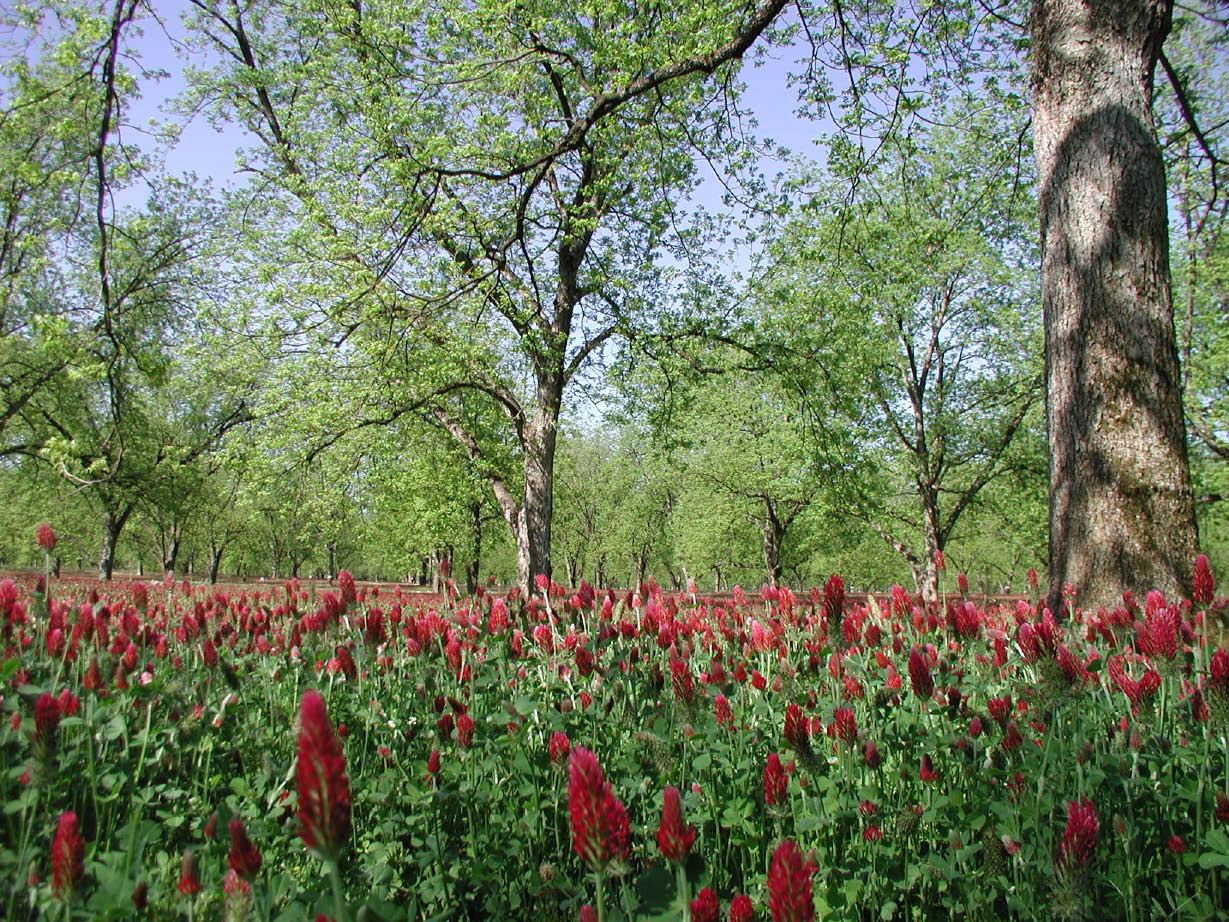
A well-established stand of crimson clover growing in a well-managed pecan orchard. (Image by Lenny Wells)
Poultry litter, with and without clover, provided available N consistently throughout the growing season, with more N being available later in the season than earlier in the year. This suggests that poultry litter applications should be timed before budbreak from late February to mid-March, well ahead of the peak N demand of pecan trees. Application in Feb/March also helps protect pecans from any potential contamination at harvest, and it is recommended to have all poultry litter applications out by the end of May. In addition, it appears that the availability of N from poultry litter increases with time. This supports previous studies in agronomic crops, which have demonstrated that poultry litter becomes available more slowly than synthetic fertilizer as a result of the mineralizing activity of soil microorganisms. Both clover and, under certain conditions, poultry litter enhance soil organic matter and microbial activity in southeastern pecan orchard systems.
Each of the N fertilizer regimes examined has merit as a component of pecan N fertilization programs. To time N fertilizer applications to best meet the pecan tree’s primary demand, applications of ammonium nitrate should be timed at or soon after pecan budbreak, depending on tree N reserve status and soil N availability. Pecan producers using crimson clover as a groundcover should continue to supply N in another form during early spring because a large percentage of N from the clover crop is unavailable until later in the growing season. However, crimson clover can, over time, provide substantial supplemental N, which can help reduce fertilization costs by reducing the overall application amount required. Synthetic N applied in spring to orchards using clover should be directed toward herbicide strips to minimize the effect of applied N on N fixation by clover. Properly timed applications of poultry litter can also provide N for pecan trees during their peak demand and throughout the growing season; however, in the first year or two of using poultry litter a low rate (30 -50 lbs) of synthetic N should be applied to get the trees through the peak demand period.
The use of clover as a cool-season cover crop between tree rows appears to provide multiple benefits for pecan orchard soil quality, including increased biological activity. Soil phosphatase (an enzyme that aids in plant availability and uptake of P) activity was also enhanced by clover during two of the three years of study. Soil elemental properties, including total N and SOM, were also enhanced by clover and/or poultry litter, although there was an obvious time lag in the response of total soil N to the treatments. Poultry litter application also enhanced soil P but did not consistently enhance the soil biological activity parameters examined in this study. At times, poultry litter appeared to neutralize or minimize the positive effects of clover on soil biological activity.
In summary, both poultry litter and clover appear to provide adequate N nutrition for pecan and can enhance orchard soil quality from a chemical and biological standpoint. Poultry litter with and without clover can provide many additional nutrients required by pecan trees, including P, K, Fe, Cu, and Zn. Where clover is used in the orchard, additional K application may be necessary. Poultry litter and clover may also provide additional benefits for pecan nutrition, primarily through the addition of organic matter, which enhances the orchard soil environment. Clover, in particular, can significantly enhance the biological activity of orchard soil. Proper use of these nutrient and soil amendments should be coupled with a working knowledge of how the tree uses N and other nutrients. Hopefully, this article can help provide that information. If you would like to see the details of the studies mentioned here, they can be found at the links provided.
https://journals.ashs.org/hortsci/view/journals/hortsci/47/7/article-p927.xml
https://journals.ashs.org/hortsci/view/journals/hortsci/46/9/article-p1294.xml
https://journals.ashs.org/hortsci/view/journals/hortsci/46/2/article-p306.xml#B40