
Stored-Product Insect Pheromones, Traps Provide Warnings
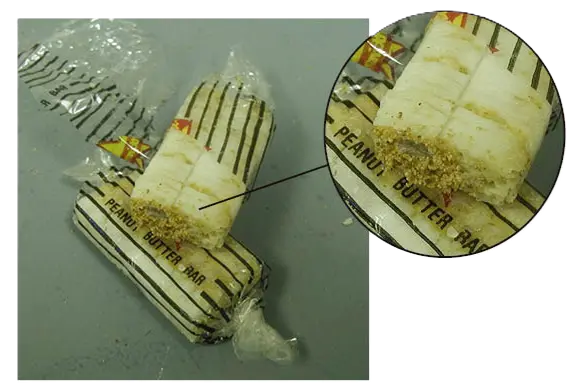
Indian meal moth infested this peanut butter candy bar; the larvae are occupying the front end of these bars and got in through the bad packaging. (Photo by Bill Ree)
Over the years there have been several Pecan South articles on stored-product insects that have addressed the problem of insects attacking post-harvest pecans. Most of the research on this topic has been conducted at Oklahoma State University (Pecan South, Native Timbre, December 2005 p.10).
Most producers are aware of the pecan nut casebearer pheromone but many might not be aware that there are pheromones and traps that can be used for detection of stored-product insects. As a group, stored-product insects attack a very wide range of food sources, and infestations can come from numerous places so producers and retailers always need to be on guard. Infestation can occur in the primary product such as pecans but infestation can also occur in other food sources, such as seeds in decorations, animal feeds and candy bars that could be sold in retail stores. As an example, a peanut butter candy bar with Indian meal moth damage is shown in the attached picture.
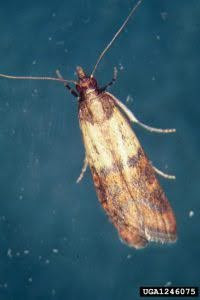
An adult Indian meal moth can be identified by its two-toned wings. (Photo by Whitney Cranshaw, Ph.D. Colorado State University)
Of those insects that attack post-harvest pecans, there are basically 2 groups: moths Lepidoptera) and beetles (Coleoptera). For the moths, the Indian meal moth is by far the most common. The adults of this species can be easily identified by the two-tone color of the forewings with the basal half being dirty white and the distal half being reddish brown. The adult female IMM is active at night and lays eggs singly or in small groups on or near food sources. There is a pheromone for this insect, which is used in conjunction with a sticky trap just like those for the pecan nut casebearer.
For the beetles, there are several species that could be found around stored pecans — some of these being the cigarette beetle, drugstore beetle, and the sawtoothed grain beetle. This group also feeds on an extremely wide range of food sources. There are attractants for these insects that can be used with several different trap styles. For some traps, more than one pheromone can be used in an individual trap. Traps for this group are usually placed on the floor under counters or work tables where it is hard to clean.
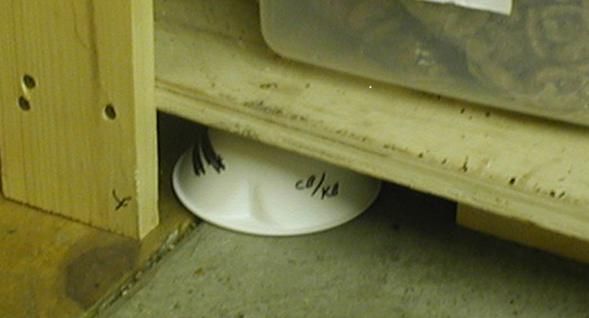
A dome trap in action; it’s tucked away beneath shelves in a hard to clean area. (Photo by Bill Ree)
The first rule for preventing or cleaning up an infestation of stored-product insects is sanitation — a broom and refrigeration will go a long way in preventing an infestation. Where possible keep all food sources that will not be used immediately in cold storage. If an infestation is discovered, you have to find the source and clean it up and this will require some detective work, for the list of food sources is almost endless. Food sources can include sources as unlikely as tobacco, seeds in flower arrangements, rodent baits, pharmaceutical drugs in addition to grains, dried fruits, candies, pet food and peanuts.
There are several sources of suppliers of stored product insect pheromones and traps, some of which are: www.trece.com and www.pantrypest.com Additional sources can be found by searching the web for pantry pests.
After an outbreak of red flour beetle from pecan shells in Socorro, Texas in 2024, the National Pecan Shellers Association implemented a best practices procedure developed by Texas A&M AgriLife entomologists to prevent future issues. If you would like information on the best practices email info@ilovepecans.org.
