
The Components of A Silvopasture System
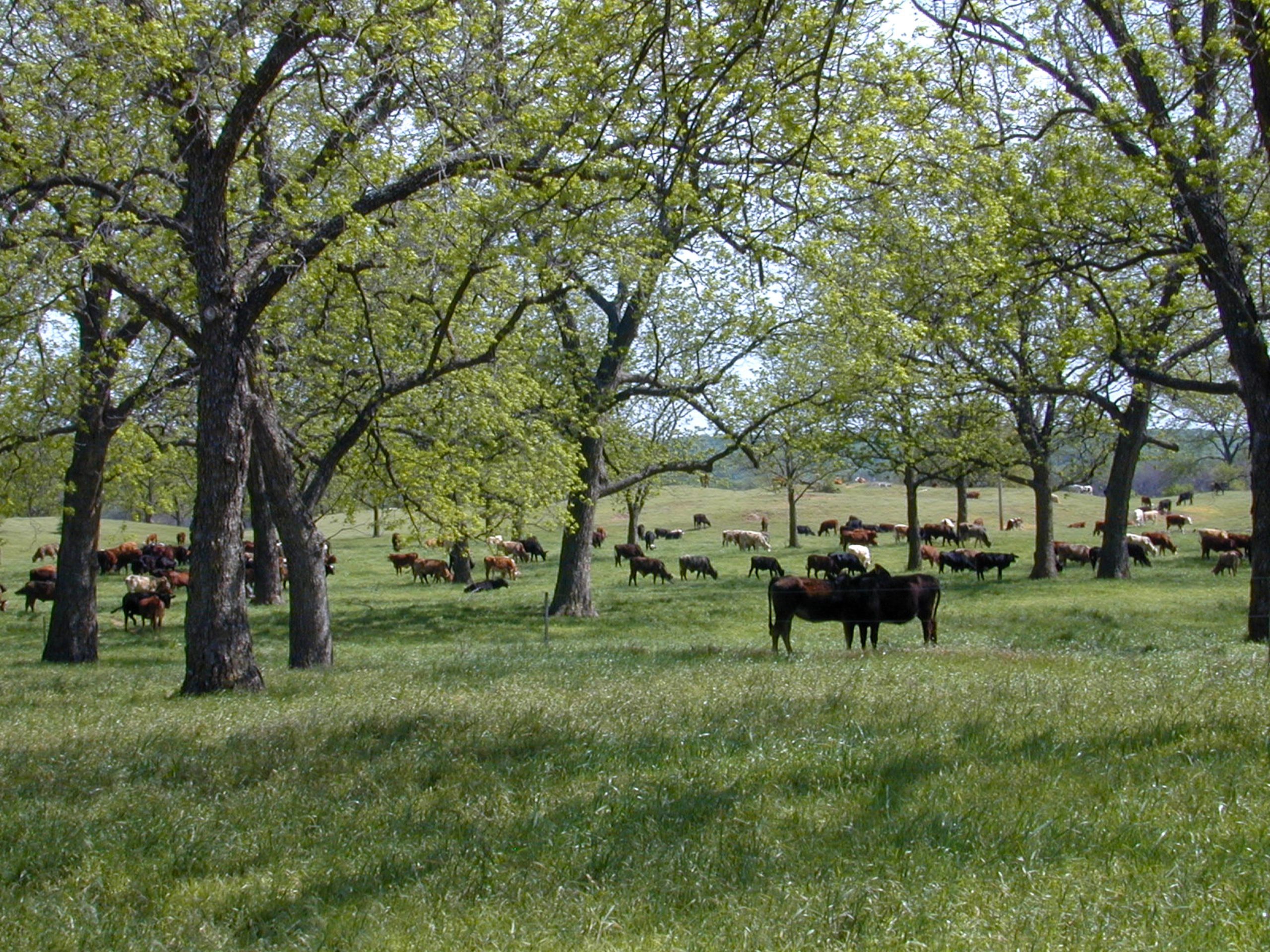
Silvopasture in a native pecan grove. (Photo by Charlie Graham)
Trees:
One of the first decisions you will need to make: are you converting pasture or forest to silvopasture, or will it be a combination of the two? The two methods will utilize a different strategy, have different labor requirements and equipment needs, and vary in cost. The method you choose may also impact orchard or grove layout.
The final arrangement of silvopasture trees could be widely spaced individual trees, a natural grove or cluster of trees, single rows, or uniform block plantings. The goal of block plantings of evenly distributed trees is to provide both trees and forages with optimal sunlight and growing space. Natural groves or trees planted in clusters will provide not only areas of concentrated shade and root competition but also more open areas for forage production. While it may not be a requirement for newly planted trees, remember that you will need adequate space for harvest equipment if you utilize trees that produce a nut crop.
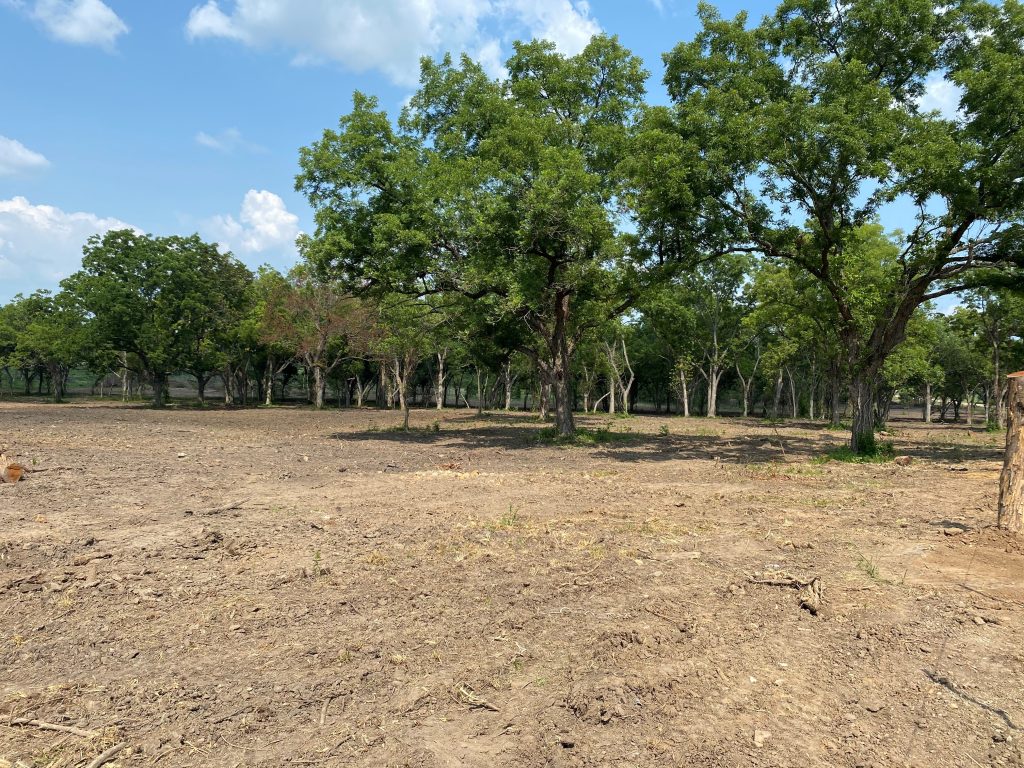
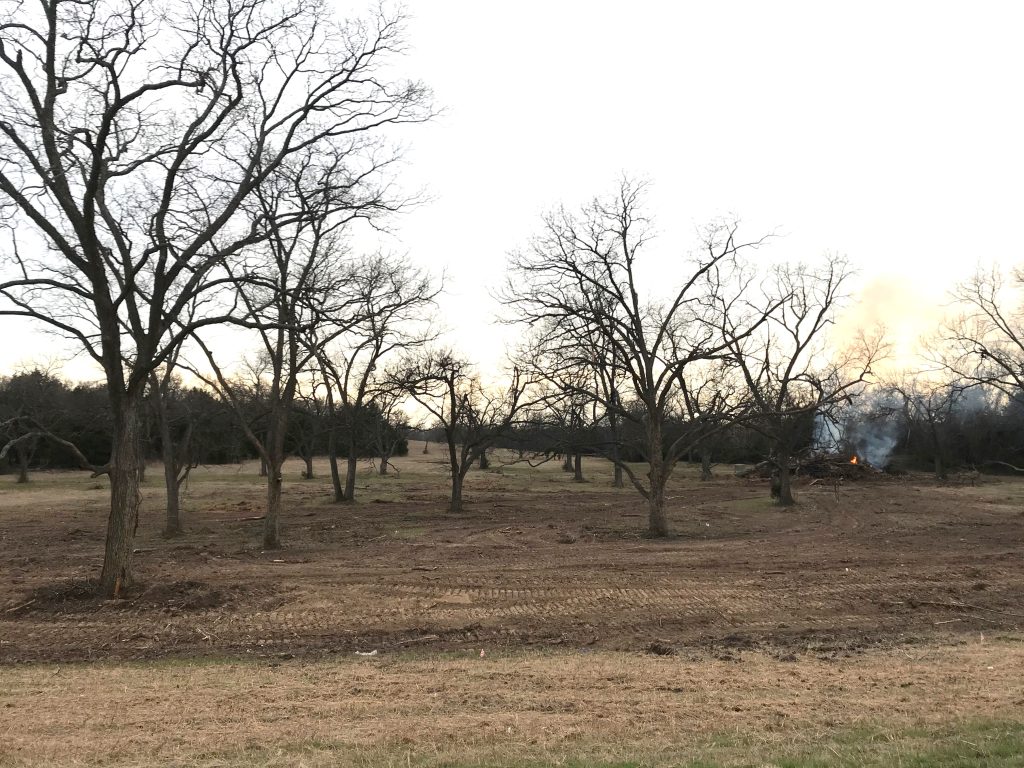
On that note, tree species selection is an important component for developing a successful silvopasture system. Commonly desired traits include rapid growth, high quality wood, marketable timber, insect and disease resistance, deep root structure, drought tolerance, and production of a marketable crop such as nuts. While I am partial to pecan, some other trees that have been successfully utilized in silvopasture systems include hickory, chestnut, walnut, almond, oak, mulberry, pine, and black locust.
Livestock:
If you are establishing a silvopasture system by planting small trees and forages at the same time or planting small trees into existing pasture, it may be necessary to exclude livestock to allow the trees to establish. Livestock can damage the new trees by browsing the foliage, trampling, or breaking the trunk while rubbing. Introduce livestock into a silvopasture system when the top branches of planted trees have grown beyond their grazing reach and a thick layer of bark has developed. An alternative to excluding livestock is to use electric fence to keep animals away, tree sleeves, or cages for protection. At Noble Research Institute, we use electric fence to protect the trees and rotationally graze the alleyways. But remember that just like any other input in an orchard, the establishment cost of the protection system is compared to the projected benefits to determine if it is financially feasible (i.e., cost-benefit analysis).
Considering livestock selection, it is important to match the animals with the land type and succession stage. While it is true that animals can potentially provide many benefits in the silvopasture system, they also have the potential to detrimentally impact the system. Additionally, environmental adaptability and marketability should also be considered when selecting livestock. Cattle, sheep, and goats are the most commonly used livestock in silvopasture, but other successfully used animals include swine, turkeys, and chickens. Forage requirements will vary depending on the type of livestock and their nutritional requirements. Well-managed forage production provides improved nutrition for livestock growth and production.
Grazing:
Silvopasture does not recommend the use of continuous grazing due to the detrimental impact it has on soil properties and forage performance. Rotational grazing is the system of choice, and unfortunately, it is often the greatest hurdle faced by ranchers considering using the system. This is especially true for ranchers that have exclusively used continuous grazing for many years. Rotational grazing is perceived as being too complicated or too time-consuming or too expensive. However, with proper planning and infrastructure development, it can be an easily managed and efficient system that provides many benefits. Rotational grazing minimizes soil compaction while boosting forage utilization but limiting overgrazing by the livestock. Followed by an adequate recovery period, this system improves forage quality and results in increased forage production while also minimizing potential growth reductions of your selected tree species.
Forage:
As mentioned earlier, a wide range of forages for silvopasture were discussed in the May 2023 issue of Pecan South. A variety of plant types—including grass, legumes, and forbs—can be chosen based on your livestock selection and the forage’s grazing, drought, and shade tolerance. Most forages need at least 50 percent sunlight, which works well in a pecan grove as we recommend keeping the trees thinned to allow at least 50 percent of the orchard floor to receive sunlight at high noon. Tree canopies modify the orchard floor climate and light levels, generally resulting in increased grass and legume growth and reduced lignification of the leaves (higher quality) than seen in the same forages growing in full sunlight. Orefice et al. (2019) reported that the presence of trees in a silvopasture system increased the nutritive value of the forage without decreasing its digestibility.
Microclimate:
Compared to open pastures, silvopasture systems offer many benefits in terms of microclimate modifications. For example, in temperate regions, forage crops remain near dormant during the early and late part of the growing season due to episodic radiation frost. A well-designed silvopasture can potentially extend the grazing season period on both ends of the growing season (Feldhake 2002; Kallenbach 2009). For example, Kallenbach (2009) showed that cool season forage growth started earlier in the spring and lasted longer in the fall in silvopasture than in open pasture. Forage growth in the silvopasture was also higher in the hottest time of the summer—mid-July through mid-August—compared to open pasture. Tree canopies can reduce temperature during summer months so that heat stress on forage can be alleviated. Additionally, a major constraint impacting optimal livestock production is heat stress during the summer. Trees in a silvopasture system impact shade, humidity, air temperature, and wind speed, and these changes have been shown to improve livestock performance.
Soil and Environment:
Properly managed silvopasture can improve soil health by increasing organic matter and biological activity that accelerates nutrient cycling. Water infiltration and retention are improved, as well as reductions in soil compaction and soil erosion. Shade also reduces the amount of solar energy reaching the ground, which creates lower surface soil temperatures and reduces the amount of water lost to evaporation. Within silvopastures, deep-rooted trees are able to capture excess nutrients leached from the root zone of the understory forages, thus reducing the nutrient load entering aquifers.

An example of silvopasture. (Photo by Charlie Graham)
Economics:
The integration of livestock, forage, and trees into a cohesive system reduces economic risk by providing short-term income from livestock sales (and value-added livestock products) and tree products (nuts, fruits), as well as a long-term high value timber product. Additional income could come from recreational sales, such as hunting leases or agrotourism. Savings are realized through reduced production costs and the ability to spread management costs among all three enterprises—livestock, forage; tree. The initial cost of the rotational grazing infrastructure can be offset by the long-term environmental benefits as well as the livestock benefits such as reduced stress and higher stocking rate potential. Increased cattle productivity, reduced input costs, and improved pasture health can lead to higher profits in the long run. Additionally, the demand for environmentally friendly, regeneratively produced products continues to increase which can give growers a competitive advantage in the market.
Summary:
Converting a pasture or forest into a fully functioning silvopasture system isn’t a short-term project. The significant investment in fencing, water distribution, tree establishment or removal, forage establishment, and possible temporary pastures requires a well-thought-out transition plan. Silvopasture, as an integrated land use practice, has been proven to be economically and environmentally sustainable both at small and large scales. It provides several benefits, including improved soil health and water quality, enhanced animal welfare, enriched biodiversity, and expanded carbon sequestration. However, industry adoption of silvopasture systems still struggles with several barriers such as lack of information, perceived transition risks, available financing, and lack of technical support. Despite these barriers, interest in silvopasture practices continues to grow.
Literature Cited:
Feldhake, C.M. 2002. Forage frost protection potential of conifer silvopastures. Agric For Meteorol 112:123–130
Kallenbach, R.L. 2009. Integrating silvopastures into current forage-livestock systems. In: Agroforestry comes of age: putting science into practice. Proceedings of the 11th North American Agroforestry Conference, Columbia, Missouri, USA, 31 May–3 June, pp 455–461.
Orefice, J., Smith, R.G., Carroll, J., Asbjornsen, H., Howard, T. 2019. Forage productivity and profitability in newly-established open pasture, silvopasture, and thinned forest production systems.
