
The Night Shift in the Orchard
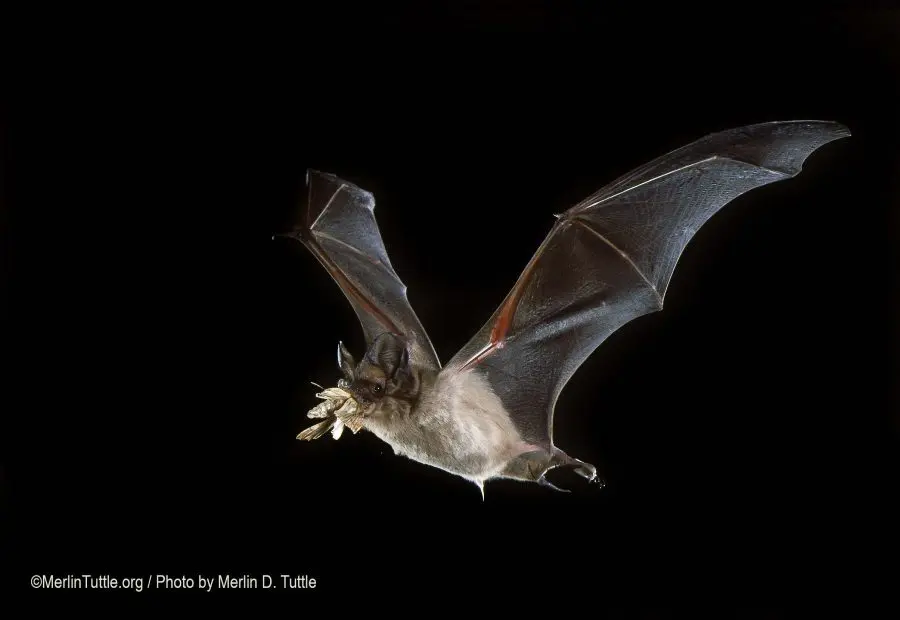
A Brazilian free-tailed bat (Tadarida brasiliensis) eating a corn earworm moth (Helicoverpa zea) in flight in Texas. ©MerlinTuttle.org / Photo by Merlin D. Tuttle
Producer-driven research
In pecan systems, pest management is often one of the biggest decisions producers make, especially as they look for ways to protect the crop while reducing unnecessary chemical inputs. For Troy Swift of Swift River Pecans, LLC, that challenge sparked a closer look at biodiversity, soil health, and the role natural predators may play in the orchard. Since beginning his transition toward regenerative agriculture, Troy has noticed signs of a recovering ecosystem and has continued to assess how those changes fit into day-to-day pecan production. In 2023, he joined Noble Research Institute’s Pecan Research Strategy project, which follows management practices across 22 pecan producers to better understand how producer decisions influence soil health, orchard productivity, and the broader ecosystem.
From Troy Swift
Dr. Merlin Tuttle visited Swift River Pecans in 2021, about the time I began studying regenerative agriculture. He suggested adding bats to my IPM program. Dr. Tuttle explained that all Texas bats are insectivores. I had never even considered bats as important in the pecan ecosystem. This was a new and interesting subject.
Dr. Tuttle suggested a couple of his bat house designs, so I figured why not give it a try? After some education and guano lab results, I now call bats the “night shift” and birds the “day shift.” Increasing biodiversity in the orchard both above and below the orchard floor has become a priority for me and an important part of my farming objectives. Bats are just one part of that biodiversity. Biodiversity is necessary for natural predators to work. Natural predators will not stay in the orchard if there’s nothing to eat.
I’ve always disliked spraying insecticides, herbicides, and fungicides. I sprayed them only because that is what I was taught to do. As my orchards grew and my chemical bill grew, my desire to reduce chemicals grew too. The first to go was herbicides. Eliminating herbicides was the easiest. Insecticides and fungicides are more difficult to eliminate. Scouting and observation in the orchard are imperative for deciding whether a pesticide is even needed. I make one exception at budbreak, when I use a biological or plant stimulant to help deter pecan scab. Beyond that, I do not spray by the calendar. I rely on scouting and avoid broad‑spectrum pesticides whenever possible. My goal is to build soil health and biodiversity, so I don’t have to use them. If Lepidoptera pressure shows up, I’ll apply IRAC Group 18 or Bt, but only when scouting warrants.
I believe soil health, tree health, and biodiversity are fundamental to a good IPM program. Even for me, regenerative agriculture is still a new, evolving paradigm. Breaking old paradigms is hard. I read and experiment a lot. I make decisions based on tree and crop performance backed up by the Noble Research Institute’s scientific data. Each year I worry about the results, but the results keep getting better and more cost-effective.
Where bats fit in the orchard
According to Texas Parks and Wildlife, there are over thirty-two species of bats in Texas. The area along the Edwards Plateau is of specific interest to our research study, where experts have cited up to fifteen distinct species of bats. Brazilian (more commonly referred to as Mexican) free-tailed, cave myotis, eastern red, evening, and tricolored bats are among the species known to the area. These insectivorous mammals each have different behavioral patterns, including foraging and roosting habits. Colony occurrence based on migratory patterns can begin in spring and last until late fall. Artificial roosts, like Troy’s bat houses, can provide seasonal bat habitat in orchards. Researchers can also evaluate whether bat house use overlaps with the seasonal activity of specific pecan pests, such as pecan nut casebearer, by using pest-specific traps and pheromones to confirm pest presence.

Producer Troy Swift shares his experience with bat boxes during a Noble Research Institute event (Image provided by Noble Research Institute)
From Troy Swift
All bat houses produced and used in my orchard, Swift River Pecans LLC, were designed by Dr. Merlin Tuttle. The rocket box is a tall, double-chamber box designed to offer the bats the thermal conditions needed to be comfortable. The Zent box is a flatter design that is well ventilated. Both are about twenty feet off the ground. Trials indicate both designs work well. Bat houses have been installed in at least seven Texas counties and two Oklahoma counties. There is no guarantee bats will inhabit a house, but most installed houses have had some level of occupancy. Bats come and go seasonally and yearly. Nobody understands their behavior, but there are theories as to why they move. Predators, food, insecticide applications, farming factors (like plowing or mowing), water availability, temperature, bat house sanitation (pests like fleas or mites), natural migration, and more could all contribute to movement. It is common for the colony to move from one box to another in the same vicinity.
It is impossible to know the exact impacts of bats on pecan farming. Some of the native bats – especially red bats and evening bats – were probably already around. We have done mist netting and acoustic studies for several years now and know of seven species of bats in the area. So why install bat houses? Dr. Tuttle thinks the bat populations of species that use bat houses in the area could increase due to the installation of these roost facilities. We have indeed had more in the bat houses each year. There are also more bat houses in the area now that farmers are becoming aware of the project.
Reading the clues in guano
The Pecan Research Strategy team at Noble Research Institute is closely examining which bats occupy these bat houses, as well as key pecan insect pests, through guano analysis. Researchers collect guano non-invasively from a wire mesh screen beneath the bat houses, while collecting insect control samples using various trap methods. The samples are stored in a solution to help mitigate sample degradation. In the lab, researchers extract DNA from the guano and use a process called PCR, or polymerase chain reaction, to detect the target DNA. PCR works like a copier for DNA: it makes many copies of a small DNA segment so researchers can study it more closely. If the target pest DNA is present, the test confirms which species the bats may have eaten. This method is simple, timely, and cost-effective for showing whether a particular pest species is present or absent in the sample.


Pecan pests worth watching
Pecan nut casebearer is one of the most important early-season pests because its larvae tunnel into young nuts and can cause heavy crop losses when populations are high. Hickory shuckworm can cause nuts to drop early, and later in the season it can contribute to poorly filled kernels, sticktights, and delayed maturity. Stink bugs damage developing kernels as they feed, sometimes leaving dark spots and a bitter taste that lowers nut quality. Pecan weevils can also be costly, causing nuts to drop before harvest or damaging the kernels inside mature nuts.
The cost of pest damage can vary from year to year, depending on crop value, pest pressure, and what it takes to manage the problem. In numerous commercial pecan orchards, insecticides are still applied on a calendar schedule throughout the season. While these sprays can be useful, broad-spectrum products can also affect beneficial insects and other non-target species. That is why many pecan producers use integrated pest management, or IPM, to make more targeted decisions. IPM relies on scouting, pest identification, and treatment thresholds to help determine when action is needed. Even then, insecticides do not prevent all damage, especially when timing, spray coverage or resistance reduce their effectiveness. These limits show why additional tools, such as encouraging natural predators like bats, may have value as part of a broader IPM program.
From Troy Swift
In 2025, for the first time ever, I chose not to spray my Staples, Texas orchard for pecan nut casebearer. That decision was based on scouting for eggs with results under the economic threshold and a strong bat population in the orchard bat houses. We noticed some pest PNC damage later, but it was mild. Scouting is a main part of our IPM system, though I must admit not spraying is nerve-racking and could be risky. That choice also highlights the need to better understand how bats, insect vectors, and pecan diseases may interact as this research moves forward.
While the research team is targeting specific pecan pests, understanding the broader diet of these insect-eating bats is also valuable. Through a collaboration with Merlin Tuttle’s Bat Conservation, producer-collected guano samples were analyzed by Northern Arizona University’s Bat Ecology and Genetics Lab, Species from Feces, using a method called metabarcoding. This detects many types of insect DNA in a sample to identify what bats have eaten in greater detail, sometimes down to the genus or species level. These results offer a more complete picture of bat foraging habits and can help guide future wildlife conservation and orchard management efforts.
What the night shift is leaving behind
(Staff Photos by Rob Mattson/Noble Research Institute) An assortment of bat, wildlife and pecan experts, enthusiasts and researchers gather in a native pecan orchard to set-up for catching, documenting and releasing captured bats as part of the bat survey workshop, Friday evening, September 20, 2024, at Swift River Pecans in Fentress, Texas.
Within Noble Research Institute’s study, over 250 guano samples have been processed from seven orchard site locations across central Texas and southern Oklahoma since 2023. Researchers have found two dominant bat species across artificial roosts throughout the study: the evening bat (Nycticeius humeralis) and the Mexican free-tailed bat (Tadarida brasiliensis). Although both species are opportunistic insectivores, they use the orchard landscape in different ways. This difference in flight behavior is important when thinking about pest management because it suggests the two species may be filling distinct roles within the same ecosystem. Both consume night-flying insects such as moths and beetles, but Mexican free-tailed bats may be more likely to intercept insects higher above the canopy, while evening bats may have greater influence on insects within the canopy.
Other bat species have been confirmed in areas along the San Marcos River that have not used the artificial roosts, including the eastern red bat and tricolored bat, using mist-net capture and acoustic monitoring. According to studies by Brown et al. (2019), guano screens for pecan nut casebearer detection showed the highest occurrence in eastern red bats. This aligns with this species’ known foraging habits and pest occurrence in the canopy. As suggested by Dr. Kyle Slusher’s April 2026 article “Beneficial Spotlight: Bats; Conserving native pecan groves protects tree-roosting bat species, like the eastern red bat, which are known predators of moth pests”, continued research should focus on conserving native groves to support bat habitat.
From Noble’s study, targeted PCR pest detection was limited to green and brown stink bug. Pecan nut casebearer, hickory shuckworm, and pecan weevil were not detected in the bat guano samples thus far. Because each guano sample captures only one window of time when bats return to the house, rather than a full night of feeding activity, the low detection frequency may not tell the complete story of what bats are eating. In addition, pest population studies are needed to quantify bats’ impact on pecan pests. Future work could address these limitations through more strategic sampling across multiple time points throughout the night as well as monitoring pest pressure.
From Troy Swift
When somebody asks me about bats or why I continue to study bats, I say the data supports that bats are good to have around. I know from guano testing that bats eat many insects, including moths, stink bugs, beetles, mosquitoes, gnats, termites, leafhoppers, roaches, and more. They work every night for free, so why not take advantage of this natural predator? I also realize bats benefit much more than just the pecan orchard. Bats eat other crop pests too. Reducing mosquitoes also helps livestock, pets, and people participating in outdoor activities. Bats are not the whole answer, but they are part of nature’s plan. Watching bats emerge and return is also fun and interesting.
Considerations
Bats should not be viewed as a replacement for orchard scouting, treatment thresholds, or established pest management recommendations. Instead, they represent one more beneficial component within an integrated pest management system — one that may support natural pest suppression while contributing to a more diverse and resilient orchard ecosystem. Continued monitoring through guano analysis, scouting records, pest traps, and economic thresholds will be essential for understanding when bat activity overlaps with pest presence and when additional management action is needed. In this way, bat conservation and artificial roosts offer growers a practical opportunity to encourage biodiversity without stepping away from sound, data-driven decision-making. What bats leave behind may become one more way growers learn to read the orchard — linking conservation, research and practical pest management in a system that keeps working after dark.
Please note: All cited references will appear in the online version of this article.
