
The Pecan Crop Corner

Northern Hemisphere:
According to the American Pecan Council, as more data becomes available, we can surmise that the 2025 harvest was generally average; some areas made up for crop losses or shortages in other regions. One glaring issue that many growers are staring down the barrel of is the rise in fertilizer prices. The conflict in the Strait of Hormuz has caused price spikes for many farming fertilizer applications. Specific to pecan farming, access to nitrogen fertilizer has driven prices up sharply over the last few months. This rise in costs will likely prompt growers to use more selective applications.
In early May, the United States Department of Agriculture released the Noncitrus Fruits and Nuts report for 2025. This report from USDA NASS contains preliminary and annual summaries of acreage, yield, production, use, price, and value by state. Data is collected through monthly grower surveys and annual surveys. According to this Summary, 2025 pecan production totaled 284 million pounds, up 7 percent from the 2024 crop year. Bearing acreage has held steady, only down 1 percent from the previous year. The average yield per acre was 648 pounds per acre, up 49 pounds from the previous year. The crop’s value totaled $596 million, up 27 percent from the previous season. According to this report, the average price for pecans is $2.10 per pound, compared to $1.77 per pound reported last year.
This spring has shifted toward warmer and wetter conditions, and temperatures across the pecan‑growing regions from California to Florida show that all areas are experiencing unusually high heat. Some states are running above average, while others are setting new spring records.
Ongoing high temperatures and little to no precipitation led to multiple wildfires across the Southeast, destroying 40,000 acres of land. Some residents of Brantley County were evacuated as the fire spread, and businesses and homes were lost to the flames. This was considered one of the largest and most destructive fires the state of Georgia had seen to date. Combined with the already dry conditions, both Georgia and Northern Florida battled to contain the flames.
In Texas and Oklahoma, recent rainfall benefited pecan orchards in some more central regions. However, many areas were still dealing with lingering drought and inconsistent soil moisture. Pecan trees further West have received their second irrigation, and overall growth benefited from cooler temperatures and periodic showers despite typical drought conditions. Pest pressure from the pecan nut casebearer remained low as trees continued to leaf out. Continued rainfall will be critical for supporting nut set and early‑season development across the states.
Mexico has increased its export presence, with more and more pecans being shipped to the United Kingdom and the European Union. United States pecan production is still reported to be sending some pecans to these countries; however, much of the demand for pecans remains in the United States. In May, the National Pecan Federation recently submitted a letter, led by Rep. Austin Scott, to the U.S. Trade Representative (USTR) outlining the growing market pressures U.S. pecan producers are experiencing. The letter encourages the Administration to review current trade dynamics and to consider measures that support a more balanced, competitive environment for American growers.
Harvest in South Africa & The Southern Hemisphere:
The South African pecan industry is heating up. The pecan crop is coming along, with harvest around the corner in the southern hemisphere. In May, China implemented a zero-tariff policy on imports from 53 African countries, reducing the rate from 7 percent to zero. Demand for pecans is still strong in China, and growers in South Africa are grateful for the advantage in an uncertain global trade environment. With over 90 percent of South African Pecans exported to China and Hong Kong, the counter-seasonal production cycle aligns with the availability of fresh pecans during the Chinese New Year.
In the coming years, South African Pecan production is expected to rise with the newly planted trees eventually coming into production. The country’s total planting area has now reached 57,000 hectares (140,000+ acres) and continues to expand. Other regions in the Southern Hemisphere, such as Argentina, are continuing to harvest, with an overall good outlook for this year’s crop. Favorable weather conditions in Argentina have helped advance the harvest. Reports say this year’s crop is of excellent quality and high quantity. A common thread among growers worldwide is that planting pecans means more than planting for yourself; it also means planting for the next generation.
For ongoing coverage of the pecan industry, follow Pecan South all year long. The Pecan Newsletter will be back in September with weekly harvest and market updates. To subscribe to the Pecan Newsletter, visit our website, pecansouthmagazine.com/pecan-newsletter/ and add a subscription to your cart! If you have any questions, call or email us with the contact information listed below.
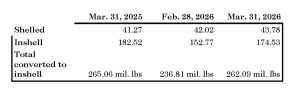
We calculate the total inshell by converting shelled meats to inshell using a yield of 50% (multiplying shelled by 2) and adding it to the reported inshell.
If you’d like to share information anonymously for the next Pecan Crop Corner, email pecansouth@tpga.org or call us at (979) 846-3352.
