
Tiny Titans: Lady beetles make a big impact on pecan aphid management
Across the pecan industry, insecticide use is both common and critically needed for management of economically damaging pests. Pest species that directly attack the nut, in addition to the black pecan aphid, demand immediate action with a reliable outcome to prevent economic damage. In these cases, it is understandable that an insecticide application is often the tactic of choice. Well-timed insecticide applications that control the targeted pest at the threshold of causing economic crop damage almost always provide a positive return on investment. However, other pests can be damaging but less acute in their attack, leaving room for non-insecticidal management options.
This is where the natural enemies can do the job for which they are built – free pest control. In my past articles, I have pointed out that early to mid-season ‘yellow’ pecan aphids (blackmargined aphid and yellow pecan aphid) can be managed by natural enemies. Many different species of natural enemies contribute to the demise of pecan aphids, but here I will focus on the lady beetles, specifically the exotic multicolored Asian lady beetle (Harmonia axyridis) and the native ashy gray lady beetle (Olla v-nigrum).

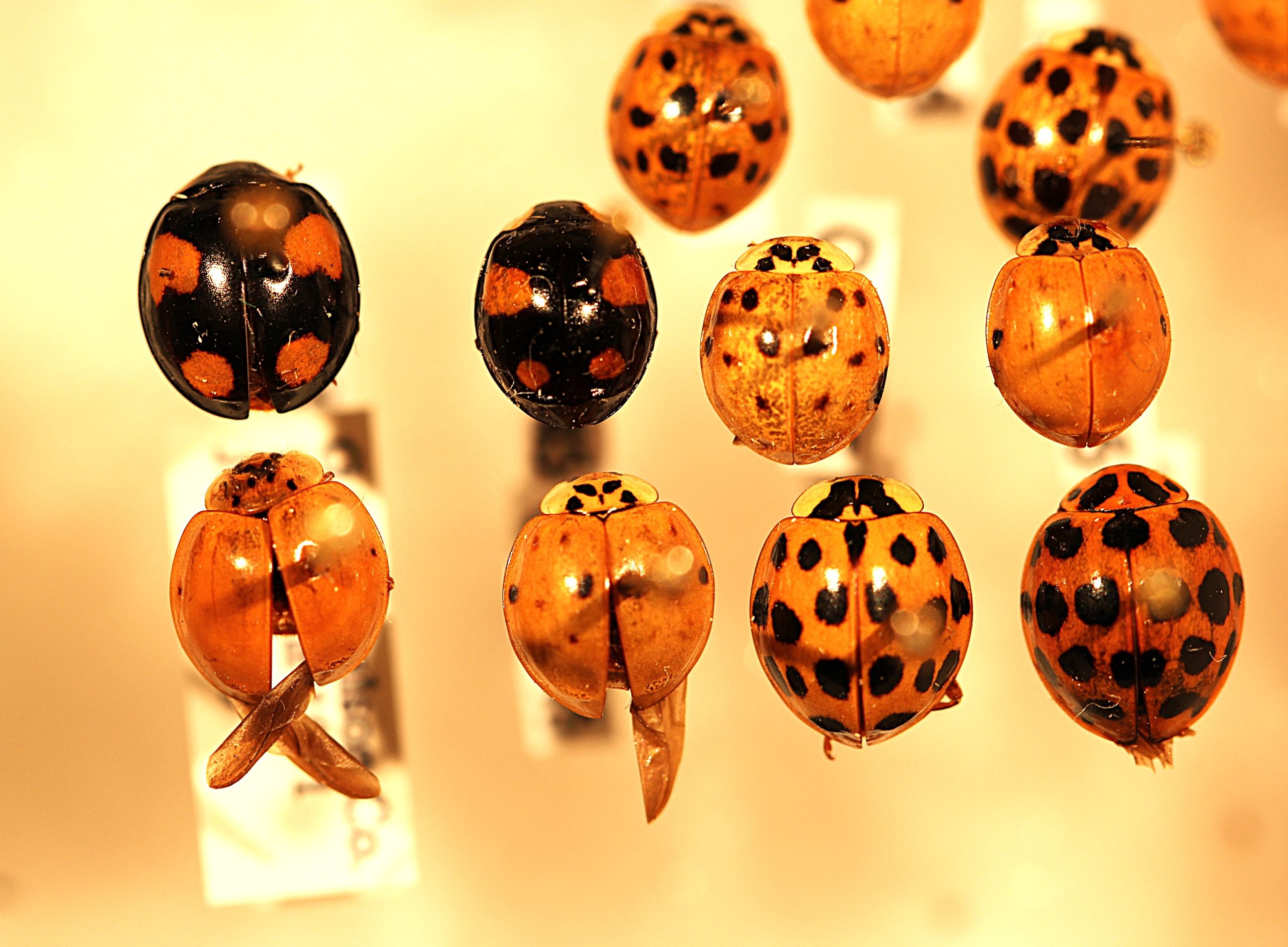
The color morphs of the ashy gray lady beetle. The two lady beetles on the left are the most common forms found in nature. (Photo credit by Ted Cottrell)
Lady beetles are esteemed predators of soft-bodied insects, especially aphids. However, there is an assumption that one lady beetle species is as good as another for aphid control. Overall, this is not true, and it certainly is not true for pecan orchards filled with tall trees. Like any other group of organisms competing for the same or similar resources, different species of lady beetle exploit niches that are most suitable for them. Of course, there is niche overlap among species, but not all species inhabit the entire niche of another species. On a pecan tree, a delimiting factor for lady beetle presence would seem to be aphid abundance, and this is true to an extent. However, when aphids are available on the orchard floor vegetation and throughout the pecan canopy, tree height separates where you will find certain species of lady beetles. For instance, most of the lady beetle species found on the orchard floor covers (i.e., sevenspotted lady beetle, convergent lady beetle, and pink spotted lady beetle) prefer to be low and will not move into the pecan canopy, especially high in the canopy, in appreciable numbers. In this case, a bountiful supply of aphids high in the tree does not overrule the niche constraints of these species. For these reasons, releasing commercially purchased convergent lady beetles into orchards for pecan aphid control is ineffective. In contrast, the native ashy gray lady beetle (Olla v-nigrum) and the exotic multicolored Asian lady beetle (Harmonia axyridis) tend to be more arboreal and do inhabit the pecan canopy. Both can be found on orchard floor vegetation, but both are adept at responding to pecan aphids in the orchard canopy.
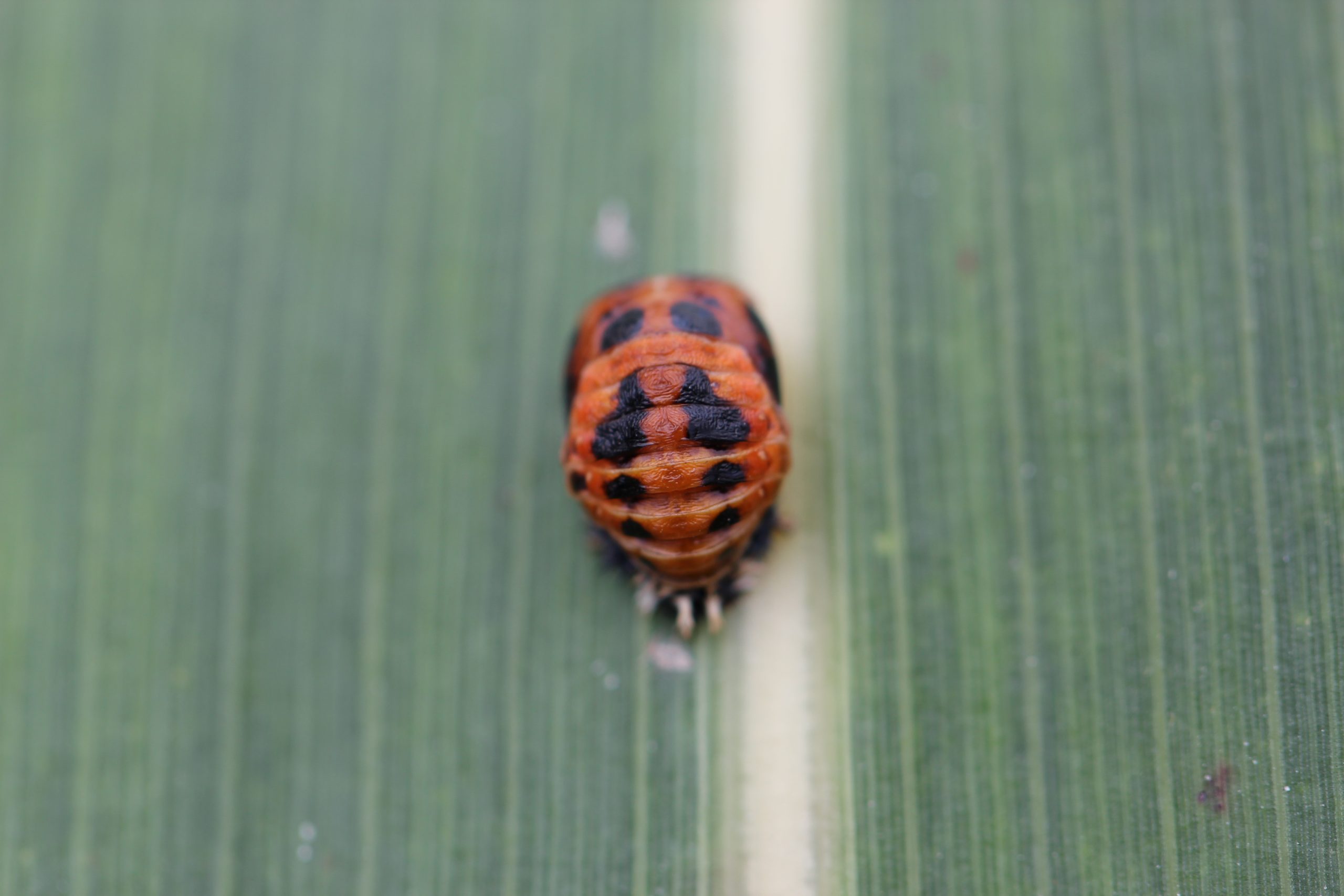
A pupa of the multicolored Asian lady beetle. (Photo credit Ted Cottrell)
A look at the ashy gray lady beetle life cycle reveals that it overwinters as an adult. It seems particularly fond of spending the winter in small groups of up to about 20 beetles under the bark of trees. Schley cultivar pecan trees and other trees with loose bark are suitable places to find them during the winter. Unfortunately, the naturally occurring fungal insect pathogen Beauveria bassiana is commonly found infecting beetles in these overwintering clusters, with some or all individuals becoming infected and dying. When spring arrives, the beetles move back to habitats that provide the resources they need, and females begin to lay eggs.
The multicolored lady beetle made quite the entrance into U.S. pest management in the 1980’s and 1990’s. This species is native to East Asia and was purposefully released numerous times at numerous locations in the U.S. beginning in 1916. However, genetic research indicates that the population that became established in the U.S. was from an accidental introduction at a port of entry along the U.S. Gulf Coast, not intentional introductions. From there, it quickly spread across the U.S. and now occurs in many countries worldwide. It has become a cosmopolitan species.
For pecans, this new lady beetle has had a tremendous positive impact on aphid control. The combination of this predator and the move away from many of the broad-spectrum insecticides that flare aphid populations has essentially made early to mid-season aphid damage negligible. And here it is cogent to state if you experience serious aphid issues at this time of the season, check your spray records for maybe a broad spectrum used against the pecan nut casebearer. For example, the insect growth regulator diflubenzuron is used against the pecan nut casebearer but is known to flare aphids and mites and is detrimental to natural enemies. Exotic species tend to establish in a new region from a small population of introduced individuals. This founding population does not carry the full cohort of pathogens that attacked the species in its native region. Nor will it be subject to the numerous parasites and predators that it suffered from in its native land. This ‘freedom’ from its own natural enemies, once established in a new region, is referred to as the ‘enemies release’ hypothesis. Basically, the newly established species does quite well in its new region because the resources are suitable and it is free from its own natural enemies (i.e., pathogens, parasites, and predators) that keep it in check in its native range. Additionally, the native natural enemies within its new range that attack native lady beetle species have not yet adapted to attacking this new exotic species. Because of this, the invader is free to thrive and compete against native insects occupying similar niches. For some native lady beetle species that have been outcompeted by the multicolored Asian lady beetle, this is bad. But when you focus on the original intent of pest control from the planned releases (that failed), the eventual but accidental establishment of the multicolored Asian lady beetle has provided tremendous success, contributing to early-to-midseason aphid control. This predator, along with the native ashy gray lady beetle, provides a formidable defense against pecan aphids at this time of the season.
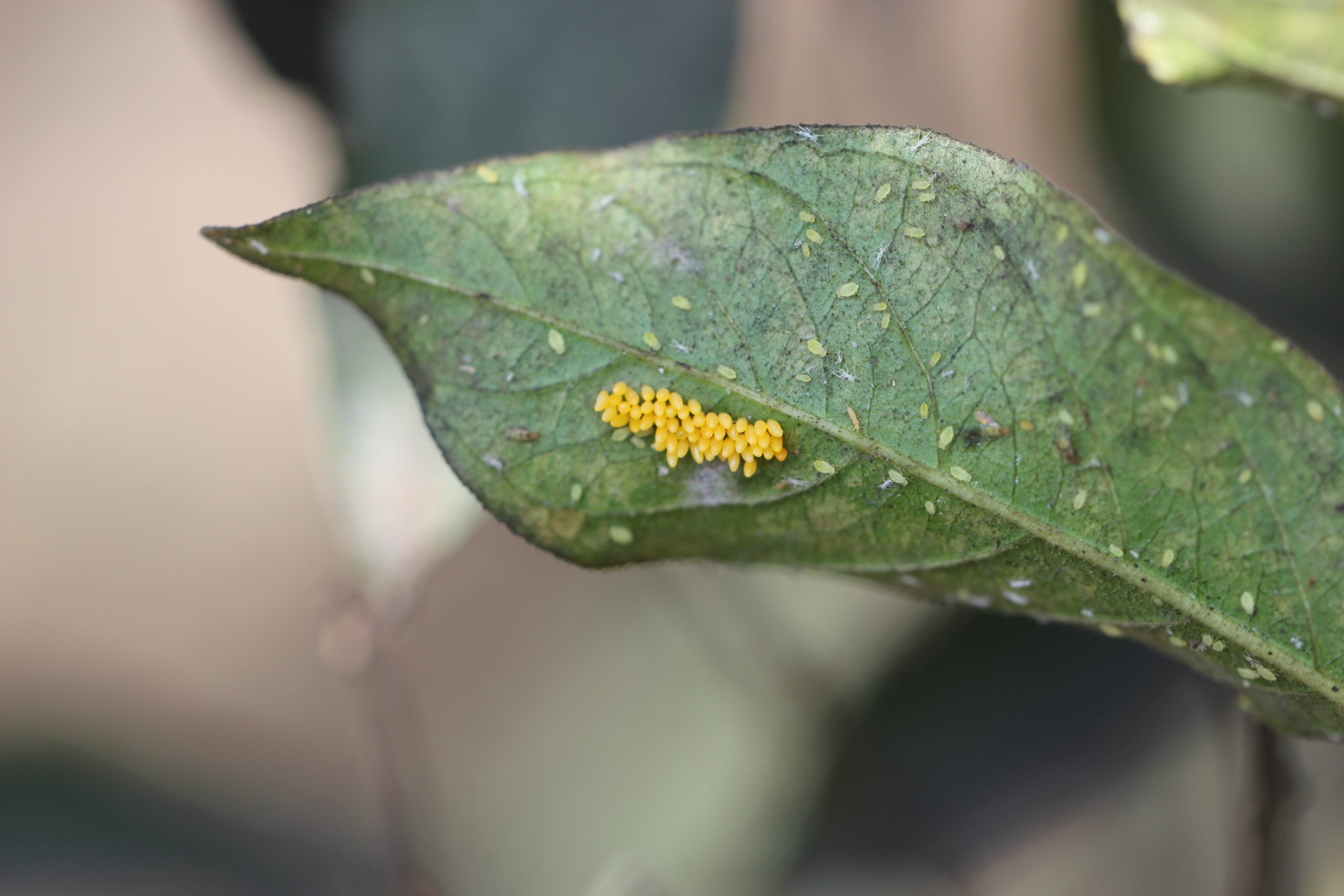
Lady Beetle eggs laid near aphids when aphids are abundant. (Photo credit by Ted Cottrell)
When prey is abundant, lady beetles will lay egg clusters near the prey. With prey being abundant, the lady beetle eggs are somewhat safe from predation, generally by their own species, making egg cannibalism a sometimes high source of lady beetle mortality. Cannibalism can also be prominent because different species of lady beetles are chemically defended against predation by toxic compounds in their blood. These compounds are also present in their eggs, thus protecting them from many predators, except themselves, which are not susceptible. When prey is scarce, lady beetles will often lay eggs in secluded areas away from prey, which lowers the chance they are discovered by predators. The life cycle of the various predatory lady beetle species is similar.
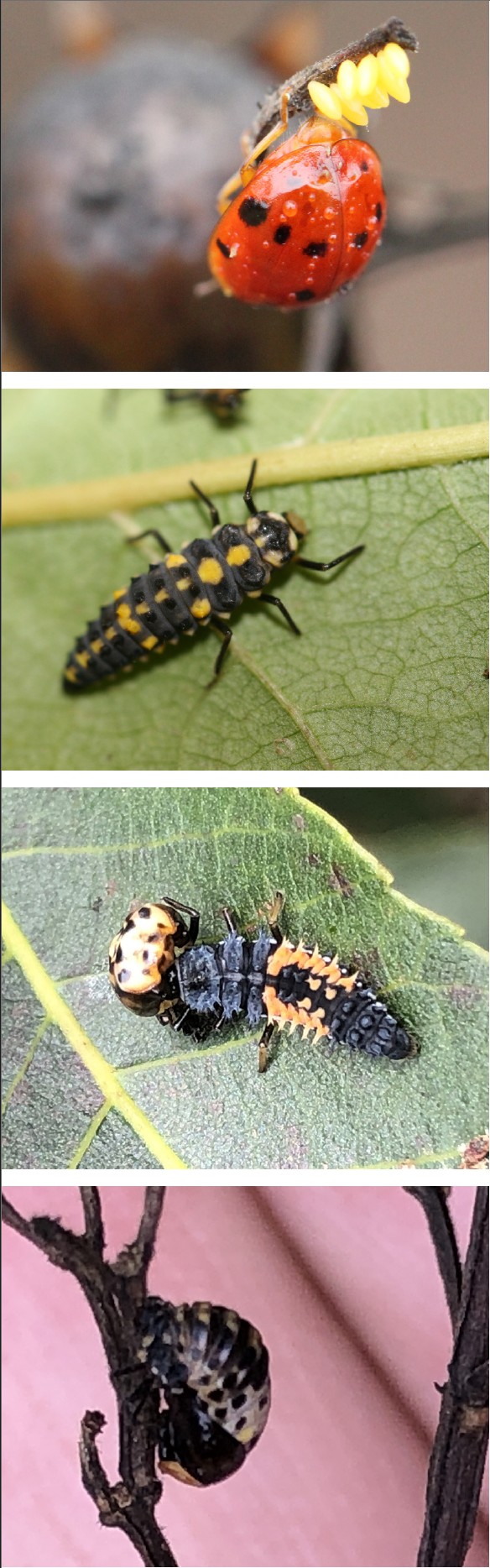
From top to bottom — A multicolored Asian lady beetle laying eggs at the tip of a branch away from predators, a larva of the ashy gray lady beetle, a multicolored Asian lady beetle larva cannibalizing a pupa, and a pupa of the ashy gray lady beetle. (Photo credit by Ted Cottrell)
Beginning with the egg stage, it takes three to four days for the eggs to hatch. These new larvae begin the first of the four intervals that constitute the larval stage: 1st instar (time between egg hatch and first molt), 2nd instar (time between first and second molts), 3rd instar (time between second and third molts), and the 4th instar (time between the third and fourth molts). During the different instars of the larval stage, the lady beetle larvae are voracious predators, eating almost anything they can subdue. After completing the 4th instar, the larva will find a place to settle, attach its posterior end to a leaf or limb, and pupate. The pupal stage lasts 4-6 days. During this time, the insect is immobile and subject to predation. Like the eggs, the pupae are chemically defended, and most acts of predation against them are cannibalism. The pupal stage ends with the emergence of the adult insect. The adults are long-lived and capable of dispersing across landscapes in search of food. Their ability to find habitats with food is critical for pecan aphid control.
Once lady beetles begin to accumulate in pecan orchards and lay eggs, their numbers will grow, dramatically reducing aphid populations. This decrease does not happen overnight, but given time, it is a certain outcome. During the early-to-mid-season, this slow-but-sure aphid management works just fine and is free. However, once we reach the late season, low populations of the black pecan aphid can cause economic damage well before lady beetles respond. The low damage threshold of the black pecan season during the late season, coupled with the slow response of the lady beetles, is why late-season aphid treatments can be critical.
