
Understanding Pecan Hurricane Risk
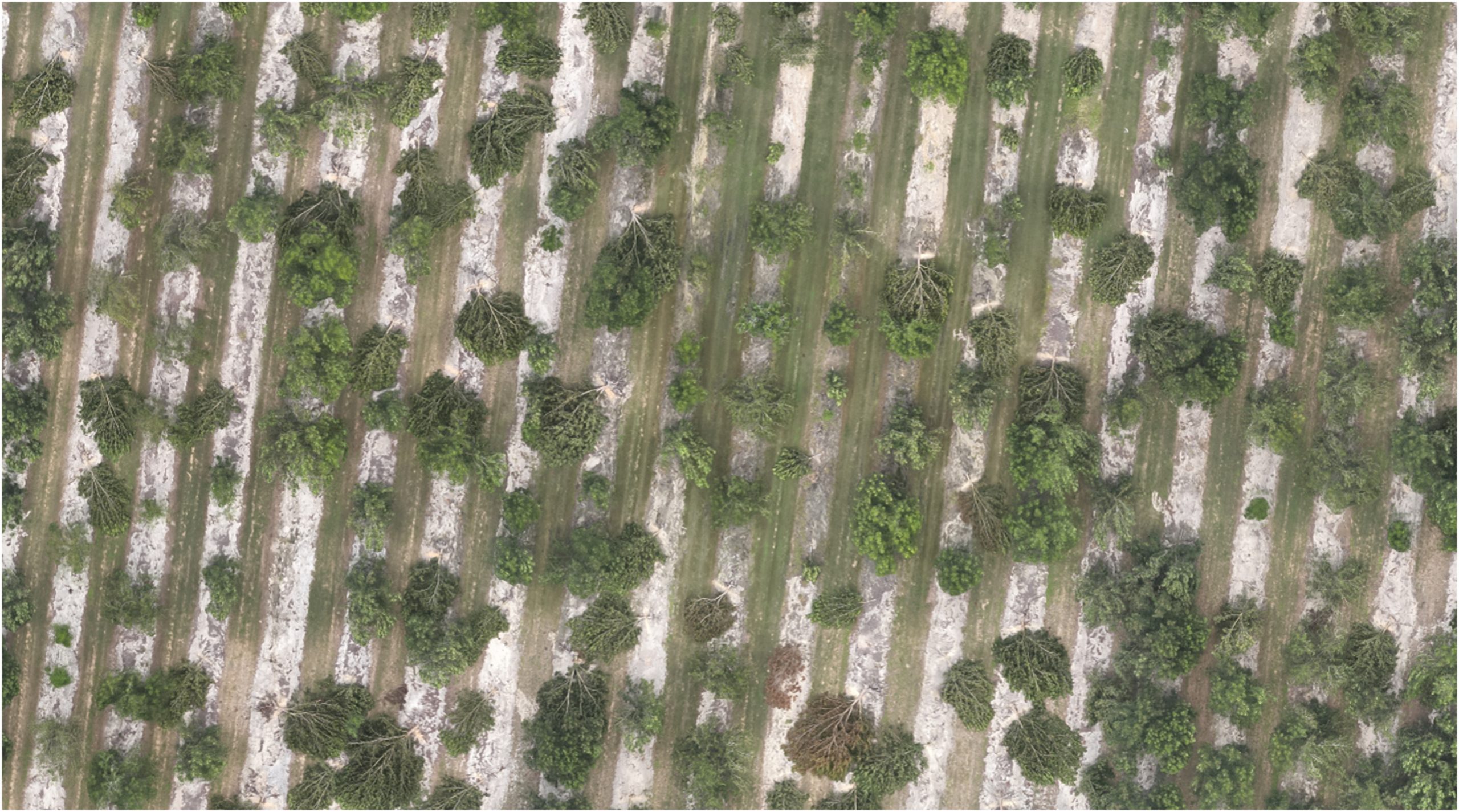
Ortho-mosaic derived from uncrewed aerial system (UAS) illustrating damage to pecan orchards in south Georgia, USA following impacts from 2023 Hurricane Idalia. image with credit to Dr. Jeff Cannon.
Hopefully, we won’t have to deal with another one in 2025, but hurricane season is here and its on everyone’s minds. Its difficult to manage a pecan orchard in a way that can have much effect in protecting it from something as powerful and out of our control as a hurricane. To date, very little empirical evidence is available to inform decision-making about wind risk in pecan, and guidelines for mitigating hurricane risk primarily rely on anecdotal evidence. However, over the last year or two, I have been working with landscape ecologist, Dr. Jeff Cannon from the Jones Center at Ichauway to better understand the patterns of damage in pecan orchards.
Understanding hurricane mortality for a range of wind speeds and tree sizes can help assess hurricane risk in real time and help decide whether mitigation measures are warranted. To provide foundational knowledge on wind susceptibility in pecan trees, we reconstructed hurricane damage to 1,142 trees from 11 pecan orchards throughout Georgia using rapid surveys after 2023’s Hurricane Idalia.
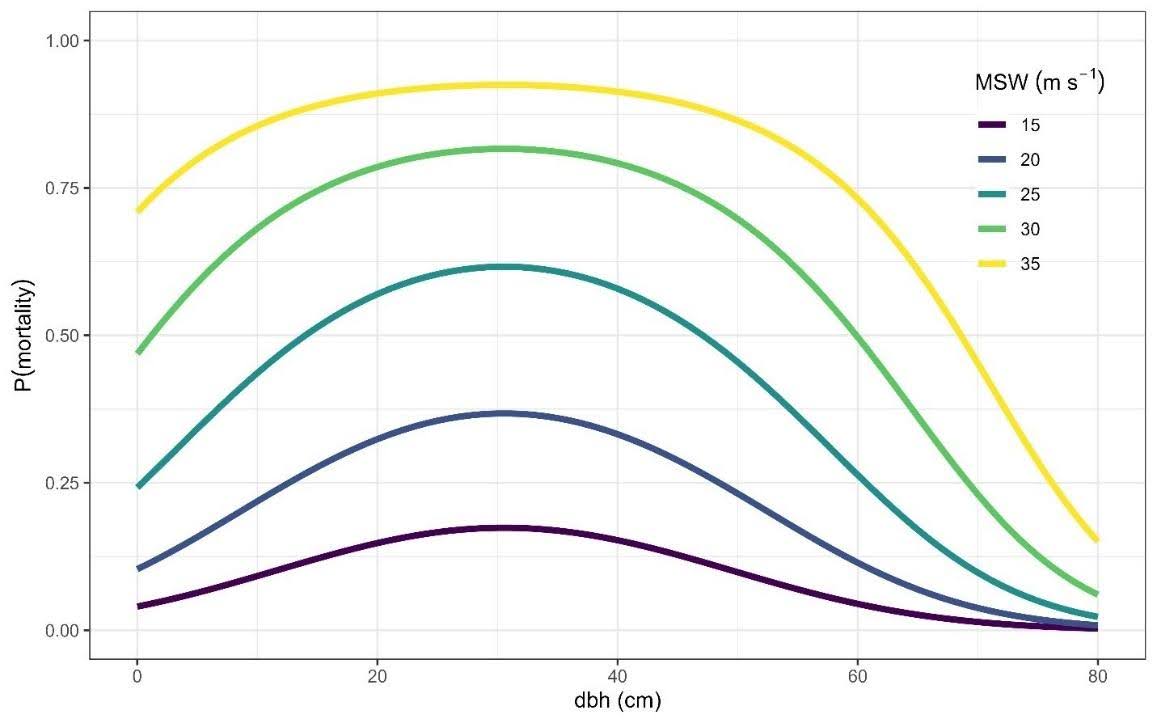
Figure 1. Pattern of pecan tree mortality across a range of wind speeds (MWS) at varying tree sizes (dbh).
Damage to pecan increased from 15-40% for tropical storm winds and rose to 70-80% for Category 1 hurricane winds. Not surprisingly, damage was highest for intermediate tree size classes—peaking at 35 cm (14 in) diameter at breast height, which are often our most productive trees.
The post-Hurricane Idalia survey found that diversifying orchard age structure and canopy management—such as pruning—can influence vulnerability to wind damage. We recommend that pecan growers consider age and size structure in their orchard planning with orchards of different ages that balance maximizing production and reducing wind risk. Prior research also suggests that mechanical hedge pruning can reduce wind damage by as much as 60%, depending on wind speed.
In inter-planted orchards, small trees are often in subcanopy positions where they are sheltered from extreme winds by larger surrounding trees. In orchard settings with wide tree spacing, protection from neighbors may be less important, except in cases of under-planted orchards. However, other mechanisms, such as increased stem elasticity among young trees may reduce the probability of lethal damage among younger pecan trees.
Large trees with sprawling crowns should be exposed to greater wind by drag, yet they can also exhibit sublethal damage patterns such as defoliation or broken limbs and crowns. This sublethal damage can substantially reduce drag and may afford protection from more severe damage such as uprooting or snapping. Of course, every storm has its own characteristics. At 90-100 mph winds, especially with heavy rain before the arrival of the wind, even the largest trees are susceptible to loss.
It’s natural for pecan growers to push young trees to try and get them into production as soon as possible. This generates large tree canopies at early tree ages, often at the sacrifice of generating strong root systems and deep anchorage. Previous hurricane damage and the information we’ve gained highlights the need for us to slow down the growth rate on our young pecan trees to allow the root systems to catch up to tree canopy size for better anchorage at these vulnerable tree sizes.
Our next step is a statewide analysis to assess how soil types and landscape features contribute to risk, with the goal of supporting future orchard site planning and management.
You can find the link to our first research publication on this topic below:
Cannon, J.B., A.W. Whelan, A.S. Johnson, and M.L. Wells. 2025. Mitigating tropical cyclone susceptibility in pecan (Carya illinoinensis). Scientia Horticulturae. doi.org/10.1016/j. scienta.2025.114236