
Why we Want ALL your Weevils
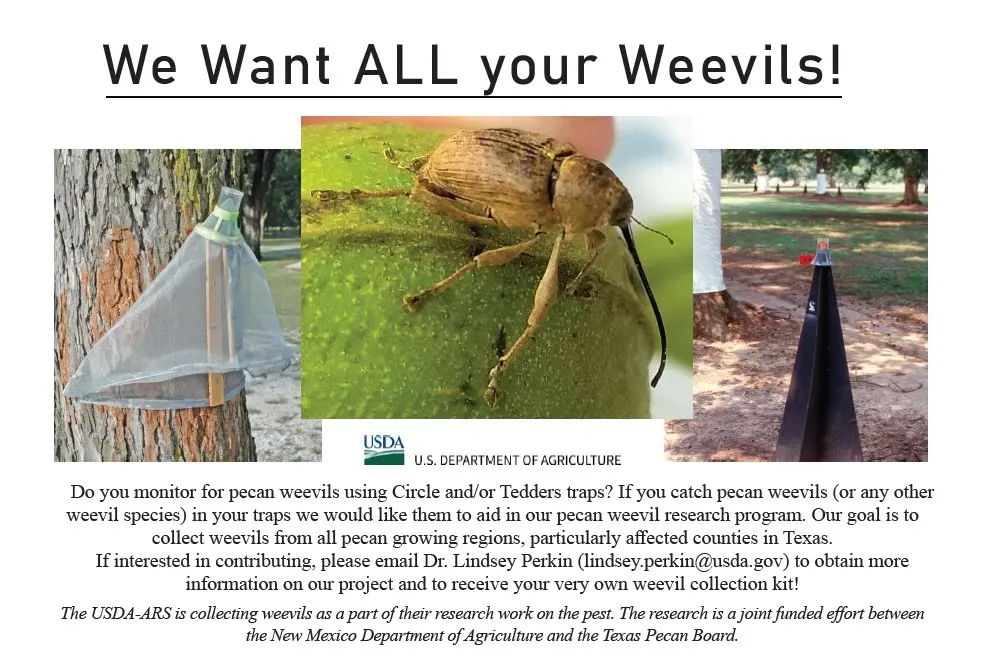
Solicitation for weevils printed in May Pecan South.
You may have noticed in previous issues of Pecan South an “advertisement” towards the back of the magazine asking for “ALL your weevils”. (If you haven’t, we have included the same advertisement here.) This article will explain why we want your weevils and how it will benefit pecan growers across the south.
As you may know, the pecan weevil, Curculio caryae (Horn), is a devastating pest of pecans and, if not managed properly, can damage and destroy an entire orchard. The pecan weevil’s distribution largely matches the region where commercial and native pecan trees grow. Nevertheless, in Texas, the pecan weevil has expanded its range over the last two decades and, as of 2018, has been reported in 132 of the 254 counties (Dr. Bill Ree, personal communication).
However, there is a six-county area in southwest Texas that remains weevil-free and essentially surrounds a major pecan processing facility in El Paso, TX. This facility processes pecans from Texas and other states, including Georgia. Thus, maintaining this weevil-free area is considered a high priority by the Texas Department of Agriculture (TDA), New Mexico Department of Agriculture (NMDA), Texas Pecan Board (TPB), and Texas Pecan Growers’ Association (TPGA) because only pecans produced in these six counties are permitted to export inshell nuts into Mexico. Consequently, several regulations and policies are in place to minimize the spread of pecan weevils into this weevil-free area. For example, TDA enforces a set of regulations that quarantines pecans produced in all other Texas counties, as well as several counties in New Mexico, and all other states and districts of the U.S. except Arizona, California, and the remainder of New Mexico (Anonymous 2025). These regulations require inshell pecans to be treated accordingly and certified before entering the weevil-free area. Should a pecan weevil be detected in the area, confirmation of the weevil’s identity and identification of the likely geographical source of the weevil will be paramount for developing new regulations/policies to minimize future infestations. In fact, suspect pecan weevils and potentially infested nuts were collected in El Paso in 2023. However, the insects and nuts were destroyed before their identity and likely geographical origin could be confirmed.
In order to better manage similar situations in the future, we want to collect weevils from across its range to determine their genetic makeup (population structure). Similar to the way Ancestry.com uses your DNA to determine who you are and where you come from, we anticipate that weevils from different geographical areas will also possess unique DNA markers that can be used to determine their geographical identity. For example, pecan weevils from Georgia will possess unique DNA markers that can be used to distinguish them from weevils in Texas or Oklahoma. However, as the distance between weevil populations decreases, we expect to see less differences in their DNA. Thus, we may not be able to distinguish weevil populations from two adjacent orchards, but this information will give us some insight into the pecan weevil’s movement and dispersal capabilities. That way, when a weevil is found in a new county or at a shelling facility, we will be able to determine the most likely geographic origin of the weevil(s). A previous study did something similar with molecular markers and was able to group weevils by broad geographic location (Mynhardt et al., 2007). Our study aims to duplicate this, but at a finer scale, which is now possible due to advances in sequencing technology. Thus, should a pecan weevil be detected in the six-county weevil-free area of Texas, our new data will not only help determine the most likely geographical origin of the weevil but also provide insight into how weevils are spreading, either through natural dispersal and/or human-assisted movement. Collectively, this information may be used to create new or to modify existing regulations and policies to reduce the spread of this insect.
Starting in August 2020, our research group began collecting pecan weevils from four orchards in Comanche Co., Texas, to examine pecan weevil pheromone production. Each of the locations was approximately 1 to 1.5 miles apart from each other. Out of curiosity, we looked at the genetic makeup of weevils from each location to see if the weevil populations in each orchard were intermixing. We found complete genetic admixture, meaning all weevils were genetically related to one another, leading us to conclude that pecan weevils can disperse farther than previously thought.

Principal components analysis showing no clustering of distinct groups across the four Comanche Co. orchards over a two-year period. Colors denote the different orchards separated by year. Dots within the plot represent individual weevils analyzed from each respective orchard.
We have continued to collect weevils from Comanche Co. as well as other areas across pecan growing states, such as Oklahoma, New Mexico, and Georgia. In preparation for the upcoming season, we have already sent weevil collection kits to six new locations across Texas, Oklahoma, and New Mexico. We continue to seek weevils from other producers in Texas and hope to also find cooperators in Kansas, Arkansas, Missouri, and Illinois. The more weevils we have from as many locations as possible will make our analysis more robust and specific to a geographic location.
In addition to the benefits described above, the pecan weevils you supply will also allow us to pursue several other studies that may benefit the pecan industry. For example, we are developing an artificial intelligence (AI)-driven model that can identify weevils to the species level based on photographic images – think facial recognition for weevils. So, all the weevils that are sent to us for the genomic study will first be photographed to assist in the development of an accurate AI model. Ultimately, the AI model will be capable of distinguishing pecan weevils from other weevil species (e.g., acorn weevils) based solely on photographic images of the suspect weevils.
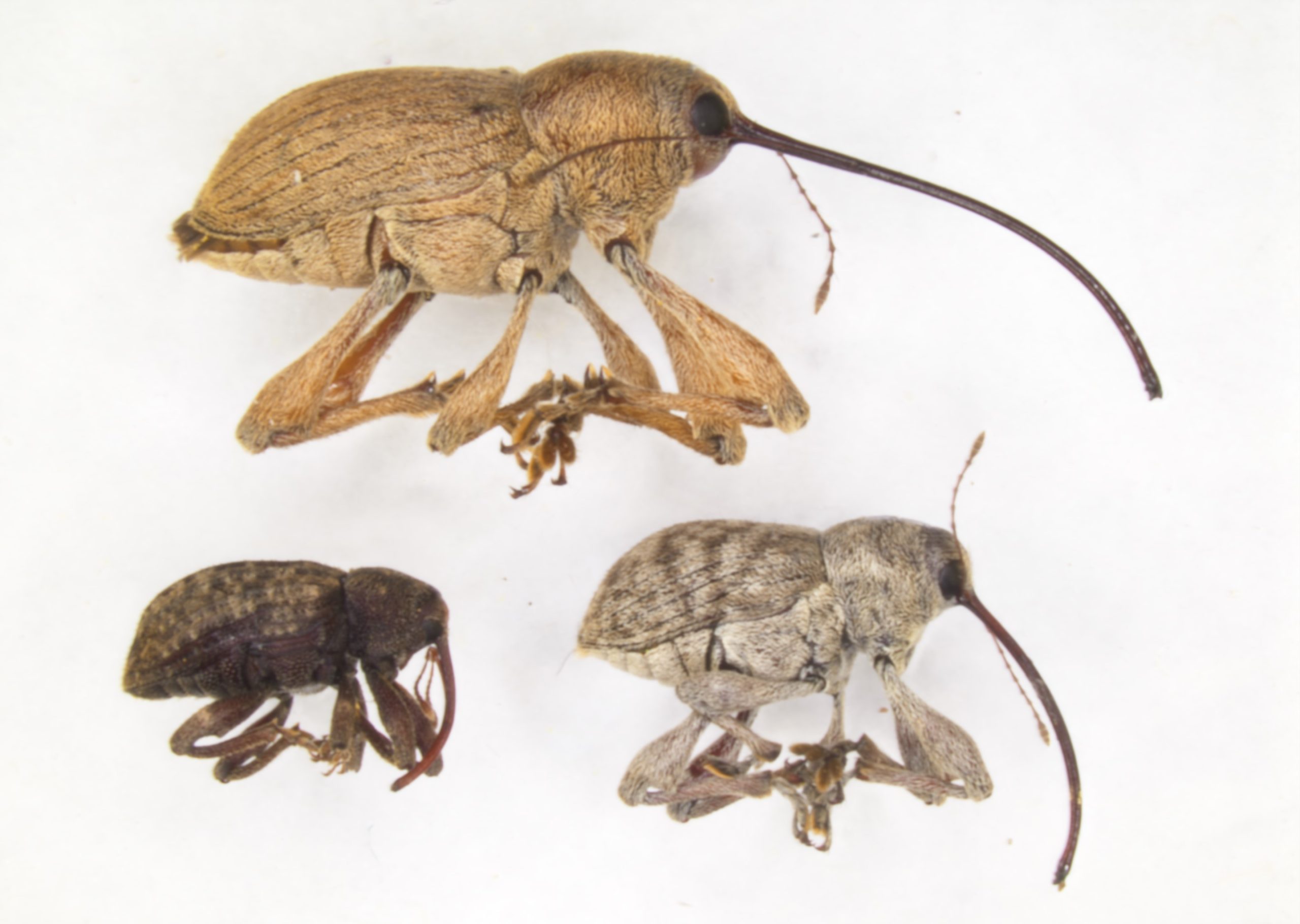
Photograph of the pecan weevil, Curculio caryae (Horn) (top), and “acorn” weevils Conotrachelus naso (LeConte) and Curculio fulvus (Chittenden), bottom left and right, respectively.
Lastly, the early collections from Comanche Co. gave us the resources to assemble a reference genome for the pecan weevil that will be a valuable genomic tool for further studies, including a pangenomic study that currently lacks weevil specimens from distinct populations. Your weevils will help fill this gap and allow us to find the “core” genes that are responsible for critical biological life processes such as diapause, reproduction, metamorphosis, etc. This knowledge could lead us down the path of developing weevil-targeted pest control tactics that exploit and disrupt critical biological processes. While this may sound “(pecan)-pie-in-the-sky”, it is not impossible and is being done in other tree systems (Hunter & Larson, 2025).
Therefore, we really do want ALL your weevils. So, tell your friends and spread the word! Please contact me if you are interested in being part of our research, and we can provide you with all the equipment and supplies needed to trap, collect, and ship specimens back to us.
Acknowledgements: Special thanks to Mike Barry (Comanche Co., TX Extension Agent) and Patrick Dudley (Texas Department of Agriculture) for their assistance in setting up Circle traps, and Mike O’Neil, Ritchie Eyster, and Derrick Hall (USDA-ARS) for their technical assistance. Special gratitude is extended to the Texas Pecan Board and New Mexico Department of Agriculture for supporting and funding the project. Thank you to Dr. Charles Suh (USDA-ARS) for editing this article. Mention of trade names or commercial products in this article is solely for the purpose of providing specific information and does not imply recommendation or endorsement by the U.S. Department of Agriculture. The USDA is an equal opportunity provider and employer.
Reference:
Anonymous. 2025. Texas Department of Agriculture. https://texasagriculture.gov/Regulatory-Programs/Plant-Quality/Pest-and-Disease-Alerts/Pecan-Weevil (accessed 6/20/25).
Hunter, W.B., Larson, N.R. (2025). Invention of RNAi Biopesticides to Psyllid Vectors and Bacterial Pathogens of Citrus: Future Technologies for Gene Targeting. In: Smagghe, G., Palli, S.R., Swevers, L. (eds) RNA interference in Agriculture: Basic Science to Applications. Springer, Cham. https://doi.org/10.1007/978-3-031-81549-2_17
Mynhardt, G., Harris, M.K., Cognato, A.L. 2007. Population genetics of the pecan weevils (Coleoptera: Curculionidae) inferred from mitochondrial nucleotide data. Ann. Entomol. Soc. America, 100(4) 582-590.
