
Flight of the Moths: The 2026 First-Generation Pecan Nut Casebearer (PNC) Flight in Texas and the Future of PNC Research
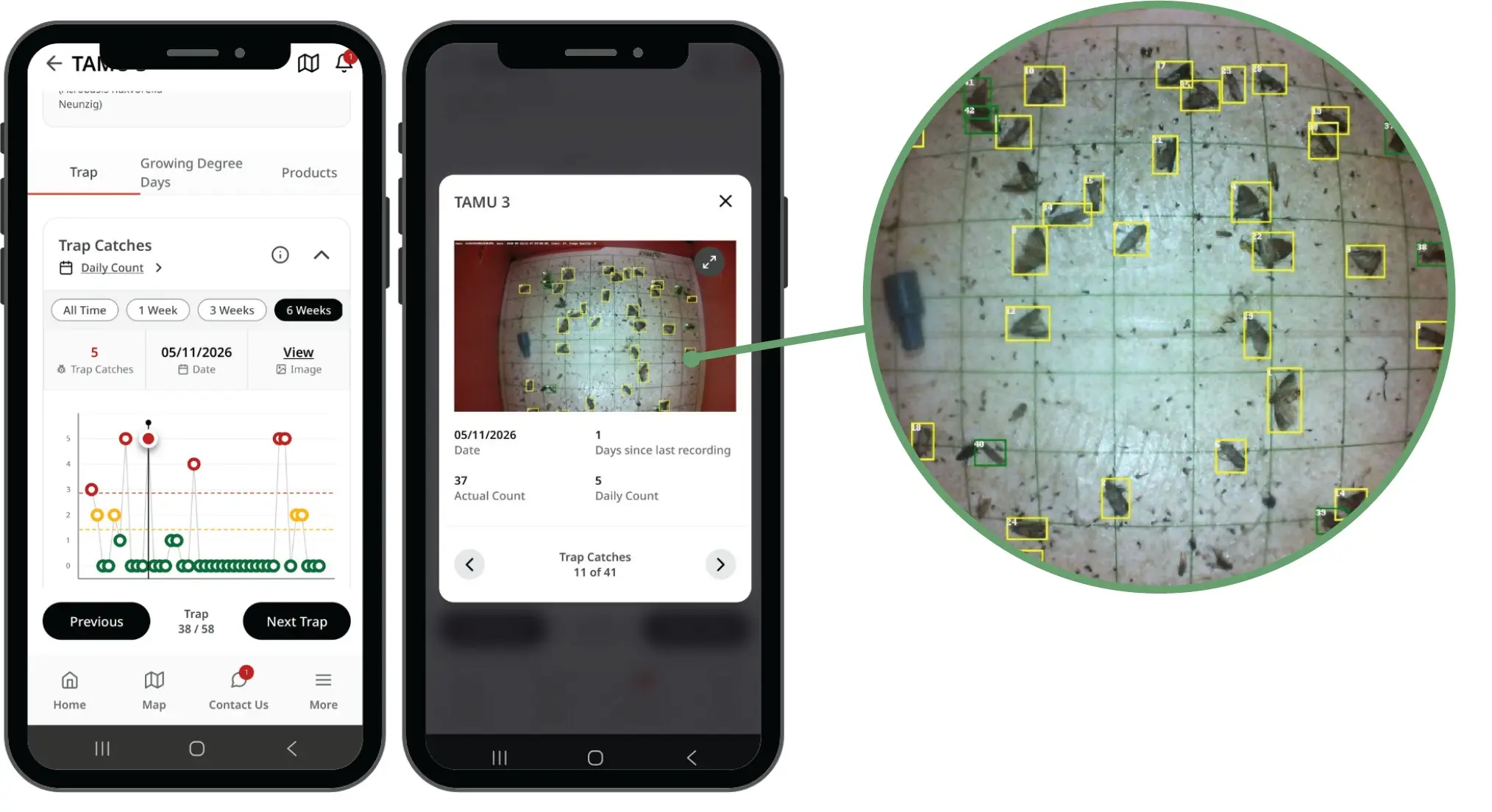
Images and graphs generated in the Arc Farm Intelligence app using data transmitted from CropVue Smart Traps: graphical representation of PNC counts (left), pheromone trap image with associated trap data, including photo date and number of moth captures (middle), and close-up photo of the sticky liner with PNC moths marked in green (moths caught that night) or yellow (moths caught on previous nights).
This year, traps were deployed in eighteen participating counties across Texas: Anderson, Bastrop, Bowie, Burleson, Calhoun, Caldwell, Clay, Comal, Comanche, Erath, El Paso, Fort Bend, Guadalupe, Palo Pinto, San Saba, Tom Green, Wise, and Victoria. At least three smart traps were deployed in each county, except for El Paso, Guadalupe, and San Saba, where six traps were deployed, and Palo Pinto, where four traps were deployed. Erath County and DeWitt County did not receive smart traps and instead used traditional PNC manual traps. All traps were lined with Trece Pherocon liners, baited with Trece Pherocon PNC lures, and deployed at least 200 feet apart in each participating orchard. Traps were deployed between late March and mid-April to coincide with the anticipated first-generation PNC flight. In Texas, first-generation moth flight typically occurs earlier in southern parts of the state, often between early and mid-April, while northern parts of the state may not see moths until mid-May in some years.
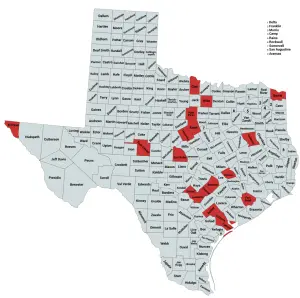
State map highlighting the eighteen participating Texas counties where monitoring traps were installed.
First-Generation PNC Flight Patterns in Texas for 2026
PNC flight activity in 2026 could only be described as unpredictable and interesting. The warm winter leading into spring seemed to indicate an early arrival for moths, with some models predicting emergence up to three weeks earlier than last year. In Texas, differences in moth activity compared with last year varied by county. Anderson, Burleson, Caldwell, DeWitt, Palo Pinto, and Tom Green counties all reached biofix within a few days of what was reported last year. Several counties reported a biofix this year after not reporting one last year, including Bastrop, Calhoun, Comal, Guadalupe, and Victoria. Traps in Guadalupe County captured large numbers of moths throughout most of April and into May. Comal County presented an interesting scenario: despite being only 36.4 miles from the Caldwell County trapping site and approximately 22.7 miles from the Guadalupe County site, traps at the Comal County site began catching moths more than two weeks after the Caldwell and Guadalupe sites. This appears to reflect the degree to which orchard location and the surrounding environment can influence PNC populations in an orchard. Northern Texas appeared to experience significantly earlier flights this year compared with 2025. Bowie County reached biofix 13 days earlier than in 2025, Clay County reached biofix 14 days earlier, and Wise County reached biofix 10 days earlier. Far West Texas also experienced a significantly earlier moth flight, with traps in El Paso capturing moths 17 days earlier than last year. Interestingly, Comanche and San Saba counties had low to no moth flight this year. San Saba reached biofix on May 4, but moths were captured at only one site in the county and in very low numbers. A verbal survey of growers at the 2026 San Saba County Pecan Field Day on May 4 revealed that most growers had not yet captured moths at the time of the meeting. This was a significant contrast to last year, when a decent number of moths were captured in pheromone traps in the county. Comanche County continues to have low PNC numbers, as it has over the past few field seasons. Although it did reach biofix in 2025, it reached this threshold over a week later than nearby monitoring sites. 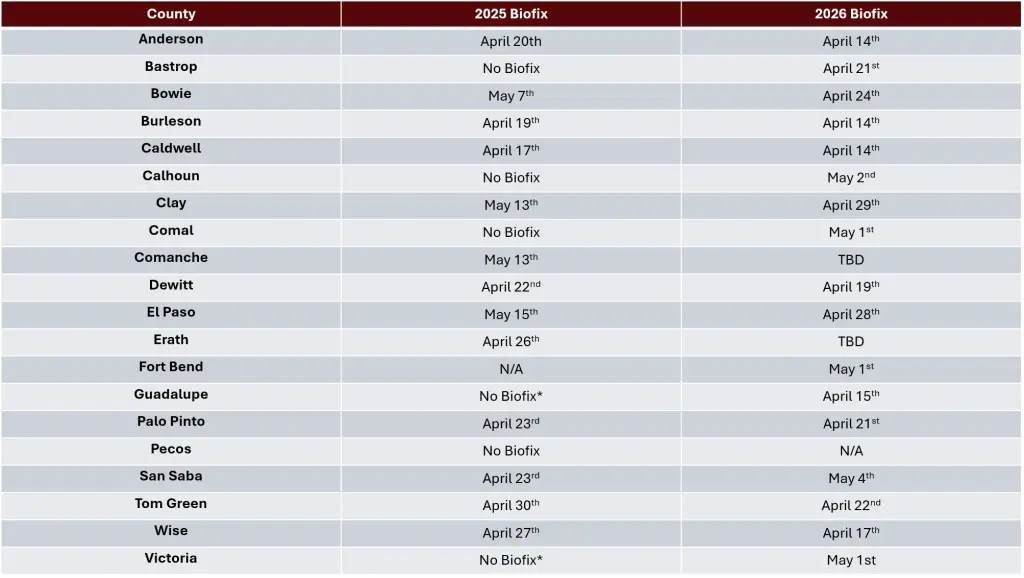
Overall, first-generation PNC emergence in Texas occurred over 21 days this year, compared with 29 days last year. Some growers reported seeing some of the largest moth captures they had ever observed, while others barely saw any moths. Long-term studies on PNC populations, like the one I am currently developing through the PNC monitoring program, should help inform future flight predictions and improve decision making regarding trap deployment, egg scouting, and insecticide application timing.
Challenges for PNC Management
The past couple of years of PNC monitoring have raised new questions about PNC monitoring and management. Conversations with growers, researchers, and industry representatives have highlighted how much we still need to learn about this important pecan pest. Despite the substantial amount of work that has been done to understand PNC biology, several important questions remain unanswered, I will discuss a few of these throughout the rest of this article.
Predicting the PNC Life Cycle for Management.
Currently, the only proven management practice for PNC involves applying an insecticide to target newly hatched larvae before they tunnel into the nutlet. This is a tall order because this vulnerable period lasts only two to three days, during which the larva feeds on a dormant bud before returning to the nutlet cluster. Current products such as methoxyfenozide, which can provide residual activity for two to three weeks, have reduced the risk of making an ill-timed application, but timing remains the key to effective PNC management. There is currently no evidence to support treating at any other time. As a result, pecan entomologists and growers have worked for years to develop a reliable way to predict larval hatch.
Pecan scientists have attempted to develop this process by using information on moth life history to time insecticide applications. The core component of this approach is based on what are known as degree-day models, which estimate the growth and development of organisms such as insects by tracking accumulated heat units, or degree days. While the variables used to calculate degree days vary among organisms, the following formula is commonly used:

The base temperature is the temperature below which the organism does not develop. Dennis R. Ring and Marvin K. Harris determined the base temperature for PNC development to be 37.98 degrees F.
Developing an accurate degree-day model for PNC has been attempted multiple times. Dennis Ring and Marvin Harris developed the Texas Model in the 1980s, which used a starting date based on the number of frost-free days that had occurred in the area being monitored. While this model was effective in certain areas of Texas and Louisiana, it was reportedly poor at predicting flights in the southeastern United States and in southern and western Texas. Darryl Sparks later developed a Georgia model that uses heating and chilling units to predict pecan budbreak. This information could then be used to predict when PNC nut entry exceeded 1%. An alternative model, where heat units are accumulated beginning 10 days before 50% budbreak has also been used, with first significant nut entry predicted at 1,831 heat units. Using budbreak to predict PNC phenology was attractive because budbreak helps trigger PNC overwintering emergence in the spring.
Current techniques for predicting PNC flight rely on pheromone-baited traps to monitor male flight patterns. Some growers time sprays based on the peak flight of male moths captured in the spring. For example, a grower may apply an insecticide one to two weeks after 20 to 25 moths have been caught in a trap. Allen Knutson and Mark Muegge later developed a degree-day model initiated by sustained pheromone trap captures of male moths on back-to-back nights, known as biofix. This model predicted an average of 667 degree days from biofix to first PNC larval nut entry. The biofix date based on male moth capture could be used to predict female egg lay in the orchard, letting growers know when to begin scouting for eggs. This is the current model used to predict PNC life stages throughout most pecan-growing areas of the United States and is the foundation for the Ag Pest Monitor: Pecan Forecasting Tool.
While these models are currently the best options for predicting PNC flight activity, they still need continued refinement and validation as new information becomes available. One major pitfall of relying on pheromone traps is that nut entry can occur even when no male moths are captured. This can be caused by something as simple as a bad lure, but it may also indicate that we are missing important information, such as a clearer understanding of the relationship among trap capture, egg lay, and treatment timing, or a better understanding of how male and female moth population dynamics affect trapping success. Answering these questions is key to refining models and providing growers with better information on when to treat for PNC.
Understanding the geographic distribution of different PNC pheromone types and populations.
Studies have revealed at least two pheromone types of PNC: a standard pheromone that is attractive to moths in the southern United States but not Mexico, and a Mexican pheromone that is attractive to moths in both the southern United States and Mexico. The absence of the standard pheromone in Mexican populations of PNC is theorized to have developed because sugarcane borer (Diatraea saccharalis) produces the same sex pheromone as the standard PNC pheromone. Because of the abundance of corn and pecan grown in Mexico, there is substantial overlap between corn- and pecan-growing regions and, as a result, substantial overlap between PNC and sugarcane borer populations. This may have resulted in Mexican PNC populations become unresponsive to the standard pheromone to avoid wasting energy pursuing a pheromone trail produced by the wrong species. Sugarcane borer is also present in several Gulf Coast states, including Louisiana and Texas, but it is unknown what effect, if any, this species has had on the makeup of PNC pheromones in those states because a recent survey and characterization of different PNC pheromone types has not been conducted. As a result, growers currently lack region-specific guidance on which lures to purchase and how lure type affects monitoring accuracy.
Alternative Management Strategies for PNC.
Current management strategies for PNC are largely limited to insecticide applications. Few other components of the integrated pest management paradigm have received much attention as potential alternatives. While current products such as methoxyfenozide (the active ingredient in Intrepid 2F and one component of Intrepid Edge, along with spinetoram) and chlorantraniliprole (Vantacor) are very effective at managing PNC, history reminds us that we should always be looking for alternatives. In 1988, pecan producers lost phosalone (Zolone), a stalwart of PNC management through the 1980s. Its heir apparent, chlorpyrifos (Lorsban), was later removed from routine use after a 30-plus-year run as an important product for managing pecan aphids, hickory shuckworm, and, of course, PNC. Monte Nesbitt wrote a great article about his experience with this change in the May 2022 issue of Pecan South.*
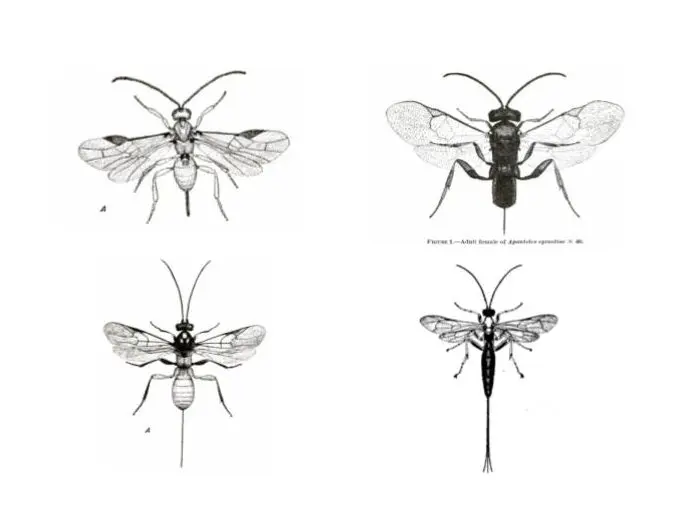
One understudied aspect of PNC management is biological control, which is the use of natural predators or parasitoids to manage pest populations. Some background work has been done to catalog potential biological control agents for PNC. For example, surveys have identified 20 to 30 parasitic wasps and flies that attack PNC. However, little work has been done to assess the impact of these parasitoids on PNC populations. Other potential candidates include mini-hemipteran predators such as minute pirate bugs/insidious flower bugs and predatory mirid bugs. These tiny predators are known to feed on insect eggs, and their populations appear to peak during first-generation PNC activity, but there has been no assessment of their impact on PNC eggs. Bats have also gained interest from growers, as discussed in my previous Pecan South article. Interesting research is currently being conducted through a joint venture among Merlin Tuttle’s Bat Conservation, Noble Research Institute, and pecan growers in Texas and Oklahoma to determine the impact of bats on PNC. There is a lot of exciting work to be done to determine the role of biological control in PNC management.
What Are We Doing?
A current multi-state, multi-institutional effort is underway to answer some of the questions presented in this article. Scientists from Texas A&M AgriLife Extension, USDA-ARS laboratories in Somerville, Texas, and Byron, Georgia, and pecan scientists from other institutions throughout the pecan belt, including the University of Georgia and New Mexico State University, are working together to address these questions. In addition, we are currently assessing alternative methods of PNC management not discussed in this article, including pheromone disruption and new biologically based and conventional insecticides. We look forward to sharing this new information with you in future issues of Pecan South.
Acknowledgements: I would like to thank all the growers and county agents who participated in the 2026 PNC monitoring program for their assistance in setting up and checking traps: Jim Livergood and Truman Lamb (Anderson County); Dakota Kempken and Travis Britt (Bastrop County); Brian Triplett and Brent and Caleb Ramage (Bowie County); Monte Nesbitt (Burleson County); Troy Swift and Wayne Morse (Caldwell County); Stephen Biles (Calhoun and Victoria counties); Bill Holcombe and Jake Montz (Clay County); Mark Friesenhahn (Comal County); Mike Berry and Will Cullers (Comanche County); Anthony Netardus (DeWitt County); Jonathan Consford, Larry Cabellos, Shannon Ivey, and Isaiah Ulmer (El Paso County); Lonnie Jenschke (Erath County); Jody Taylor (Fort Bend County); Mike Willard and Travis Franke (Guadalupe County); Jason Westbrook, Laura and Raymond Miller, and Mike Hopkins (Palo Pinto County); Dennis Hardman, Winston Millican, and Neal Alexander (San Saba County); Allison Schwarz (Tom Green County); and Marty Morgan and James Haynes (Wise County). I would also like to thank the FMC team of Holly Davis, Sharyn Kane, Jonathan Sanchez, and Erica Rudolph for assistance with Smart Trap maintenance and troubleshooting.
Literature Cited Grantham, R. A., Mulder, P. G., Cuperus, G. W., & Carlson, J. D. (2002). Evaluation of pecan nut casebearer Acrobasis nuxvorella (Lepidoptera: Pyralidae) prediction models using pheromone trapping. Environmental entomology, 31(6), 1062-1070.
Hartfield, E. A., Harris, M. K., & Medina, R. F. (2010). Searching for pheromone strains in the pecan nut casebearer. Entomologia experimentalis et applicata, 137(1), 11-18.
Knutson, A. E., & Muegge, M. A. (2010). A degree-day model initiated by pheromone trap captures for managing pecan nut casebearer (Lepidoptera: Pyralidae) in pecans. Journal of economic entomology, 103(3), 735-743.
Knutson, A. E., & Ree, B. (2019). Biology and management of the pecan nut Casebearer (Lepidoptera: Pyralidae). Journal of Integrated Pest Management, 10(1), 29.
Nickels, C. B., Pinkney, C. C., & Pierce, W. C. (1950). Parasites of the pecan nut casebearer in Texas (No. 1011). US Department of Agriculture.
Ring, D. R., & Harris, M. K. (1983). Predicting pecan nut casebearer (Lepidoptera: Pyralidae) activity at college station, Texas. Environmental Entomology, 12(2), 482-486.
Ring, D. R., Calcote, V. R., & Harris, M. K. (1983). Verification and generalization of a degree- day model predicting pecan nut casebearer (Lepidoptera: Pyralidae) activity. Environmental Entomology, 12(2), 487-489.
Sparks, D. (1995). A budbreak-based chilling and heating model for predicting first entry of pecan nut casebearer. HortScience, 30(2), 366-368.
