
For Everything There is a Season
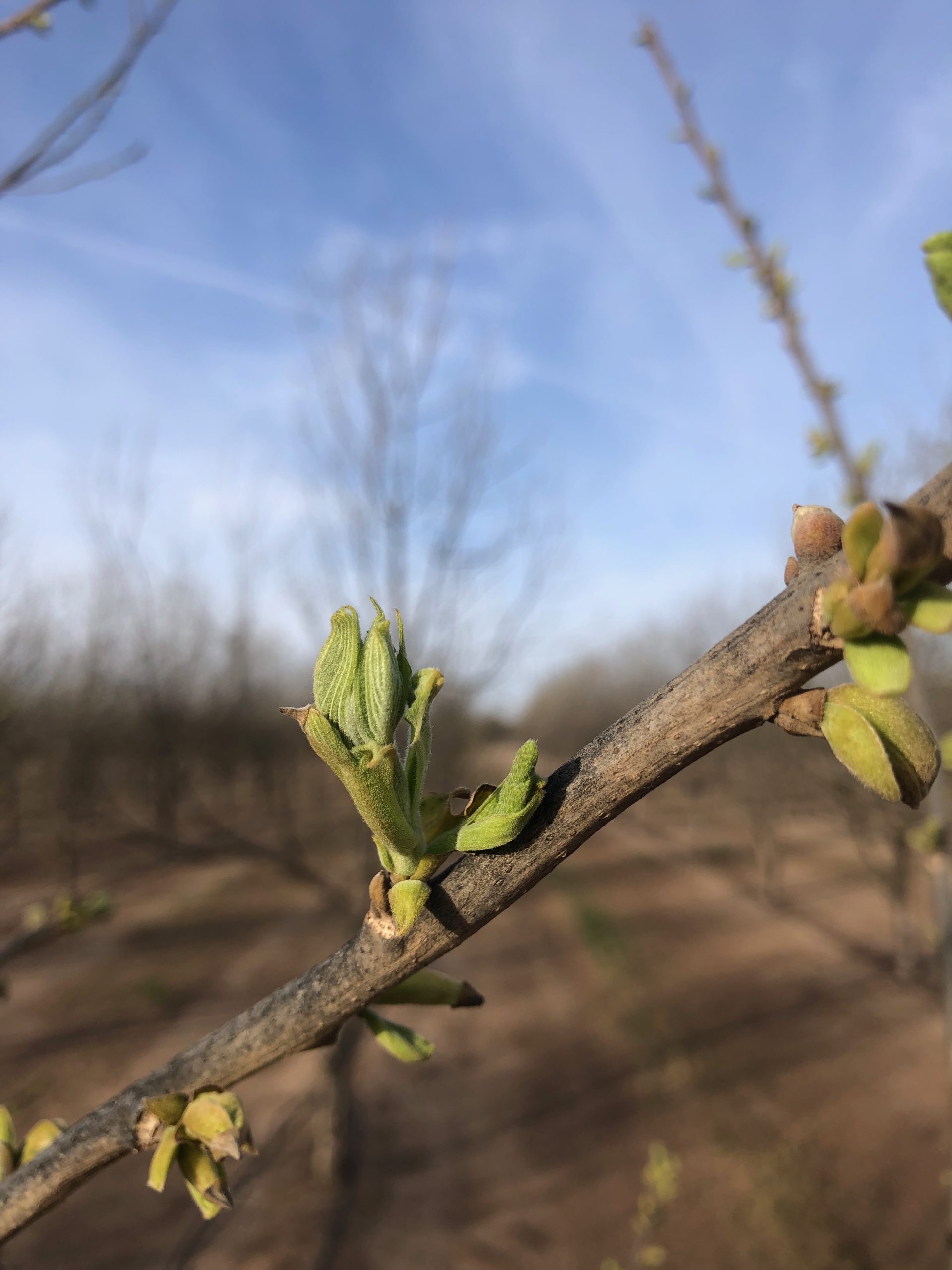
Pecan buds during 2024 bud break on April 19, near Las Cruces, NM. (Photos submitted by Richard Heerema)
Plants also keep track of time to live their lives, but they do so with nary a Rolex, Apple Watch, or Big Ben to assist. Plants rely on environmental cues to track the passing of time at the diurnal (daily) scale and at seasonal and annual scales. The timing of flower appearance and function is one of the better-known biological processes that needs to be tightly controlled for many plants to reproduce successfully. Most famously, there is a plant called the Four O’Clock (Mirabilis species) whose flowers use changing light intensity and temperature signals to open around 4:00 pm, attracting insect pollinators that are also active in late afternoon and early evening. Other plants like Morning Glories (Ipomoea species) and Chocolate Flowers (Berlandiera lyrata; a wonderfully scented little Southwest native plant!) also use light and temperature signals to have the opposite timing of flower function as 4 O’Clocks, opening up their flowers instead in the early morning when the native bees are most active, and closing them again (like clockwork!) in late morning to protect the delicate flower parts and pollen from the intense afternoon heat. Before we get to pecans, here’s another somewhat different example of plants keeping track of time at the seasonal time scale using environmental cues to determine time of flowering: in nature, Poinsettias (Euphorbia pulcherrima) are “short day” plants that only begin to make bracts and flowers during the winter when the period of daylight get short and the nights get long. This knowledge is, of course, of huge importance in the nursery trade so that the plants are at peak color just in time for the Christmas season.
What about fruit and nut tree species like pecans? Do they also have any biological clocks, like Morning Glories and 4-O’Clocks, that allow them to function properly in their environment? There are undoubtedly numerous such biological clocks in orchard trees that we could talk about. But perhaps the best described—and perhaps the most timely to discuss in an April Issue of Pecan South magazine—is the process of rest breaking in the spring, which determines the timing of the budburst and flowering.

Pecan buds during 2024 bud break on April 19, near Las Cruces, NM. (Photos submitted by Richard Heerema)
Temperate-zone and subtropical-zone fruit tree species are faced with an environmental challenge every year during the winter months: the risk of freezing temperatures that can damage or kill sensitive tissues. Many of these tree species are winter deciduous, dropping their leaves and entering a physiological state of dormancy during the period when risk for freezing exists. During winter dormancy, growth on the tree ceases altogether, the tree relies on carbohydrates and minerals from the previous growing season to continue essential life processes, and the plant maintains a relatively high level of cold-hardiness. But, as usual, more is going on than meets the eye. During most of the cold period (from fall/early winter through late winter/early spring), the tree should normally be in a special state of “endodormancy”. While in endodormancy, the plant would remain dormant even if a period of unusually warm, summer-like weather arrived. This is an absolutely critical feature for temperate fruit and nut trees, because sometimes unusually warm weather does arrive in the middle of winter. If such warm weather were to end the period of dormancy and initiate growth, there would (at least in many areas) be an extremely high chance that there would subsequently be freezing weather that would completely destroy the new growth, including flowers.
However, it could be equally devastating for trees if they remain dormant through the whole growing season or multiple growing seasons (like Rip Van Winkle). Even a late “wake-up” of a week or a couple of weeks could be very bad news indeed for the trees in multiple ways. Without leaves, delayed rest breaking would mean lost opportunity for photosynthesis and depletion of carbohydrate reserves from previous seasons. This, in turn, would reflect less total food energy available for survival and fruit and seed production. It could also mean poor synchronization with pollinizers and a shortened effective pollination period (hot weather both shortens the female flower period of function and reduces pollen longevity).
Here’s where the trees’ internal biological clock comes into play. Fruit and nut trees in endodormancy have a mechanism by which they, in a sense, “record” the amount of winter weather that has occurred and use this as a kind of proxy for the passage of time. When the trees’ chilling requirement has been met, the dormant trees transition to a state of “ecodormancy”. A tree in ecodormancy looks, for all intents and purposes, just like one in endodormancy, but, unlike trees in endodormancy, the buds of trees in ecodormancy are ready to “wake up” (break rest) and begin growing when the weather consistently becomes warm enough. Winter chilling is like an alarm clock on the nightstand!
Not all orchard tree species need the same amount of winter chilling to make that transition from endodormancy to ecodormancy. Subtropical tree species (like figs) might have very low or even no chill requirement, while more temperate-zone type species (like apples) have much higher chill requirements on average. Not all varieties (or genotypes) within a species, however, have the same winter chilling requirement. Pecans are interesting in this regard because their native range extends from Iowa and Indiana in the north (brr!), all the way to Oaxaca in southern Mexico (well south of the Tropic of Cancer). It goes without saying, then, that pecan varieties whose genetic backgrounds originate from very northerly locations would be expected to have a higher winter chilling requirement than genotypes coming from southern Mexico. This can be noticeable and problematic, especially when people plant varieties that are genetically adapted for short winters (low chill requirement) in a place with long winters or vice versa.
A low chill variety planted in the north will likely accumulate its full chill requirement early in the winter and could “wake up” with the first warm spell. A high chill variety planted in a warm, short winter location will never meet its winter chill requirement before summer weather arrives. Pecan trees planted in a location with insufficient winter chilling don’t just stay dormant forever. It seems that the lack of chilling can be overcome by exposure to larger amounts of heat. After exposure to significant heat in the spring, the trees do eventually start growing, but it tends to be late and with an abnormally high degree of bud-to-bud variability in timing. Fortunately, thus far, in most of our major US pecan production regions, there seems to be sufficient winter chilling for the common commercial pecan cultivars in most winters. While this hasn’t presented any major concerns for pecan production, for some other fruit and nut orchard tree species (e.g., peaches and pistachios), difficulties associated with insufficient winter chilling have arisen in the past decade in some parts of the US. Pecan producers in the state of Sonora in Mexico, however, have found that insufficient winter chilling can be an important limiting factor under their very warm winter-time conditions.
To gain a clearer understanding of how environmental differences affect the phenology (the fancy, scientific word for ‘timing’) of pecan bud-break and to better enable pecan farmers to select pecan varieties that are adapted to their environments, a multi-state, multi-year study as part of a larger grant funded by the USDA Specialty Crops Research Initiative (USDA NIFA 2022-51181-38332; “Trees for the Future”) is underway. Originally, all pecan budbreak phenology data were collected manually from ladders or pruning towers. While this approach is very meaningful, it is also extremely labor intensive, time consuming, and risky to do in some weather conditions (those who have seen springtime winds in New Mexico know exactly what I’m talking about!).
A preliminary study was performed in Spring 2024 by Drs. Randy Norton and Debankur Sanyal at the University of Arizona, who tested the use of digital cameras for collecting growth phenology data in four Arizona pecan orchards. The cameras automatically took pictures of tree canopies every 15 minutes for the entire growing season and into dormancy. These images had sufficient resolution for them to watch individual buds as they progressed through the various stages of budbreak, which could be tracked over time. So, in Spring 2025, our other collaborators across the country (California, New Mexico, Texas, Georgia, and Oklahoma) similarly deployed digital cameras in their locations.
Graduate students at NMSU in the National Science Foundation-funded training program Artificial Intelligence for Arid Land Agriculture (AIALA) are developing machine learning tools for analyzing these images of the progression of pecan budbreak and bloom through the spring. This process will be useful to track the timing of other economically-significant traits, such as the appearance and function of flowers, nutlet development, timing for nut drop, and nutrient deficiency disorders (this could help determine the optimal timing for sprays). Image data collected from individual locations are being used to determine when stages of budbreak occurred in 2025 for particular varieties, and the same type of data is currently being collected for 2026. Correlating the budbreak phenology data with weather data for each region and year will allow us to build predictive models for budbreak, improve our understanding of how the internal clocks govern pecan tree biology, and allow the farmers to better match pecan tree genotypes with the range of climatic conditions that exist across the US pecan-growing belt.
