
Growing Pecans Under Waterlogging Conditions

Outlet gates seen from the inside that help to divert excess water from the orchard and through various channels. (Photo courtesy of Nadia Venticinque)
Continuing from that article, Agricultural Engineer Alejandro Lavista Llanos explains how the system implemented in a pecan orchard located in the lower delta of the Paraná River—approximately 125 miles south of Grupo Alto Pecán—manages excess water.
Due to comparable conditions, the area where this field is located in Argentina can resemble the Mississippi River Delta in the United States, although it is less densely populated.
First, it is crucial to understand the area’s agroecological characteristics; without this understanding, establishing a pecan plantation would be impossible.
In this region of newer, lower islands near the mouth of the Río de la Plata, water level rises are frequent—weekly or biweekly—but brief (lasting only a few days). The southeast wind halts and reverses the water flow, causing rapid rises in river levels within hours.
Extraordinary floods also occur when the Paraná and Uruguay rivers bring excessive water to their confluence with Rio de la Plata, accompanied by several days of southeast winds that result in a tidal surge.
These conditions need careful planning and the construction of robust levees that, when well-maintained and managed, can withstand constant river rises. Simply raising the land surface is inadequate. Hence, Lavista Llanos emphasizes that “growing pecans under these conditions is feasible but requires effective river water management.”
The orchard where Lavista Llanos serves as advisor is on a 500-hectare island protected by a levee, with 100 hectares dedicated to pecan cultivation, and it has been successfully producing nuts for about 15 years despite the challenges posed by the river.
This area has alluvial, hydromorphic soils formed by river floods that are generally light in the upper layers and heavier and more impermeable at depth. They are often highly acidic, with a pH around 5. The terrain is mostly flat, with slightly higher areas along the embankments and lower central areas where water accumulates during heavy rains or river influxes.
According to Lavista Llanos, meeting the following criteria is essential for successful production under these conditions:
- Building appropriate protective levees,
- Ensuring rapid drainage of excess water,
- Implementing effective land drainage,
- Providing irrigation as necessary, and
- Establishing firm ground for maintenance and harvesting operations.
The system designed for this orchard, situated in a region with distinct conditions, differs from Grupo Alto Pecán’s. However, they share a common approach to terrain analysis and pre-installation planning for the plantations.
Experts meticulously planned the levees. They measure 40 meters wide and are elevated 4 meters above ground level with gentle slopes. Regularly trimmed vegetation helps prevent water erosion. These levees withstand periodic water surges and significant southeast winds but not maximum tidal surges.
To manage these surges effectively, the levees incorporate fusible zones—strategic depressions that allow river water to enter the orchard during extreme floods. After the flood subsides, the water exits through gates and is pumped out to drain the area as quickly as possible.
To protect the shores, producers construct “restingas” or structures similar to sturdy wooden docks nearly parallel to the coast. These act as coastal defenses against constant river currents, wind-driven waves, and boat traffic.
The second critical aspect is the drainage of excess water. “Draining the land as quickly as possible is essential for cultivating pecans in these flat, flood-prone islands,” emphasizes Lavista Llanos. Pecan trees are planted in four rows of specific cultivars, spaced 33 feet (10 meters) apart within each row. These rows are laid out in well-defined blocks, each 230 feet (70 meters) wide and varying from 984 to 3,281 feet (300 to 1000 meters).
The blocks are separated by tertiary channels, 6 to 10 feet (2 to 3 meters) wide. A subsoiler crosses these blocks annually, creating temporary subsurface channels 23 to 31 inches (60 to 80 centimeters) deep to drain saturated soil into the tertiary channels.
These tertiary channels act like the teeth of a comb, feeding into larger secondary channels, which in turn connect to primary channels, leading water to the outlet gates and pumping stations for excess water removal.
The system’s water levels are monitored using strategically placed vertical wells that measure the depth of the water table. Gates automatically allow water out towards the river (based on the river’s level difference). Water cannot enter because the locks automatically close; these are true retention valves. Mechanically operated, they can also be manually opened to allow water entry if desired.

This diesel-powered pump helps to remove excess water from the pecan orchard, seen in the background. (Photo courtesy of Nadia Venticinque)
High-capacity pumps, both electrically driven and diesel-powered (for backup during power outages), assist in draining water when river levels prevent gravity drainage via the locks.
Regular maintenance with specialized machinery prevents natural vegetation from obstructing water flow. Without this maintenance, water levels would remain high, keeping the soils waterlogged.
Lavista Llanos estimates that with this system, the entire island can be drained within two to three days. “Effective water management through drainage is crucial for sustaining pecan tree life and production,” he stresses.
Due to precipitation and groundwater levels, little irrigation is needed in early spring. However, during the hot, drier summers, irrigation becomes essential. Similar to Grupo Alto Pecán, water from the river is utilized at minimal cost, leveraging the drainage system in reverse. Gates are opened mechanically to allow river water into the channels, ultimately reaching the pecan roots via the subsoiling tunnels.
This irrigation method isn’t flawless, as varying terrain levels within the planting blocks mean some areas receive more or less water, causing uneven soil moisture.
If rainfall is insufficient in summer, the system remains open, allowing water to enter or exit based on river levels influenced by wind conditions.
While installing a conventional irrigation system—drip or micro-sprinkler—remains an option, it would require reliable electrical power or mechanical pumping. Moreover, the layout of blocks separated by channels would need extensive and costly pipeline installation compared to an orchard in solid ground.
As previously discussed, the drawback of this system is the impracticality of implementing fertigation. Management tasks are conducted similarly to those on solid ground, facilitated by the drainage system that keeps the terrain dry and suitable for tractor and machinery operations.
Vegetation growth is more vigorous than on solid ground and is controlled through regular cutting and periodic herbicide application, particularly under the pecan groves and along coastal defense levees. Fertilization involves surface solid distribution complemented by aerial spraying.
Sanitary control measures are also crucial, requiring regular crop inspections. Preventative actions include scab control due to the humid environment, morning mists, and summer heat, as well as curative measures against endemic pests such as hairy caterpillars and yellow aphids.
Harvesting employs inverted umbrellas, mechanical handling systems with tarps, and manual re-checks, all essential for maintaining controlled vegetation. Pruning is conducted using elevated equipment and chainsaws, with the necessary removal and stacking of ground materials throughout the year.
Lavista Llanos further clarifies the challenges pecan growers face in this region. The island’s microclimate is characterized by humidity, mists, frosts, and periodic southeastern storms. This obligates the selection of more resistant cultivars and meticulous planning for both preventative and curative sanitary measures. Securing labor is more challenging than on solid ground due to the remote location; daily commuting is not feasible, making logistics complicated and costly as everything must be transported by water. This includes suitable boats, loading docks for personnel, supplies, machinery, services, fuels, transfer visits for oversight and consultation, and crucially, the removal of the harvest.
“For instance, initially amending highly acidic soils with dolomitic limestone would be highly advisable, requiring tons per hectare to correct acidity levels. However, the logistics—transport to the port, loading onto ships, river freight, unloading at the island port, mechanical distribution across the blocks—are so costly that this is rarely executed,” he explains.
Facilities for initial drying, primary nut cleaning, and storage in optimal conditions are necessary, awaiting sufficient batches for transport to solid ground. Thus far, production yields have not matched those from orchards on solid ground.
“Planting pecans in this lower Paraná Delta region is feasible, but water management, especially drainage to keep the soil dry and prevent pecan tree roots from being waterlogged, must be meticulously managed,” Lavista Llano” concludes. “While land costs are lower than on solid ground, all costs associated with the described system to manage water must be carefully budgeted.
“The costs of initial investment, operational activities described, ongoing maintenance, and especially logistics, are very high, and yields are lower. It is imperative to involve experts knowledgeable in pecans and their management on islands for a well-planned, detailed, and thoughtful initial planning phase.”
He adds, “Especially for small growers, it’s crucial to consider whether to manage alone (as there are many small individual plantations) or to form partnerships to tackle the challenges described.”
It’s important to highlight that everything discussed in this article and the one in the May edition does not guarantee that a pecan orchard won’t suffer consequences from an extreme weather event. However, it can certainly help mitigate its impact.
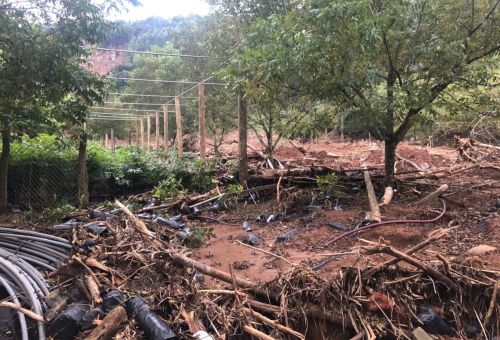
This pecan grove in Brazil was destroyed by the historic flooding earlier this year. (Photo courtesy of Nadia Venticinque)
Nonetheless, as seen in the unprecedented floods that recently hit Rio Grande do Sul (RS), Brazil, everything depends on the scale of such events. Little can be done in the face of rainfall amounts between 20 to 28 inches (500-700 millimeters) in less than a week.
“It was the biggest socio-environmental disaster in Brazil’s history, which consisted of an extreme climatic event with intense volumes of rain in a short period, starting at the end of April with high volumes in the first days of May, extending through the rest of May and June in smaller volumes. [The disaster affected] a total of 478 [out of 497] municipalities in the state,” explains Carlos Martins, an official from the Brazilian Ministry of Agriculture, Livestock and Food Supply (Embrapa). “Some regions were also affected by micro explosions, a phenomenon characterized by heavy rains in a short period, usually accompanied by intense wind gusts. The volume of rain exceeded 500 millimeters, reaching up to 800 millimeters [31 inches] in some locations in just two to three days, exceeding the monthly average rainfall for the past 30 years for April and May.”
The pecan sector, a cornerstone of Rio Grande do Sul’s agricultural economy, did not escape unscathed. With over 80 percent of Brazil’s pecan cultivation and 90 percent of the processing industries concentrated in RS, the floods severely compromised this year’s harvest. The flooding inundated orchards, destroyed infrastructure, and hindered the harvesting process, resulting in substantial losses.
The 2023/24 pecan harvest was just beginning in many orchards, severely impacting some growers. To date, it is still not possible to measure the total actual losses, but the damage to nut production is certain, which in addition to reducing the supply and quantity of nuts, may negatively impact quality. Effective impediments to harvesting nuts in orchards have been observed in several locations. Due to excess moisture, problems with viviparity also appeared, meaning the nuts still attached to the plant and inside the capsule ended up germinating, hindering the opening of the capsule and consequently increasing harvest losses. Estimates suggest a reduction in this year’s pecan production by 50 to 80 percent, plummeting from an anticipated 5,000 tons to between 2,000 and 2,500 tons.
“Orchard damage is still being assessed. Therefore, orchard recovery should occur selectively, depending on the damage and the financial capabilities of the grower to invest and manage their orchard for proper revitalization,” says Martins from the Brazilian Ministry of Agriculture, Livestock and Food Supply.
This climatic disaster in Brazil occurred at a time when the sector was striving to develop pecan cultivation in the state and the country. Growers and entrepreneurs are making significant investments to improve post-harvest equipment, qualify nut storage through cold chambers, and expand pecan processing capacity. The machinery and equipment sector is developing and marketing new products to growers, reaching markets in other countries. Additionally, new and expanding specialized agroindustries in post-harvest processing of pecans are emerging.
“There is a need for public policies and an action plan, especially from an agronomic standpoint, to overcome these extreme climatic events, whether due to excess water or water scarcity. Certainly, agronomic measures will be employed for soil and orchard recovery and conservation over the years. These measures are based primarily on soil recovery, soil conservation measures, and the management of pecan trees in orchards. Practices that increase organic matter (OM) in orchard soil should be maximized throughout the production process,” Martins adds.
As agricultural engineer Mariano Marcó explained in May’s article, soil organic matter not only provides nutrients for plants but also improves soil structure due to the mass of roots produced and organic substances released, increasing soil aggregate size and microbial population, allowing better root system development of fruit trees, and improving fruit tree tolerance to extreme events by increasing their capacity to explore deeper soil layers and absorb soil moisture.
“In fact, climatic events of this magnitude impose that we absolutely need to review our food production methods and develop soil, water, and plant management practices suitable for this new climatic reality,” reflects Martins. “The adoption of good agricultural practices with low environmental impact, low carbon, and ecological approaches are essential premises for pecan orchards, for environmental conservation, and for maintaining ecosystem services to minimize damages and allow coping with extreme situations. Thus, the adoption of integrated technologies and management practices in orchards that seek soil and water conservation is expected to achieve greater productive resilience, promote greater water security for both intense volumes and scarcity, and sustainably produce fruits.”
Anticipating future conditions where excess moisture and lack of sunlight will be a problem, Martins encourages producers and the industry to take preventive actions and measures, such as diversifying cultivar pollination types, balancing nutrition, and creating drainage areas. “The need for orchard management based on plant phenological development requires closer monitoring of what happens with pecan trees, but it is becoming an increasingly important technological tool for prevention and cultural practices appropriate to the production cycle,” he adds.
Still, Martins acknowledges that prevention can only do so much, and the industry must be proactive.
“Unfortunately, learning from such a tragedy is painful, but we need to rethink our food production and natural resource consumption routes not only in the flood-affected region but worldwide,” Martins says. “While we can develop technological strategies, these will only mitigate the adverse effects of these events. The concern and actions must be taken by all of us every day!”
In an effort to be proactive about future climatic events and disasters, Embrapa and IBPecan are conducting research titled PECAN 2030 – URPecan: Preventive action for orchard monitoring where orchards are used as strategic units to monitor and study the climatic effects and their interactions on nut production and quality over time. The research will provide more accurate and appropriate information, which will help Brazilian growers and others worldwide manage pecan trees under La Niña and El Niño conditions.

Nadia Venticinque
Nadia Venticinque is a journalist with Eurofresh Distribution Magazine and the technical facilitator for competitive initiatives in Argentina's Ministry of Agriculture, Livestock, and Fisheries.