
High-Density Pecan Orchards: Benefits, Challenges, and Recommendations
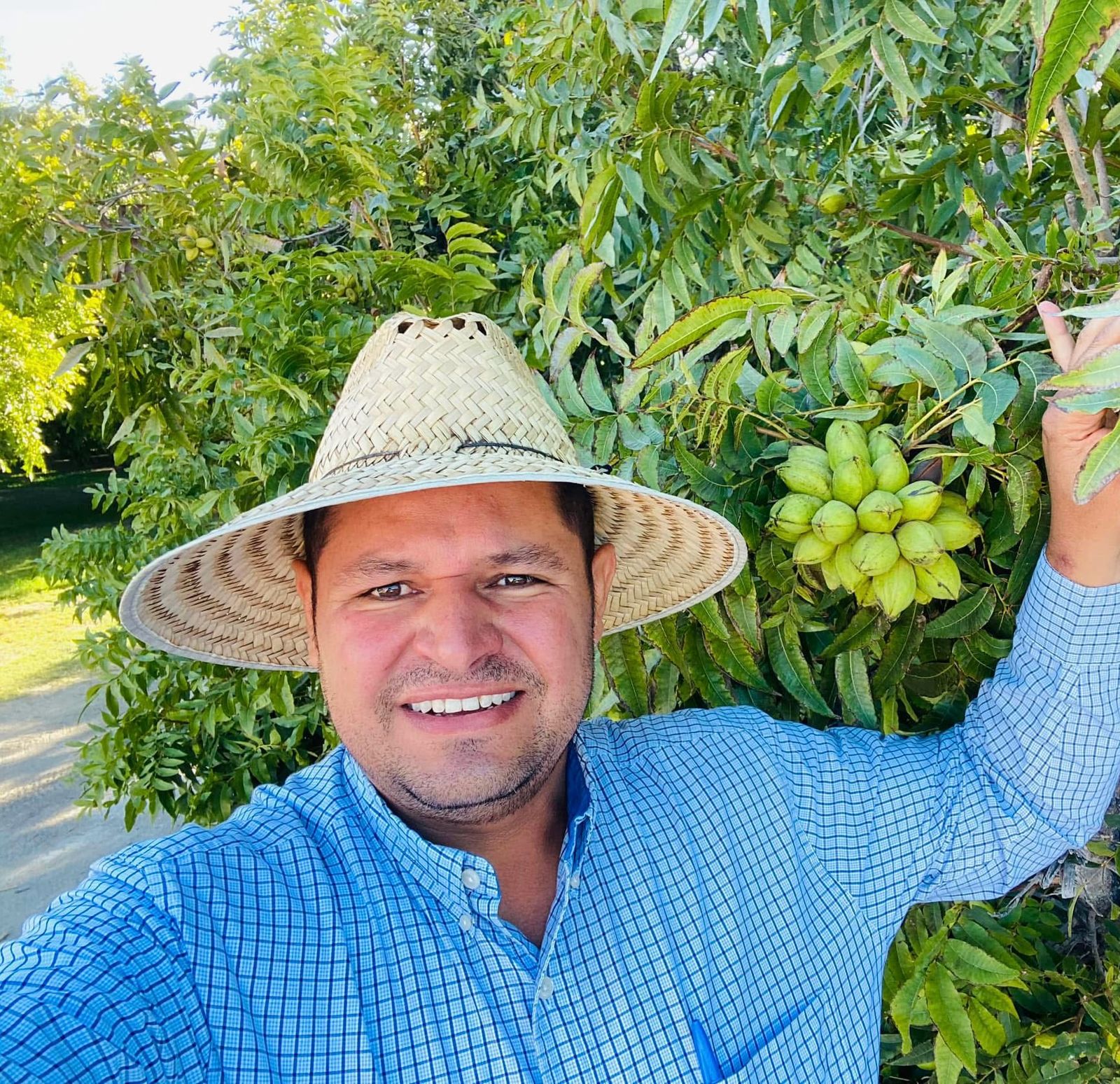
Mario Villanueva is an advisor and consultant with 20 years of experience in integrated pecan management, primarily in Chihuahua, but also in Zacatecas and Aguascalientes. He currently advises on 1,500 hectares of high-density pecan orchards. (Photo provided by Nadia Venticinque)
Mario Villanueva is a Tree fruit Engineer with approximately 20 years of experience in integrated pecan management, working as an advisor and consultant in the state of Chihuahua, with collaborations in the states of Zacatecas and Aguascalientes, Mexico. He currently advises on 1,500 hectares of high-density orchards, primarily using 7×7 meter (23 x 23 feet) planting layouts, which equals 204 trees per hectare. The predominant varieties are Western (80%) and Wichita (20%).
In an exclusive interview, Mario shares insights into the challenges of high-density planting and how to address them.
Main Challenges in High-Density Management
One of the greatest challenges is competition among trees for light, water, and nutrients. Soil conditions and water quality are critical: planting in loamy soils with good water quality is very different from planting in soils with calcium carbonate or with saline or high-bicarbonate water. In the latter cases, even with a 7×7 meter (23 x 23 feet) layout, tree canopies may not close after 12 years.
This is why pruning is the critical point in managing these types of orchards. Proper tree training—preferably with a central leader and a “pine-shaped” structure (wider at the base and narrower at the top)—allows for better light penetration from the tip to the base. Light is the primary factor for nut production, and its absence causes vegetative rather than fruiting shoots, as well as branch loss due to shading.
In northern Chihuahua, the first mechanical pruning is usually done around year 13 or 14. This should be complemented with selective manual pruning, as mechanical pruning alone is not enough for good canopy management. Additionally, regrowth must be carefully managed, as it tends to be vigorous if the pruning is too severe.
Pruning and Regrowth Strategies
Effective pruning involves alternating sides and orientations each year to avoid removing all the shoots from one season, as these will produce in the following year. For example, the orchard can be divided into quadrants and pruned mechanically in sections: one north-south side in odd years, the other in even years, and then east-west sections similarly. Regrowth should be managed manually using strategic pinching, selecting shoots and avoiding excessive intervention that could lead to excessive vegetative vigor.
Apical dominance should also be managed selectively in young trees by pruning the central leader—removing 30% to 50% of the annual growth—to promote vertical development without compromising balance.
What if Pruning Was Not Done Correctly Early On?
In orchards where proper pruning was not done from the start, it is common to find poorly structured trees, with closed canopies and dead branches due to shading. In these cases, the only viable option is a drastic training prune, adapting the tree to its current structure. The goal is to restore light penetration and improve production, even if the ideal structure is not achieved.
Pest and Disease Management in High-Density Orchards
In humid areas, high density increases phytosanitary risks. Moisture, temperature, and dense foliage create favorable conditions for disease development, and pests such as aphids thrive in this closed microclimate. Good ventilation through canopy management is key to mitigating these problems.
Target Tree Size in High-Density Orchards
In a 7×7 m planting, the ideal tree height is between 8 and 8.5 meters, as long as there is enough space between canopies to allow light penetration (at least 30% of the row width). The key is a tree structure with well-distributed light windows and balanced layers from the beginning.
Expected Production and System Sustainability
A well-managed high-density orchard can achieve sustained yields of 3.6 to 4 tons per hectare, about 15–20% more than a conventional orchard (12×12 meters – (40×40 feet) with mature trees. However, maintaining these yields over time depends on integrated management: nutrition, irrigation, pruning, pest and disease control, and tree training.
At very high densities (e.g., 5×5 or 6×6), sustainability is more limited. Under ideal conditions, such plantings may be maintained for 20–25 years, but the tree’s natural vigorous and riparian growth habit makes containment difficult without affecting production.
Economics of High-Density Systems
Initial investment is higher, mainly due to the greater number of trees, more complex irrigation systems, and specialized equipment. However, the return on investment is also faster. Inputs such as fertilizer and water are applied per hectare, so costs remain similar to conventional orchards. “Pecan trees produce and consume based on the surface area they occupy.” In this sense, it’s a misconception to assume that more trees per hectare require proportionally more fertilizer. Inputs should be calculated per hectare and then divided by the number of trees.
Final Recommendations for Growers
Each orchard is unique: there are no universal formulas. Before choosing a planting density, growers should:
- Thoroughly understand their region and agroecological conditions.
- Evaluate water and soil quality.
- Carefully select varieties and understand their characteristics: how vigorous they are, if they alternate-bearing, or if they are biparental, etc.
- Be familiar with the crop or work with experienced professionals.
- Be prepared for intensive management; have appropriate machinery and enough resources.
- Understand that a high-density orchard is a challenging project—but one with high potential if done correctly from the start.
As growers often say: every orchard tells a different story, and every tree writes a chapter.

Nadia Venticinque
Nadia Venticinque is a journalist with Eurofresh Distribution Magazine and the technical facilitator for competitive initiatives in Argentina's Ministry of Agriculture, Livestock, and Fisheries.