
Storage Strategies to Preserve Shelled Pecan Quality
Practical recommendations based on recent long-term research
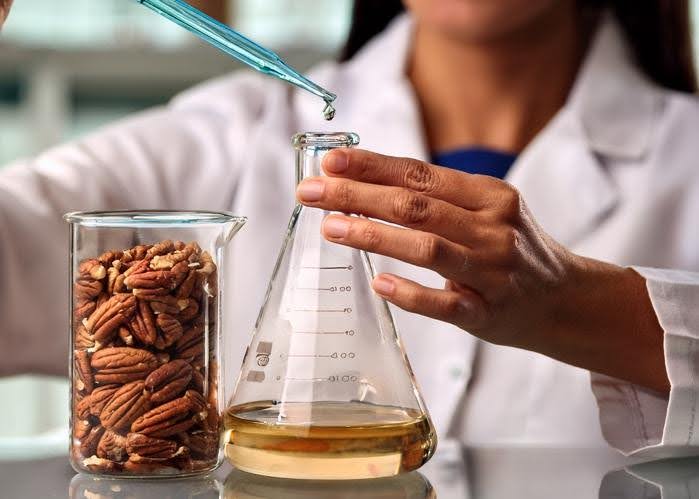
Recent long-term research conducted at the University of Georgia examined how storage temperature, packaging type, and cultivar influence the chemical, physical, and sensory quality of shelled pecans over a 24-month period. Two commercially important cultivars, ‘Stuart’ and ‘Western Schley,’ were stored at 8, 23, or 32°C under three packaging systems: traditional cardboard cartons, vacuum packaging, and nitrogen-flushed modified atmosphere packaging (MAP). The findings provide clear, applied guidance for pecan growers, shellers, and handlers.
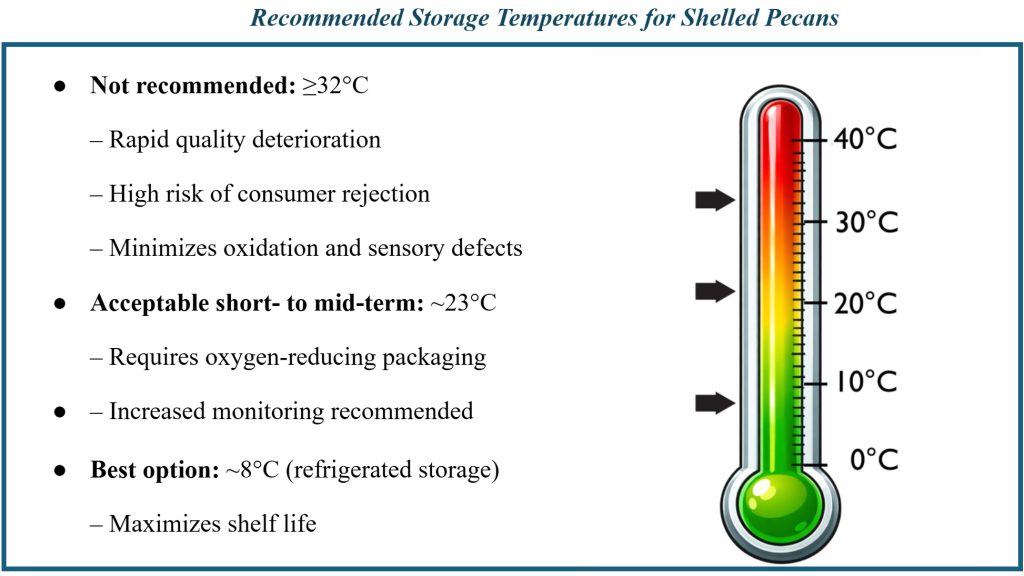
Temperature is the primary factor controlling shelf life
Across all treatments, storage temperature had the strongest effect on pecan quality. Higher temperatures consistently accelerated quality deterioration, including lipid oxidation, free fatty acid formation, darkening of kernel color, and sensory rejection.
Pecans stored at 32°C showed rapid quality loss regardless of packaging system. Many samples stored at this temperature were rejected by consumers well before the end of the 24-month study. In contrast, pecans stored at 8°C retained acceptable quality for substantially longer periods. Storage at 23°C resulted in intermediate performance, with acceptable quality maintained for several months but increased risk of deterioration over time.
From an applied standpoint, these results reinforce a key message for the industry: temperature control is the most effective single strategy for extending shelled pecan shelf life. Even small increases in storage temperature significantly increase the rate of quality loss.
Packaging and atmosphere strongly influence quality retention
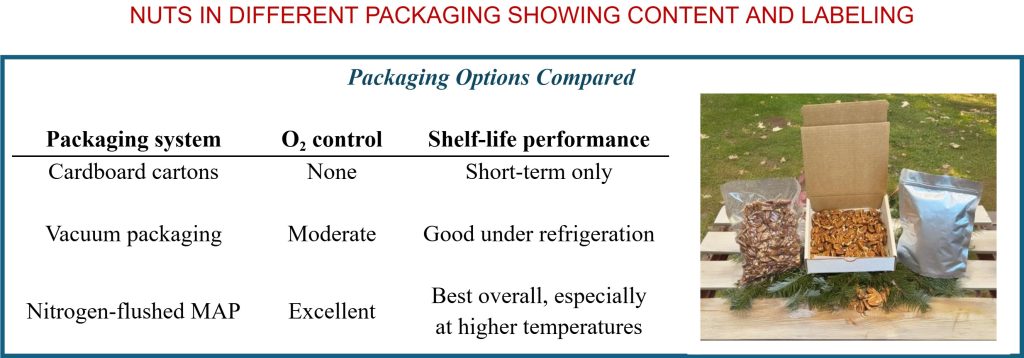
Although temperature was the dominant factor, packaging played a critical role in moderating quality loss, especially at moderate and elevated temperatures. Pecans stored in cardboard cartons deteriorated more rapidly than those stored in sealed systems. Cartons allow unrestricted oxygen exposure and moisture exchange, conditions that promote oxidative reactions and textural changes.
Vacuum packaging improved quality retention relative to cartons by limiting oxygen availability. Pecans stored under vacuum generally showed slower increases in oxidation products and better color retention. However, high-barrier laminate packaging flushed with nitrogen provided the greatest protection against oxidation and sensory decline, particularly at 23°C and 32°C. Oxygen levels within high-barrier packages remained very low throughout storage, substantially slowing the formation of volatile compounds associated with rancidity. While MAP does not fully compensate for poor temperature control, it significantly extends shelf life under less-than-ideal thermal conditions.
Moisture management supports texture and stability
Moisture content and water activity also affect pecan quality during storage. In these studies, pecans were dried to approximately 3 to 4% moisture prior to storage, consistent with industry standards. Over time, moisture levels remained relatively stable but were influenced by both temperature and packaging.
Pecans stored in cartons experienced greater moisture exchange with the surrounding environment, which contributed to texture softening. Vacuum and MAP packaging better maintained moisture stability and helped preserve kernel firmness. While texture changes alone were not the only cause of consumer rejection, they contributed to low consumer acceptability.
From a practical perspective, proper drying before storage and the use of moisture-limiting packaging are essential supporting strategies, particularly for long-term storage.
Cultivar differences matter
The studies also demonstrated cultivar-specific differences in storage stability. ‘Stuart’ pecans consistently showed faster quality degradation than ‘Western Schley’ under the same storage conditions. ‘Stuart’ samples developed higher levels of free fatty acids and oxidation products and were rejected by sensory panels earlier in storage.
These differences likely reflect inherent variations in lipid composition and endogenous antioxidant capacity among cultivars. For industry stakeholders, this finding underscores the importance of tailoring storage strategies to cultivar characteristics. More oxidation-prone cultivars may require colder storage or higher-barrier packaging to achieve an acceptable or desired shelf life.
Sensory rejection reflects multiple quality changes
Consumer rejection of pecans was not driven by a single chemical marker. Instead, sensory rejection was associated with a combination of increased free fatty acids and volatile oxidation compounds, including hexanal and related short-chain aldehydes and alcohols. These compounds contribute to rancid (i.e., cardboardy and painty), bitter, and stale flavors.
Multivariate analyses showed that rejection was most strongly associated with storage conditions that promoted oxidation: higher temperature, longer storage duration, oxygen exposure, and less protective packaging. Once these sensory defects became noticeable, quality loss was already advanced.
This highlights the importance of preventive storage management, rather than relying solely on end-point quality testing.
Key Take-Home Messages for the Industry
- Temperature control has the largest impact on shelled pecan
shelf life; - Oxygen exposure accelerates rancidity; sealed packaging
is critical; - Modified atmosphere packaging provides the greatest protection;
- Moisture stability helps preserve texture and overall quality; and
- Cultivar-specific strategies improve storage outcomes.
Practical recommendations for shelled pecan storage
Based on the combined findings of these studies, the following practical recommendations are suggested for industry application:
- Store shelled pecans at ~8°C whenever possible, especially for long-term holding
- Avoid extended storage at ≥ 32°C, even with protective packaging
- Use sealed packaging systems for anything beyond short-term storage
- Select MAP for maximum shelf-life protection, particularly when temperature control is limited
- Dry pecans properly before storage and use moisture-barrier packaging
- Adjust storage strategies by cultivar, especially for more oxidation-prone varieties
Conclusion
As pecan markets continue to expand and supply chains lengthen, storage conditions play an increasingly important role in maintaining quality and profitability. This long-term research demonstrates that shelled pecan shelf life is governed by the interaction of temperature, packaging, atmosphere, moisture, and cultivar.
By prioritizing temperature control, minimizing oxygen exposure, and selecting appropriate packaging systems, the pecan industry can significantly extend shelf life and reduce quality losses. Applying these science-based recommendations allows producers and handlers to deliver a more consistent, high-quality product to consumers—protecting both product value and brand reputation.
This study was initiated and led by the National Pecan Shellers Association (NPSA), and jointly funded by NPSA and the American Pecan Council.
More details about these pecan storage studies …
Yang VE, Kerr, WL, Pegg RB & Kerrihard AL. 2025. Effect of packaging and storage temperature on shelled pecan chemical quality indicators and their impact on consumer acceptance. Food Packaging and Shelf Life, 50, 101543.
Yang VE, Kerr, WL, Pegg RB & Kerrihard AL. 2025. Effects of packaging and storage temperature on shelled pecan quality. Postharvest Biology and Technology, 222, 113366.
This article is based on peer-reviewed research conducted at the University of Georgia by Drs. Ronald Pegg and William Kerr. They are professors of food science whose research focuses on lipid oxidation, food quality, and shelf-life stability of lipid-rich foods, including tree nuts. The studies summarized here evaluated the effects of storage temperature, packaging atmosphere, and cultivar on the chemical, physical, and sensory quality of shelled pecans during long-term storage, with the goal of developing science-based storage recommendations for the pecan industry.
