
Understanding and Managing Soil Salinity in Your Orchard
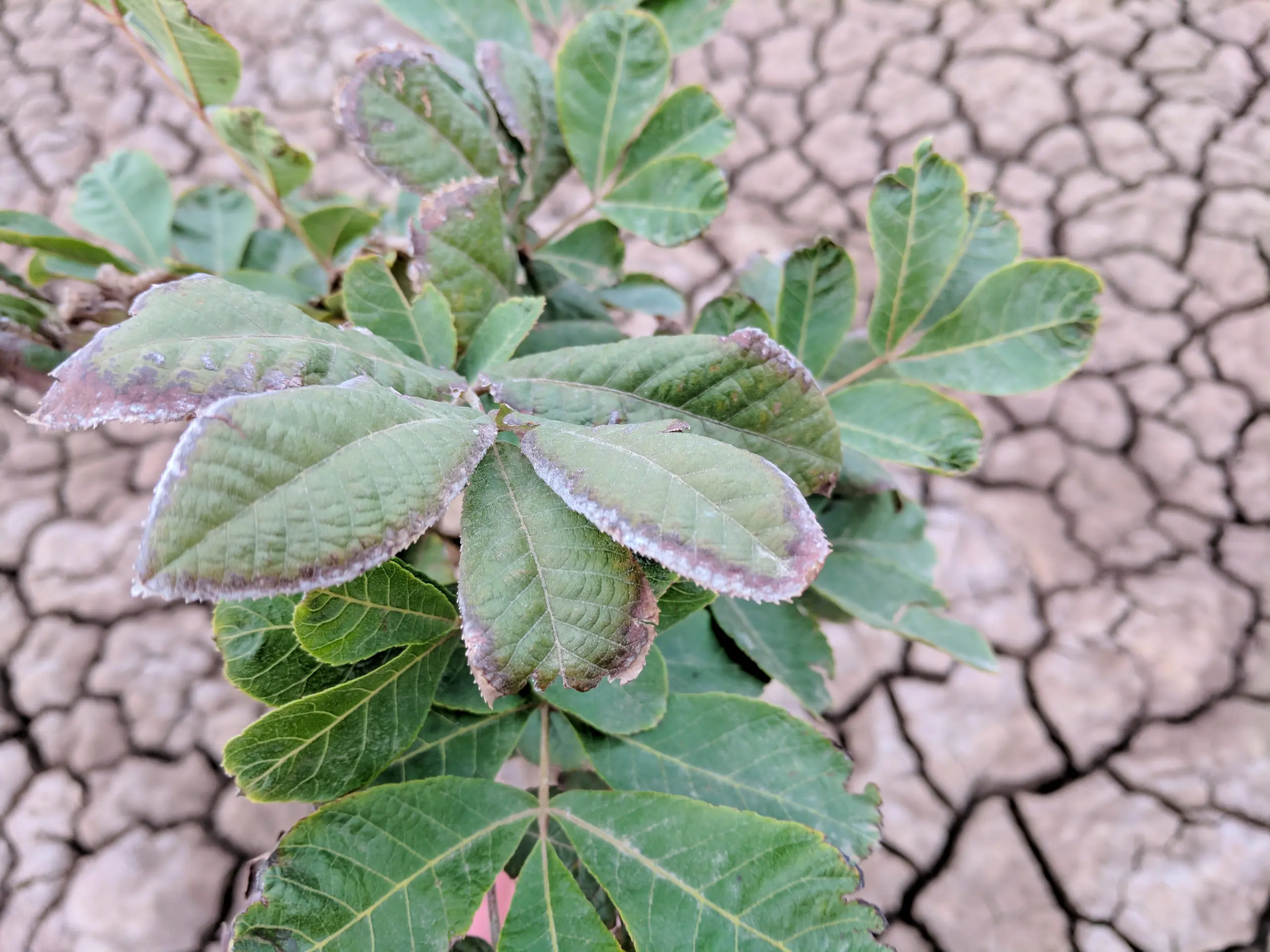
First leaf pecan tree leaves displaying salt injury, typical leaf margin necrosis, of one of the pecan cultivars in the pecan salinity project at the University of Arizona in 2017. (Photo by Josh Sherman)
Some of these salts are actually necessary. The problem, however, with the salts in irrigation water is that their concentrations can increase in soils over time if they are only added to the soils by irrigation and never adequately subtracted from the soils by leaching. Over time, an imbalance in salts “added” versus salts “subtracted” can lead to certain salts, like boron and chlorine, reaching toxic concentrations in the tree rootzone. Boron and chlorine are both essential nutrients, but they are needed by the trees in only quite small amounts. When the soil levels get too high, these nutrients accumulate to injurious levels in plant tissues, especially in the leaves. This results in the common symptom of direct salt toxicity: tissue necrosis (tissue death) at the leaf edges and tips.
Also, the water held in the soil becomes increasingly difficult for plant roots to extract as the amount of salts dissolved in the soil increases. It’s a matter of physics. Water molecules tend to move from places of higher “water potential” to lower “water potential.” The water potential is the potential energy of water, and it’s affected by pressure and gravity and, most relevant to our current discussion, the concentration of solutes in a solution. All other things being equal, more solutes in a solution means a lower (more negative) water potential. If the water potential is much lower inside the roots than in the soil solution, then water can move easily from the soil into the root. As this difference gets smaller, which happens when more salts are in the soil solution, the water moves into the roots less readily. Water movement into the root can even cease altogether if the difference in water potential from the soil to the root disappears or reverses direction. Ultimately, more salt in the soil means a thirstier pecan tree, a thirstier pecan tree means less photosynthesis, and less photosynthesis means reduced shoot growth, declining pecan nut yields, and lower nut quality.
Sodium is unique among the salt ions because it also has direct undesirable effects on soil characteristics when the levels get too high. When sodium becomes the dominant ion adsorbed on clay particles in the soil, the clay aggregates (that is, little “clumps” of clay particles) found in healthy soils start to disperse into unaggregated clay particles. This clumping causes a kind of cement to form a crust on the soil’s surface and impedes the infiltration of water into the soil. So, sodium salts, in addition to affecting the water potential directly, also make it more difficult for farmers to deliver irrigation water effectively to the tree roots.
Salinity management, first and foremost, involves balancing the salts being introduced to the rootzone soils from irrigation water and leaching these salts out of the bottom of the rootzone. Knowing what you are dealing with is where you should start, so it is important to regularly (at least once per year!) collect some soil and irrigation well water samples for lab analyses.
First, collect your soil samples from the shallow (0 to 12 inch), middle (12 to 24 inch), and lower (24 to 36 inch) rootzone depths and have them analyzed separately so that you can know how salinity varies along the vertical profile. Collect and pool multiple soil samples by depth from each block of 40 acres or smaller so that you can get a sense of the block’s salinity as a whole management unit. For both the soil and water, have the lab provide you with electrical conductivity (ECe for soil and ECw for water) and sodium adsorption ratio (SAR). Also be sure to ask your lab to do a saturated paste extract on the soil samples (instead of a 1:1 or other extract) so that you can interpret your results properly.
If you know the salinity of your soil, the salinity of your water, and your target salinity for your rootzone, you have everything you need to know about how your salinity management program is doing to date and for future salinity management to calculate a leaching requirement—that is, the amount of extra irrigation water above the crop consumptive water (evapotranspiration) requirement that needs to be applied in order to keep soil ECe below the desired target. The soil and water salinities come from the lab analyses. Your target in salinity management should be to keep the rootzone ECe below 2 millimhos per centimeter because that is the point at which pecan tree growth and productivity begin to be affected. The amount of extra irrigation water needed to achieve this is directly related to the salinity of the irrigation water applied. You can learn how to calculate a leaching requirement by consulting the Extension publications “Salinity Management and Soil Amendments for Southwestern Pecan Orchards” from the University of Arizona and “Leaching Requirements of Pecan and Fruit Trees” from New Mexico State University. (Direct links: https://extension.arizona.edu/sites/extension.arizona.edu/files/pubs/az1411.pdf or http://aces.nmsu.edu/pubs/_h/H644/)
Up until now in our discussion, we have assumed that the irrigation water actually infiltrates the soil and percolates down freely—that’s necessary, of course, if salt leaching is going to occur. However, that is not always the case in agricultural soils. Water percolation may be hindered by physical barriers such as compaction, caliche, or hardpan. These issues may sometimes be fixed with cultivation or ripping but may require more dramatic actions (like major excavator work), which may or may not be economically practicable.
As mentioned above, if sodium levels are high in a clay-containing soil, soil crusts may form and hinder water infiltration rates. Some soil or water amendments to decrease the SAR and displace sodium ions with calcium ions on the clay particles may be beneficial. One of the most common amendments used for this purpose is gypsum (calcium sulfate), typically applied at quite high rates (1 to 10 tons/acre). Sulfur- or sulfuric acid-containing amendments are sometimes used similarly, but be aware that this is effective only in calcareous soils already containing native lime as a calcium source. Freeing up the sodium from the clay particles with the application of an amendment is only the first step; irrigation water above the crop consumptive requirement must still be applied to leach the sodium ions down and out of the rootzone.
Lastly, it’s important to have a long view in this business. What we’ve thought about so far is our current situation for managing salinity in pecan orchards. But plant genetics is also part of the story. We already know that because of their genetic differences, different plant species and different plant varieties within a species can vary dramatically in their tolerance to salinity-related stresses. As scientists’ understanding of the potential physiological mechanisms of salinity tolerance in pecan and the gene pathways behind this grows, we can expect that scion cultivars and rootstocks with improved salinity tolerance will be a very real possibility.
It will depend entirely on the priorities of pecan breeding programs, and again, let me emphasize that this is the long view. But it has to start somewhere. The long view will shorten, too, as technologies improve and our scientific understanding of the inner workings of pecan trees becomes more complete. Some excellent foundational work in this direction has already begun with a USDA-funded research grant characterizing differences in salinity tolerance among seedling rootstocks from a range of mother trees. The bottom line in that study is that pecan seedlings from different maternal sources do vary dramatically in their tolerance (or susceptibility) to injury from soil salinity. This is excellent news because it shows us that the potential for genetic improvement is already right there in the pecan trees’ genomes! You can read the final peer-reviewed research paper for this work for free online here.
Another USDA-funded grant called “Trees for the Future” is currently seeking to build on what we learned from that earlier work, further evaluating the mechanisms and genetics behind salinity tolerance (among other environmental stresses) in pecan so that future generations of pecan producers in the Southwestern United States will have more and better options for managing salinity than we have today.
